


The lesson for Taiwan from the situation in Ukraine is that hostile authoritarian neighbors are not deterred when alliances between their targets and other democracies are ambiguous, Hudson Institute senior fellow Miles Yu (余茂春) said yesterday.
Yu — who was former US secretary of state Mike Pompeo’s top China adviser — made the comments in a telephone interview with the Liberty Times (the sister newspaper of the Taipei Times) the day before the two of them were to land in Taiwan.
Pompeo is to meet President Tsai Ing-wen (蔡英文) today and speak at a Prospect Foundation event tomorrow.
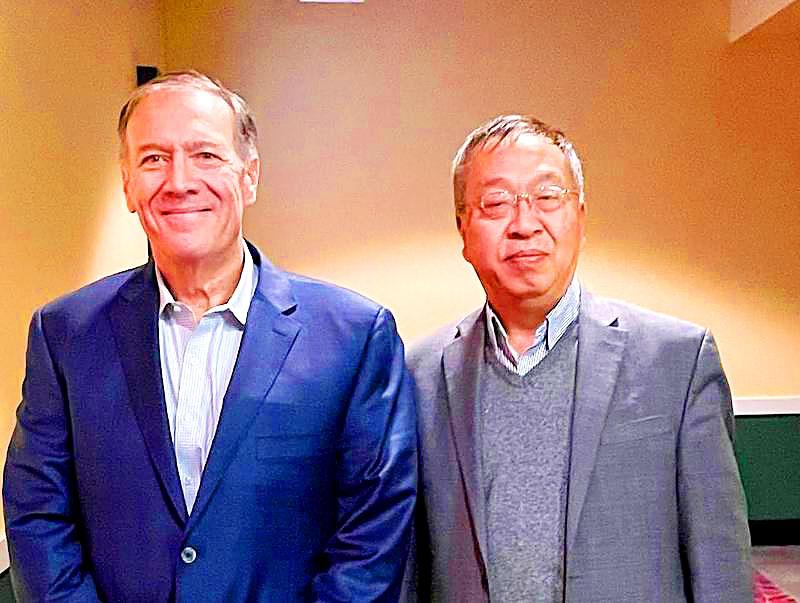
Photo taken from Twitter
Kyiv over the past few decades has walked a fine line trying to favor other European nations and Russia, but showed no conviction in its allegiances, Yu told the Liberty Times.
It even courted China’s protection when taking the middle road became unviable, he said.
In 2013, then-Ukrainian president Viktor Yanukovych signed a friendship pact with Beijing to gain access to China’s nuclear umbrella, which irked Moscow and possibly triggered the Russian invasion of Crimea, Yu said.
However, China sent no help to Ukraine, despite benefiting from Kyiv’s export of military goods at a discount, including an aircraft carrier, amphibious attack ships and heavy bombers, he said.
“There is no middle way in confronting an authoritarian regime,” he said.
When asked about reports that Tsai’s policies have antagonized Beijing, Yu criticized the pan-blue camp.
“The Tsai administration is not anti-China; it merely does not curry favor with China,” he said.
“Such a display of weakness would have emboldened the Chinese Communist Party to make Taiwan’s life more miserable,” he said.
Decades of work by Taiwanese have led to the nation becoming the most progressive democracy in Asia and a key player in world trade, achievements worthy of pride, he said.
To believe the political and cultural miracle of Taiwan has earned the country a place in the global community is not antagonistic, he said, adding: “Only the Communist Party believes that not currying its favor is being antagonistic.”
The advantage of democracy is that leaders cannot negotiate with foreign powers in secret or trade away the country’s future in defiance of the people’s wishes, he said.
Separately, Yu on Monday told Radio Free Asia that opposition politicians are mistaken in believing that the US would send arms to Taiwan, but refuse to fight for it, as former president Ma Ying-jeou (馬英九) has said.
“This argument reflects a lack of principle and conviction,” Yu said.
South Korea and Kuwait had similar concerns that the US would out of selfishness refrain from sending military forces to fight off invaders, but such anxieties were proven wrong time and again, he said.
Senior officials in Japan and Australia have expressed willingness to militarily defend Taiwan, which shows that the nation’s neighbors share its fears about Chinese aggression, he said.
The risk of harm to “Taiwan is one part of the threat China poses, which has concerned numerous other parties,” he said.

Considering that most countries issue more than five denominations of banknotes, the central bank has decided to redesign all five denominations, the bank said as it prepares for the first major overhaul of the banknotes in more than 24 years. Central bank Governor Yang Chin-lung (楊金龍) is expected to report to the Legislative Yuan today on the bank’s operations and the redesign’s progress. The bank in a report sent to the legislature ahead of today’s meeting said it had commissioned a survey on the public’s preferences. Survey results showed that NT$100 and NT$1,000 banknotes are the most commonly used, while NT$200 and NT$2,000

The Centers for Disease Control (CDC) yesterday reported the first case of a new COVID-19 subvariant — BA.3.2 — in a 10-year-old Singaporean girl who had a fever upon arrival in Taiwan and tested positive for the disease. The girl left Taiwan on March 20 and the case did not have a direct impact on the local community, it said. The WHO added the BA.3.2 strain to its list of Variants Under Monitoring in December last year, but this was the first imported case of the COVID-19 variant in Taiwan, CDC Deputy Director-General Lin Ming-cheng (林明誠) said. The girl arrived in Taiwan on

South Korea is planning to revise its controversial electronic arrival card, a step Taiwanese officials said prompted them to hold off on planned retaliatory measures, a South Korean media report said yesterday. A Yonhap News Agency report said that the South Korean Ministry of Foreign Affairs is planning to remove the “previous departure place” and “next destination” fields from its e-arrival card system. The plan, reached after interagency consultations, is under review and aims to simplify entry procedures and align the electronic form with the paper version, a South Korean ministry official said. The fields — which appeared only on the electronic form

The Ministry of Foreign Affairs (MOFA) is suspending retaliation measures against South Korea that were set to take effect tomorrow, after Seoul said it is updating its e-arrival system, MOFA said today. The measures were to be a new round of retaliation after Taiwan on March 1 changed South Korea's designation on government-issued alien resident certificates held by South Korean nationals to "South Korea” from the "Republic of Korea," the country’s official name. The move came after months of protests to Seoul over its listing of Taiwan as "China (Taiwan)" in dropdown menus on its new online immigration entry system. MOFA last week


 RSS
RSS