


Heavy traffic was yesterday reported on freeways across Taiwan, as people returned to their hometowns or flocked to major tourist hot spots at the start of the three-day weekend.
Yilan County police reported traffic jams on a recently improved section of the Suhua Highway, with heavy traffic observed as early as 5:30am and peak congestion at 8am.
The Freeway Bureau reported a traffic volume of 18.1 million vehicle-kilometers on Taiwan’s freeways, following an earlier prediction of 115 million vehicle-kilometers for the whole long weekend, or about 1.3 times that of average normal weekday traffic.
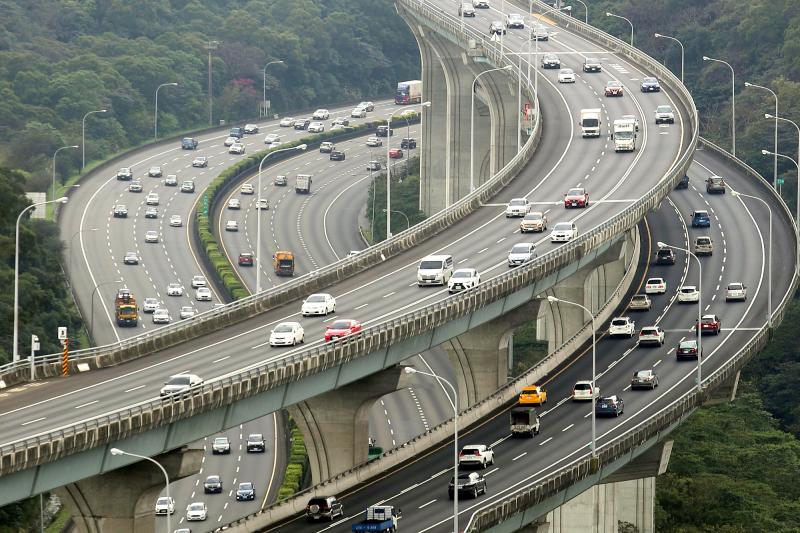
Photo: CNA
Vehicle-kilometers measure traffic flow by multiplying the number of vehicles on a traffic network by the average length of their trips.
Several protocols were put in place to respond to the anticipated traffic spikes and jams.
As part of the protocols, a high-occupancy policy was from 6am until noon imposed on vehicles entering the Chiang Wei-shui Memorial Freeway’s (Freeway No. 5) southbound interchange in Taipei’s Nangang District (南港), where only vehicles with more than three occupants were allowed to enter the freeway.
From midnight until noon, access ramps on the Pingjhen system interchange in Taoyuan and the Puyan system interchange in Changhua on the Sun Yat-sen Freeway (Freeway No. 1) were shut down to regulate traffic.
Other measures include charging NT$0.9 per kilometer traveled, while the usual daily toll-free distance of 20km has been suspended, as well as waiving freeway fees daily from midnight to 5am during the long weekend.
The bureau said that commuters and carpoolers could use provincial highways as alternatives to avoid traffic congestion on the freeways.
Monday’s national holiday commemorates the victims of the 228 Massacre, in which tens of thousands of civilians were killed following a crackdown by government forces on demonstrators and local elites after a confrontation between officials and Taipei residents on Feb. 27, 1947.
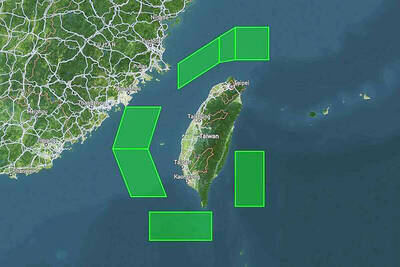
The disruption of 941 flights in and out of Taiwan due to China’s large-scale military exercises was no accident, but rather the result of a “quasi-blockade” used to simulate creating the air and sea routes needed for an amphibious landing, a military expert said. The disruptions occurred on Tuesday and lasted about 10 hours as China conducted live-fire drills in the Taiwan Strait. The Civil Aviation Administration (CAA) said the exercises affected 857 international flights and 84 domestic flights, affecting more than 100,000 travelers. Su Tzu-yun (蘇紫雲), a research fellow at the government-sponsored Institute for National Defense and Security Research, said the air
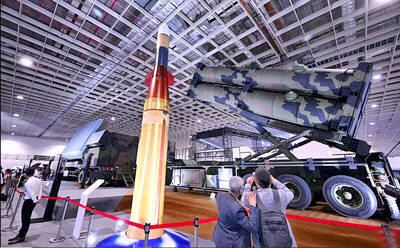
Taiwan is to commence mass production of the Tien Kung (天弓, “Sky Bow”) III, IV and V missiles by the second quarter of this year if the legislature approves the government’s NT$1.25 trillion (US$39.78 billion) special defense budget, an official said yesterday. Commenting on condition of anonymity, a defense official with knowledge of the matter said that the advanced systems are expected to provide crucial capabilities against ballistic and cruise missiles for the proposed “T-Dome,” an advanced, multi-layered air defense network. The Tien Kung III is an air defense missile with a maximum interception altitude of 35km. The Tien Kung IV and V
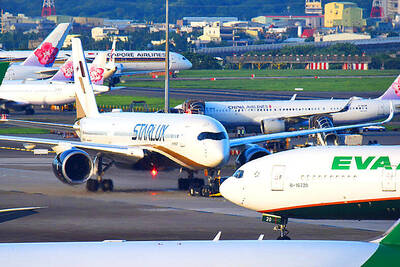
Trips for more than 100,000 international and domestic air travelers could be disrupted as China launches a military exercise around Taiwan today, Taiwan’s Civil Aviation Administration (CAA) said yesterday. The exercise could affect nearly 900 flights scheduled to enter the Taipei Flight Information Region (FIR) during the exercise window, it added. A notice issued by the Chinese Civil Aviation Administration showed there would be seven temporary zones around the Taiwan Strait which would be used for live-fire exercises, lasting from 8am to 6pm today. All aircraft are prohibited from entering during exercise, it says. Taipei FIR has 14 international air routes and
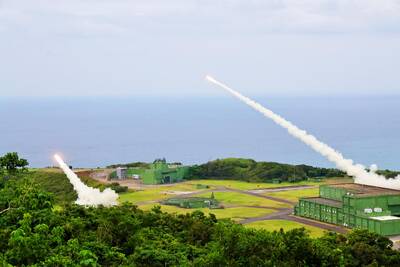
Taiwan lacks effective and cost-efficient armaments to intercept rockets, making the planned “T-Dome” interception system necessary, two experts said on Tuesday. The concerns were raised after China’s military fired two waves of rockets during live-fire drills around Taiwan on Tuesday, part of two-day exercises code-named “Justice Mission 2025.” The first wave involved 17 rockets launched at 9am from Pingtan in China’s Fujian Province, according to Lieutenant General Hsieh Jih-sheng (謝日升) of the Office of the Deputy Chief of the General Staff for Intelligence at the Ministry of National Defense. Those rockets landed 70 nautical miles (129.6km) northeast of Keelung without flying over Taiwan,


 RSS
RSS