


More than 80 percent of young people reported experiencing “fear of missing out” (FOMO) from social media, especially the increasingly popular social location-sharing app Zenly, a Child Welfare League Foundation survey found on Tuesday.
The foundation from Nov. 10 to Dec. 9 last year surveyed 1,818 junior-high and high-school students, asking them about their social media use and its potential effect on their well-being.
The most commonly used social platforms were Facebook Messenger, used by 80.4 percent of respondents, followed by Instagram (77.5 percent), Facebook (72.9 percent) and Line (72.2 percent), the survey found.
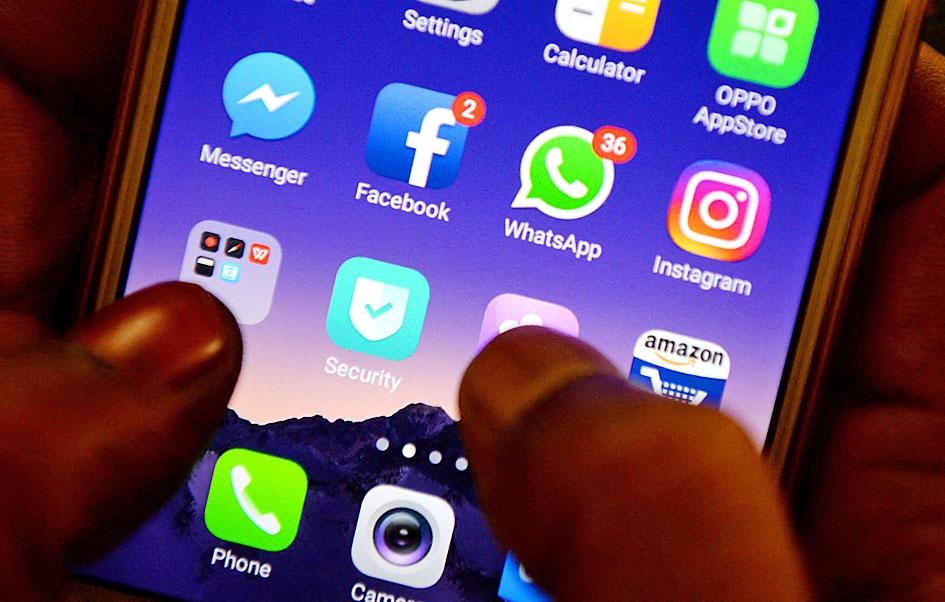
Photo: AFP
Newer platforms were also fairly popular, led by Douyin — the Chinese version of TikTok — at 55.1 percent and Zenly at 33.3 percent.
Commonly called “Popsicle” after its icon, Zenly is a social app that enables people to share their real-time location with close friends, as well as other information such as battery status and charging time.
In addition, 66 percent of respondents said that making friends online was easier than in person, the foundation told a news conference announcing the results of its survey.
However, increasing social media use also heightens exposure to online dangers, the foundation said, citing an increase in online solicitation.
The survey found that 26.5 percent of respondents reported having been solicited by a “special request” online, 6.3 percentage points higher than in the foundation’s 2020 survey, it said.
The most common request experienced by 14.1 percent of respondents was to enter into a romantic relationship, it said, adding that this request also saw the greatest increase from the previous survey.
Next were requests to video chat at 13.1 percent, followed by requests to meet in person and supply personal information at 9.9 percent each, it said.
The foundation said that 86.9 percent of respondents said they have experienced FOMO from social media — far higher than the 69 percent recorded in separate surveys in the US.
As a result of FOMO, 23 percent in the Taiwanese survey said they have felt lonely or developed low self-esteem, it added.
People susceptible to FOMO were particularly affected by Zenly, with users reporting higher rates of anxiety, insomnia and other negative emotions than people who do not use the app, the foundation said.
They also reported spending more time on the app out of a need to feel welcomed by others, it added.
Reducing the risks associated with social media requires collective effort, the foundation said.
This includes cooperation from platforms to add warnings and provide resources where people can find help, it said.
Schools should also improve online literacy education and create a trusting environment where children are willing to seek help, it said, adding that parents should also keep an eye on their children’s social media habits and set time limits.
If experiencing negative effects from social media such as anxiety or insomnia, the foundation recommended calling its hotline at 0800-001-769 or making an appointment with a counselor.

Considering that most countries issue more than five denominations of banknotes, the central bank has decided to redesign all five denominations, the bank said as it prepares for the first major overhaul of the banknotes in more than 24 years. Central bank Governor Yang Chin-lung (楊金龍) is expected to report to the Legislative Yuan today on the bank’s operations and the redesign’s progress. The bank in a report sent to the legislature ahead of today’s meeting said it had commissioned a survey on the public’s preferences. Survey results showed that NT$100 and NT$1,000 banknotes are the most commonly used, while NT$200 and NT$2,000

The Centers for Disease Control (CDC) yesterday reported the first case of a new COVID-19 subvariant — BA.3.2 — in a 10-year-old Singaporean girl who had a fever upon arrival in Taiwan and tested positive for the disease. The girl left Taiwan on March 20 and the case did not have a direct impact on the local community, it said. The WHO added the BA.3.2 strain to its list of Variants Under Monitoring in December last year, but this was the first imported case of the COVID-19 variant in Taiwan, CDC Deputy Director-General Lin Ming-cheng (林明誠) said. The girl arrived in Taiwan on

South Korea is planning to revise its controversial electronic arrival card, a step Taiwanese officials said prompted them to hold off on planned retaliatory measures, a South Korean media report said yesterday. A Yonhap News Agency report said that the South Korean Ministry of Foreign Affairs is planning to remove the “previous departure place” and “next destination” fields from its e-arrival card system. The plan, reached after interagency consultations, is under review and aims to simplify entry procedures and align the electronic form with the paper version, a South Korean ministry official said. The fields — which appeared only on the electronic form

The Ministry of Foreign Affairs (MOFA) is suspending retaliation measures against South Korea that were set to take effect tomorrow, after Seoul said it is updating its e-arrival system, MOFA said today. The measures were to be a new round of retaliation after Taiwan on March 1 changed South Korea's designation on government-issued alien resident certificates held by South Korean nationals to "South Korea” from the "Republic of Korea," the country’s official name. The move came after months of protests to Seoul over its listing of Taiwan as "China (Taiwan)" in dropdown menus on its new online immigration entry system. MOFA last week


 RSS
RSS