


Fishers and environmentalists in a contentious deadlock over a proposed ban on harvesting egg-bearing crabs prompted the Fisheries Agency on Monday to suspend discussions until late next month.
A blanket prohibition on the capture or sale of female crabs carrying fertilized eggs, eliminating a nine-month window, was proposed last month by National Chengchi University professor Cheng Tung-liao (鄭同僚).
A petition seeking stricter rules has garnered more than 5,600 signatures since it was posted on the National Development Council’s Public Policy Network Participation Platform.
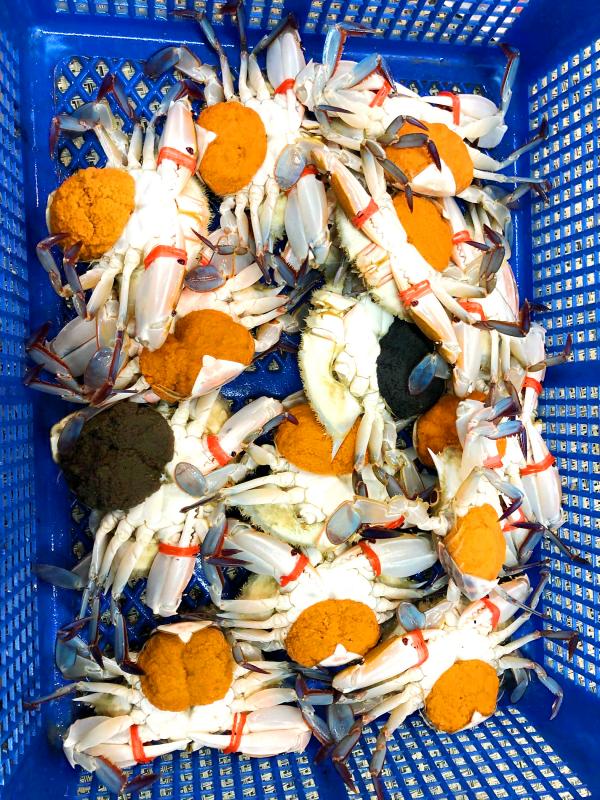
Photo courtesy of Cheng Tung-liao
Taiwan Ocean Fisheries and Sustainability Foundation chief executive officer Lin Ai-lung (林愛龍) told the panel that the meeting was overdue, as the government was supposed to convene it in late 2015.
Fisheries Agency data show that marine crab harvests fell from 2,572 tonnes in 2013 to 801 tonnes in 2020, Taiwan Environmental Protection Union Changhua Branch executive director Shih Yue-ying (施月英) said.
This suggests that there need to be more safeguards against overfishing, Shih said.
Hsu Shun-fa (許順發), executive director of the New Taipei City-based Wanli District (萬里) Fisheries Association, said that reported harvest tonnage does not prove that crab populations are declining.
Alternative explanations for the drop in harvest tonnage are that fishers are releasing crabs that cannot be harvested according to the law and complying with the rules on capturing egg-bearing crabs, Hsu said.
Some fishers might also have underreported their catch weights, he said.
Wanli association executive supervisor Lien Tsung-ming (練聰明) said that all seafood carries eggs.
Crabs carry their eggs for some of the time before they hatch, so they can be seen, which clouds the issue, Lien said.
Taiwan should not follow the example of the Philippines in banning egg-bearing crabs, as conditions in the two countries are not the same, he said, adding that a prohibition would affect the livelihoods of fishers.
Fishers want sustainable fisheries and they scrupulously follow the regulations, he said.
Wu Liang-cheng (吳兩成), president of the Taipei-based Chinese Fishery and Fishing Boat Association, called on the public to be more understanding of fishers, who are doing all they can to follow the law.
A fisher in New Taipei City was fined NT$60,000 after inspectors found an egg-bearing female crab in a 2,000 jin (1.2 tonne) catch in the hold of his boat, Wu said.
The fine was about the same as the value of the catch, Wu said.
The admission by members of the fishing industry that catch weights are being underreported shows that more inspections are required, Environment and Animal Society of Taiwan deputy director Chen Yu-min (陳玉敏) said.
The Fisheries Agency should provide an accurate estimate of the average annual income of crab fishers to improve a voluntary fishing moratorium system, she said.
Fisheries Agency Director-General Chang Chih-sheng (張致盛) said that more studies have to be conducted before the agency is prepared to bring the two sides back to the negotiating table.
It set a tentative date of sometime late next month for the next panel, Chang said.

FUKUOKA SITUATION: Japanese media reported that the pathogen is expected to be identified by the summer, while the CDC downplayed the idea that it was hMPV A “mysterious cold-like illness” reported in Japan’s Fukuoka Prefecture does not seem to be a new disease, but Japanese authorities have been asked about the situation, the Centers for Disease Control (CDC) said yesterday. The Fukuoka Prefectural Medical Association on Wednesday told a news conference that a “mystery cold” that has become a hot topic on social media is “highly likely to be caused by some kind of viral infection,” Japan’s KBC News reported. “Many people are experiencing symptoms starting with a sore throat, followed by a runny nose, phlegm and a severe cough,” KBC News reported, citing association officials. Health authorities are

Nvidia Corp CEO Jensen Huang (黃仁勳) arrived in Taiwan yesterday ahead of upcoming AI and technology events, saying he plans to meet with clients and Taiwan Semiconductor Manufacturing Co Chairman C.C. Wei (魏哲家) during his visit. After landing at Taipei Songshan Airport, Huang posed for photos with fans and handed out Yakult drinks to reporters and supporters waiting at the scene, saying he has “a lot to do” during the trip. Asked about reports that Nvidia’s planned headquarters site in Taipei’s Beitou Shilin Technology Park could break ground on May 27, Huang said that if the company holds an event, he would

The Ministry of Finance this afternoon announced the winning numbers for the March-April uniform invoice lottery. The winning number for the NT$10 million (US$318,060) special prize is 19531471, and the winning number for the NT$2 million grand prize is 85941329. Three numbers were drawn for the NT$200,000 first prize: 07225810, 20231230 and 83518781. Those with receipts matching the last seven digits of any of the first-prize numbers will win the NT$40,000 second prize, while those matching the last six digits will win the NT$10,000 third prize. Those whose receipts match the last five digits of the first-prize numbers can claim the NT$4,000 fourth prize,

Taiwan Travelogue (臺灣漫遊錄), which earlier this week became the first Taiwanese novel to win the International Booker Prize, is to be adapted into a television series through a Taiwan-Japan coproduction, producer Chang Chen-yu (張辰漁) said yesterday. Chang, a producer at World Softest Production Film Co, wrote on Facebook that the company had been searching for projects with international appeal that retain a strong Taiwanese identity after colleagues and Japanese partners strongly recommended the novel. After reading the book, Chang said he immediately decided to pursue the screen rights. “A great story has the power to transcend time and borders, and connect countless people,”


 RSS
RSS