


The Central Epidemic Command Center (CECC) yesterday reported 13 local COVID-19 infections and issued a level 3 travel alert for Palau.
The new cases are four linked to a cluster infection at Kaohsiung Harbor, two linked to a cluster at Taiwan Taoyuan International Airport, one linked to a hotel cluster in Yilan County, one linked to a family cluster in Taipei, one linked to a restaurant cluster in Taoyuan and one linked to an imported case, as well as three infections with unclear sources, said Minister of Health and Welfare Chen Shih-chung (陳時中), who heads the center.
The new cases linked to the Kaohsiung cluster are family members and contacts of previous cases, Chen said.
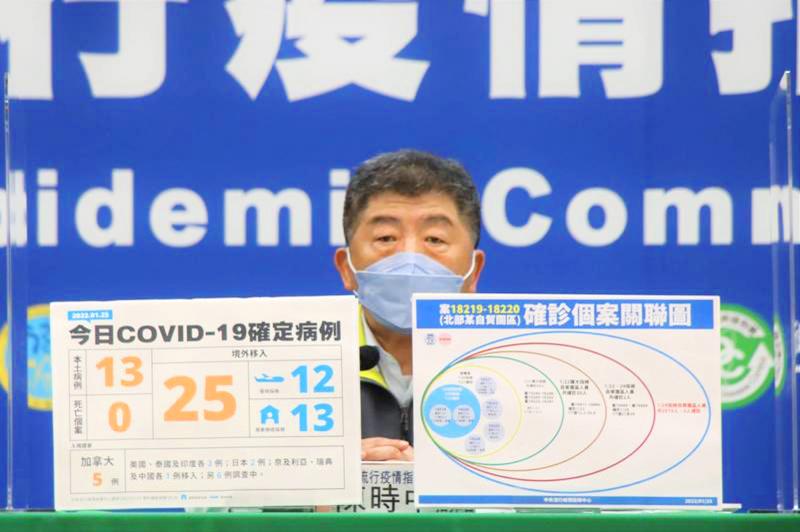
Photo courtesy of the Centers for Disease Control
No new cases were found after COVID-19 tests were conducted on Monday on 2,619 workers at Taoyuan’s Farglory Free Trade Zone (遠雄自由貿易港區), where 102 cases have been confirmed, he said.
However, some workers have not been tested, Chen said, adding that a second round was to be conducted yesterday on personnel at the two firms with the most cases.
One of the new cases is the grandmother of a child who tested positive after arriving in Taiwan, he said, adding that the grandmother had cared for the child during the latter’s isolation period.
The three new cases with unclear infection sources are two sisters who attend a preschool in Taoyuan, and a 58-year-old man who lives in Taoyuan’s Longtan District (龍潭) and had recently traveled to Hsinchu, Chen said.
They tested positive after seeking medical attention at healthcare facilities, he added.
Compared with the global COVID-19 situation, the daily case numbers in Taiwan are relatively low, and although there are a few sporadic cases with unclear infection sources, contact tracing is clarifying transmission chains and helping people feel safer as the Lunar New Year holiday approaches, Chen said.
The local COVID-19 situation is under observation and would be carefully monitored until at least Feb. 7, he said.
As many people might be concerned, the center would announce a set of COVID-19 prevention guidelines before the holiday, he said.
Asked whether people entering venues can still type “+” followed by the number of visitors when sending text messages to the center’s 1922 contact registration system after scanning a QR code, Chen said that they can.
However, it would be better if each person scans the QR code with their own device, as they would be contacted directly and immediately if a confirmed case is found to have visited the venue, he said.
Separately, Chen said the daily reported number of COVID-19 infections in Palau has been increasing, with an average of 72 per day in the past seven days.
Two people who arrived in Taiwan from Palau were diagnosed with COVID-19 on Monday, he said.
US Centers for Disease Control and Prevention specialists who have been in Palau have said that the infections were from the Omicron variant of SARS-CoV-2 and that the number of cases might peak in the next couple of weeks, he added.
Due to the increased risk of infection in Palau, the center has raised its travel notice for the country to level 3 — “warning” — the same as rest of the world, Chen said, adding that travelers from Palau must from now on follow the entry and quarantine rules that apply to people arriving from other counties.
The CECC yesterday also reported 25 imported cases: 12 who tested positive at ports upon arrival and 13 who tested positive during quarantine.

Considering that most countries issue more than five denominations of banknotes, the central bank has decided to redesign all five denominations, the bank said as it prepares for the first major overhaul of the banknotes in more than 24 years. Central bank Governor Yang Chin-lung (楊金龍) is expected to report to the Legislative Yuan today on the bank’s operations and the redesign’s progress. The bank in a report sent to the legislature ahead of today’s meeting said it had commissioned a survey on the public’s preferences. Survey results showed that NT$100 and NT$1,000 banknotes are the most commonly used, while NT$200 and NT$2,000

The Centers for Disease Control (CDC) yesterday reported the first case of a new COVID-19 subvariant — BA.3.2 — in a 10-year-old Singaporean girl who had a fever upon arrival in Taiwan and tested positive for the disease. The girl left Taiwan on March 20 and the case did not have a direct impact on the local community, it said. The WHO added the BA.3.2 strain to its list of Variants Under Monitoring in December last year, but this was the first imported case of the COVID-19 variant in Taiwan, CDC Deputy Director-General Lin Ming-cheng (林明誠) said. The girl arrived in Taiwan on

South Korea is planning to revise its controversial electronic arrival card, a step Taiwanese officials said prompted them to hold off on planned retaliatory measures, a South Korean media report said yesterday. A Yonhap News Agency report said that the South Korean Ministry of Foreign Affairs is planning to remove the “previous departure place” and “next destination” fields from its e-arrival card system. The plan, reached after interagency consultations, is under review and aims to simplify entry procedures and align the electronic form with the paper version, a South Korean ministry official said. The fields — which appeared only on the electronic form

The Ministry of Foreign Affairs (MOFA) is suspending retaliation measures against South Korea that were set to take effect tomorrow, after Seoul said it is updating its e-arrival system, MOFA said today. The measures were to be a new round of retaliation after Taiwan on March 1 changed South Korea's designation on government-issued alien resident certificates held by South Korean nationals to "South Korea” from the "Republic of Korea," the country’s official name. The move came after months of protests to Seoul over its listing of Taiwan as "China (Taiwan)" in dropdown menus on its new online immigration entry system. MOFA last week


 RSS
RSS