


The Executive Yuan on Thursday approved a bill that would allow religious groups to change the registrations of their real-estate assets.
Properties owned by religious groups can be regarded as public goods, and the bill would prevent individuals from appropriating them for their own benefits, Premier Su Tseng-chang (蘇貞昌) told a weekly Cabinet meeting.
Data from the Ministry of the Interior showed that about 750 hectares of land belonging to 7,500 temples nationwide are registered under the name of natural persons.
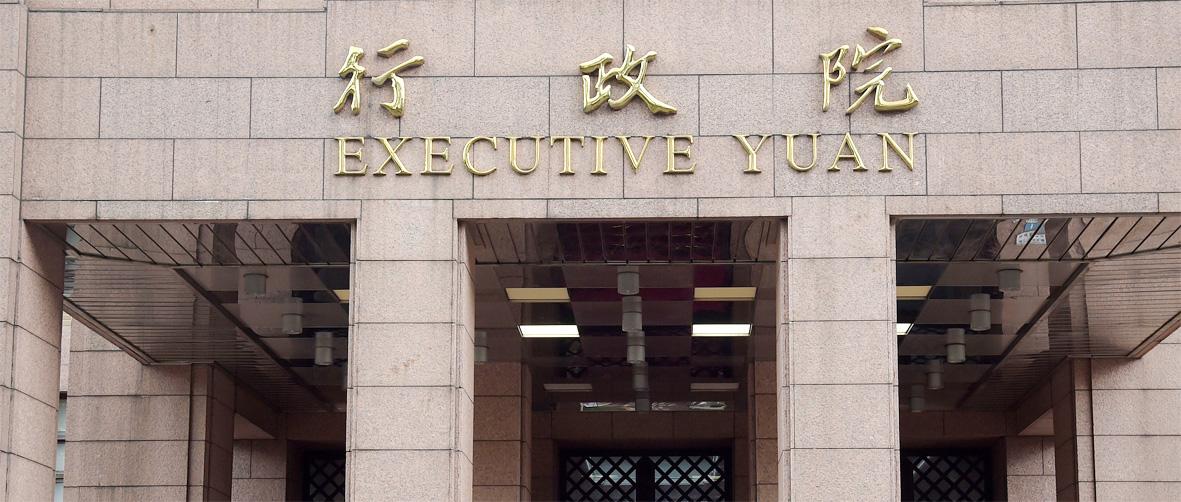
Photo: CNA
That is due to religious groups not having completed their temple registration at the time they acquired land, temples being unable to pay land taxes on donated land, or their land being used for farming and other reasons, Department of Civil Affairs Deputy Director Cheng Ying-hung (鄭英弘) said.
Given frequent arguments among group members over property ownership, the draft bill aims to use administrative tools to reduce such arguments and prevent individuals from appropriating temple assets, he said.
The practice of registering temples under individual names has generated many conflicts, such as when an owner is ordered to auction off the property or about inheriting it, Executive Yuan spokesman Lo Ping-cheng (羅秉成) said.
The new bill seeks to prevent such conflicts, Lo added.
The proposal is to be forwarded to the Legislative Yuan for review and approval.
Two years after the bill is passed by the legislature, qualified religious groups seeking to change a temple’s registration can file an application with the interior ministry, Cheng said.
Qualified religious groups include those registered as foundations, corporations and temples, Cheng said, adding that groups whose applications are being reviewed would be regarded as unregistered temples.
The bill is not applicable to altars, and unregistered churches or structures, he added.
Religious groups cannot own farmland, so the bill would restrict third parties or inheritors from transferring land used for farming to another party, Deputy Minister of the Interior Hua Ching-chun (花敬群) said.
Restrictions on temples acquiring certain categories of land would remain, Hua said.
Due taxes would have to be paid before land can be prepared under the bill, he added.
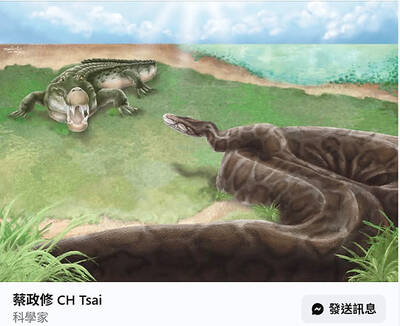
Taiwanese paleontologists have discovered fossil evidence that pythons up to 4m long inhabited Taiwan during the Pleistocene epoch, reporting their findings in the international scientific journal Historical Biology. National Taiwan University (NTU) Institute of Ecology and Evolutionary Biology associate professor Tsai Cheng-hsiu (蔡政修) led the team that discovered the largest snake fossil ever found in Taiwan. The single trunk vertebra was discovered in Tainan at the Chiting Formation, dated to between 400,000 and 800,000 years ago in the Middle Pleistocene, the paper said. The area also produced Taiwan’s first avian fossil, as well as crocodile, mammoth, saber-toothed cat and rhinoceros fossils, it said. Discoveries

WATCH FOR HITCHHIKERS: The CDC warned those returning home from Japan to be alert for any contagious diseases that might have come back with them People who have returned from Japan following the World Baseball Classic (WBC) games during the weekend are recommended to watch for symptoms of infectious gastroenteritis, flu and measles for two weeks, the Centers for Disease Control (CDC) said. Flu viruses remain the most common respiratory pathogen in Taiwan in the past four weeks and the influenza B virus accounted for 55.7 percent of the tested cases, exceeding the percentage of influenza A (H3N2) infections and becoming the local dominant strain, CDC Epidemic Intelligence Center Deputy Director Lee Chia-lin (李佳琳) said at a news conference on Tuesday. There were 82,187 hospital visits for

Alumni from Japan’s Kyoto Tachibana Senior High School marching band, widely known as the “Orange Devils,” staged a flash mob performance at the Grand Hotel in Taipei yesterday to thank Taiwan for its support after the Great East Japan Earthquake. The show, performed on the earthquake’s 15th anniversary, drew more than 100 spectators, some of whom arrived two hours before the show to secure a good viewing spot. The 26-member group played selections from “High School Musical,” “Beauty and the Beast,” and their signature piece “Sing Sing Sing” and shouted “I love

Taiwan’s three major international carriers are increasing booking fees, with EVA Airways having already increased the charge to US$28 per flight segment from US$25, while China Airlines (CAL) and Starlux Airlines are set to follow suit. Booking fees are charged by airlines through a global distribution system (GDS) and passed on to passengers. Carriers that apply the fees include CAL, EVA, Starlux and Tigerair Taiwan. A GDS is a computerized network operated by a company that connects airlines with travel agents and ticketing platforms, allowing reservations to be made and processed in real time. Major players include Amadeus, Sabre and Travelport. EVA Air began


 RSS
RSS