


The Legislative Yuan yesterday passed an amendment to the Act of Gender Equality in Employment (性別工作平等法) that would give fathers-to-be two more days of paid leave to accompany their spouse to prenatal checkups, but civic groups said that the amendment would not offer adequate support for couples who want to raise their children together.
The current regulations stipulate that employers must grant female employees five days of paid leave for pregnancy checkups. Employers should also grant male employees five days of paid paternity leave to care for their spouse and children during and after childbirth.
The amendment, which is to be implemented at a date designated by the Executive Yuan, would require employers to give female employees seven days of paid leave for pregnancy checkups, while granting male employees seven days of paid leave to accompany their spouse to pregnancy checkups, and to care for their spouse and children during and after childbirth.
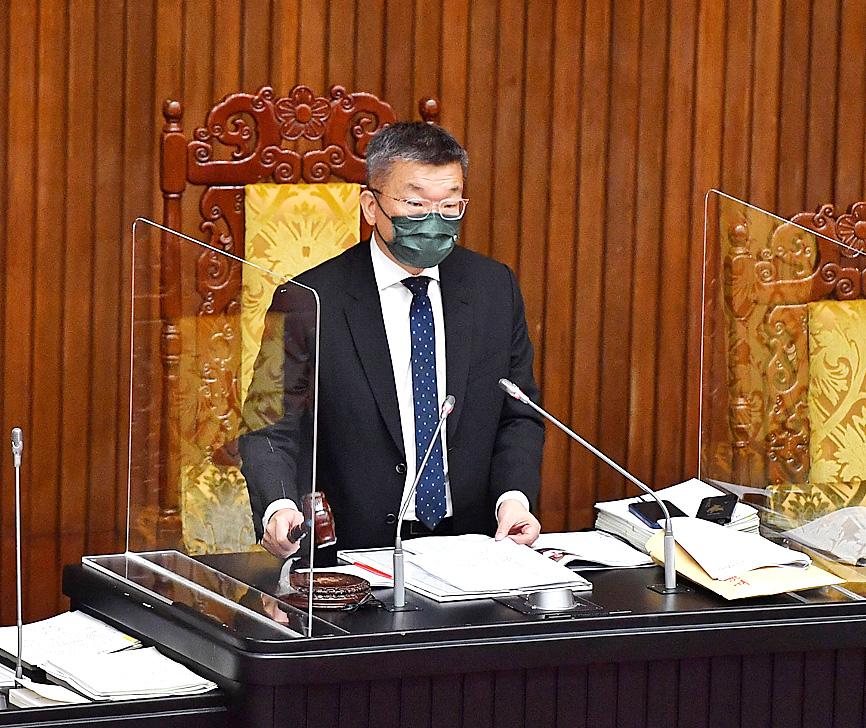
Photo: CNA
However, the bill fell short of the expectations of women’s rights advocates, as they had demanded that fathers be granted seven days paid leave for prenatal checkups and another seven days paid paternity leave.
Before the bill was passed yesterday, the Awakening Foundation, the Birth Reform Alliance, the Breastfeeding Association of Taiwan and the Not So Tiny Alliance jointly launched a signature drive for people to support their version of the bill.
As of midday yesterday, more than 1,200 people had signed, they said, adding that group representatives had attended a meeting with legislative caucus whips on Monday.
“To our dismay, Democratic Progressive Party legislators, who are the majority at the legislature, went ahead and passed their own version of the bill without further negotiations with other caucuses,” the foundation said. “Their version would only extend the paid leave for fathers to seven days. Employers would only pay for five days of the leave, while the government would make up the rest.”
Seven days paid leave would put fathers in a bind, rather than helping them, the foundation said.
“If they want to be at every prenatal checkup with their spouse, they would have to go to work once the child is born. If they want to take care of their spouse and children after childbirth, they cannot be at every checkup. However, the law gives pregnant women seven days paid leave for pregnancy checkups and eight weeks of maternity leave,” it said. “The shows that the act has essentially reaffirmed the notion that pregnancy and childbirth are a woman’s duty and a man’s limited participation in these matters is normal. Husbands seeking a full participation before, during and after childbirth must then do so at their own expense or use parental leave.”
In addition to prenatal checkups, couples need to make a lot of preparations before childbirth, from taking prenatal classes, consulting doctors and childcare specialists to redecorating their home, the Birth Reform Alliance said in a statement.
“If the Ministry of Labor thinks seven days of paid leave for fathers is enough and they can decide for themselves if they want to spend more time with their wives before or after childbirth, then should the ministry not extend the paid leave to parental leave as well?” the alliance said.
Numerous studies have shown that more spousal participation during pregnancy helps lower the risk of women experiencing postpartum depression, it said, adding that risks of experiencing postpartum depression are two to four times higher for those who do not receive adequate spousal support.

Considering that most countries issue more than five denominations of banknotes, the central bank has decided to redesign all five denominations, the bank said as it prepares for the first major overhaul of the banknotes in more than 24 years. Central bank Governor Yang Chin-lung (楊金龍) is expected to report to the Legislative Yuan today on the bank’s operations and the redesign’s progress. The bank in a report sent to the legislature ahead of today’s meeting said it had commissioned a survey on the public’s preferences. Survey results showed that NT$100 and NT$1,000 banknotes are the most commonly used, while NT$200 and NT$2,000

The Centers for Disease Control (CDC) yesterday reported the first case of a new COVID-19 subvariant — BA.3.2 — in a 10-year-old Singaporean girl who had a fever upon arrival in Taiwan and tested positive for the disease. The girl left Taiwan on March 20 and the case did not have a direct impact on the local community, it said. The WHO added the BA.3.2 strain to its list of Variants Under Monitoring in December last year, but this was the first imported case of the COVID-19 variant in Taiwan, CDC Deputy Director-General Lin Ming-cheng (林明誠) said. The girl arrived in Taiwan on

South Korea is planning to revise its controversial electronic arrival card, a step Taiwanese officials said prompted them to hold off on planned retaliatory measures, a South Korean media report said yesterday. A Yonhap News Agency report said that the South Korean Ministry of Foreign Affairs is planning to remove the “previous departure place” and “next destination” fields from its e-arrival card system. The plan, reached after interagency consultations, is under review and aims to simplify entry procedures and align the electronic form with the paper version, a South Korean ministry official said. The fields — which appeared only on the electronic form

The Ministry of Foreign Affairs (MOFA) is suspending retaliation measures against South Korea that were set to take effect tomorrow, after Seoul said it is updating its e-arrival system, MOFA said today. The measures were to be a new round of retaliation after Taiwan on March 1 changed South Korea's designation on government-issued alien resident certificates held by South Korean nationals to "South Korea” from the "Republic of Korea," the country’s official name. The move came after months of protests to Seoul over its listing of Taiwan as "China (Taiwan)" in dropdown menus on its new online immigration entry system. MOFA last week


 RSS
RSS