


American Institute in Taiwan (AIT) Deputy Director Jeremy Cornforth yesterday affirmed the US’ support for Taiwan’s participation in international organizations, as he praised the nation’s technological contributions.
Cornforth made the remarks at an awards ceremony for the annual Presidential Hackathon organized by the Executive Yuan.
This year’s theme, “Sustainability 2.0 Resilient Islands,” was inspired by lessons learned from the COVID-19 pandemic, particularly the need to create systems that are not just efficient, but also resilient.
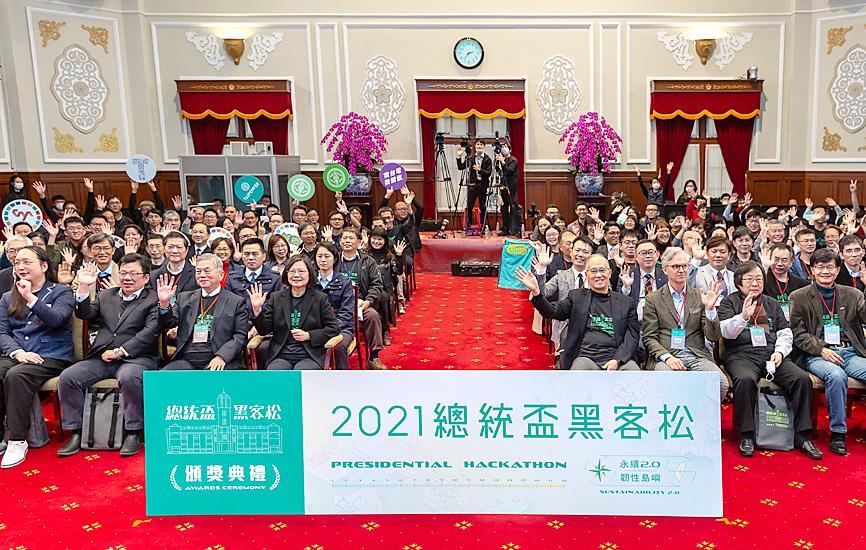
Photo: CNA
Cornforth in his address lauded Taiwan’s commitment to fulfilling the UN’s Sustainable Development Goals, despite being excluded from international organizations.
“Taiwan is a reliable partner, a vibrant democracy and a force for good in the world,” he said. “The United States will continue to support Taiwan as it seeks to engage internationally and meaningfully participate in international organizations.”
He also praised the hackathon as a means of envisioning technological solutions to social problems, rather than just seeing technology as a means to benefit businesses.
“Through events such as these, Taiwan not only reaffirms its status as a technological powerhouse, but also showcases that it is a good global citizen,” he said.
Taiwan has taken the concept of a hackathon and brought it to a whole new level, he said, while recognizing a Taiwanese team that earned the Best Use of Science award in this year’s NASA Space Apps Challenge.
President Tsai Ing-wen (蔡英文) in her address touted the participants’ use of innovative technology to “demonstrate Taiwan’s resilience.”
The five winning teams were among 164 who made proposals to address “pressing policy priorities for Taiwan,” including energy transformation, decarbonization, marine and river conservation, and healthcare, she said.
Climate action was the focus for teams in the international track, many of whom included Taiwanese, Tsai added, recognizing two winners who created systems to help farmers adapt to climate change and drivers switch to cycling.
In closing, she thanked all participants for working with the government to seek solutions to global challenges.
“We will continue to cooperate with the private sector to address these issues using innovative technology to help Taiwan become a sustainable island of resilience,” Tsai said.

The military has spotted two Chinese warships operating in waters near Penghu County in the Taiwan Strait and sent its own naval and air forces to monitor the vessels, the Ministry of National Defense (MND) said. Beijing sends warships and warplanes into the waters and skies around Taiwan on an almost daily basis, drawing condemnation from Taipei. While the ministry offers daily updates on the locations of Chinese military aircraft, it only rarely gives details of where Chinese warships are operating, generally only when it detects aircraft carriers, as happened last week. A Chinese destroyer and a frigate entered waters to the southwest

A magnitude 6.1 earthquake struck off the coast of Yilan County at 8:39pm tonight, the Central Weather Administration (CWA) said, with no immediate reports of damage or injuries. The epicenter was 38.7km east-northeast of Yilan County Hall at a focal depth of 98.3km, the CWA’s Seismological Center said. The quake’s maximum intensity, which gauges the actual physical effect of a seismic event, was a level 4 on Taiwan’s 7-tier intensity scale, the center said. That intensity level was recorded in Yilan County’s Nanao Township (南澳), Hsinchu County’s Guansi Township (關西), Nantou County’s Hehuanshan (合歡山) and Hualien County’s Yanliao (鹽寮). An intensity of 3 was

Japanese Prime Minister Sanae Takaichi’s comment last year on Tokyo’s potential reaction to a Taiwan-China conflict has forced Beijing to rewrite its invasion plans, a retired Japanese general said. Takaichi told the Diet on Nov. 7 last year that a Chinese naval blockade or military attack on Taiwan could constitute a “survival-threatening situation” for Japan, potentially allowing Tokyo to exercise its right to collective self-defense. Former Japan Ground Self-Defense Force general Kiyofumi Ogawa said in a recent speech that the remark has been interpreted as meaning Japan could intervene in the early stages of a Taiwan Strait conflict, undermining China’s previous assumptions
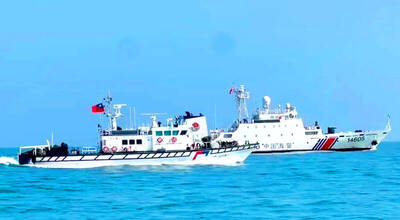
Instead of focusing solely on the threat of a full-scale military invasion, the US and its allies must prepare for a potential Chinese “quarantine” of Taiwan enforced through customs inspections, Stanford University Hoover fellow Eyck Freymann said in a Foreign Affairs article published on Wednesday. China could use various “gray zone” tactics in “reconfiguring the regional and ultimately the global economic order without a war,” said Freymann, who is also a nonresident research fellow at the US Naval War College. China might seize control of Taiwan’s links to the outside world by requiring all flights and ships entering or leaving Taiwan


 RSS
RSS