


Civil society groups on Tuesday called for the removal of the Chiang Kai-shek (蔣介石) statue from the Chiang Kai-shek Memorial Hall in Taipei in what they called a key move to promote transitional justice in Taiwan.
More than 400 human rights and other civil society groups signed a petition for the removal of the 6.3m-tall bronze statue in the main chamber of the memorial hall building, Chou Wan-yao (周婉窈), a history professor at National Taiwan University, told a news conference.
The petition seeks to show support for a plan revealed by the Transitional Justice Commission in September to remove “symbols of authoritarianism” from the hall, Chou said.
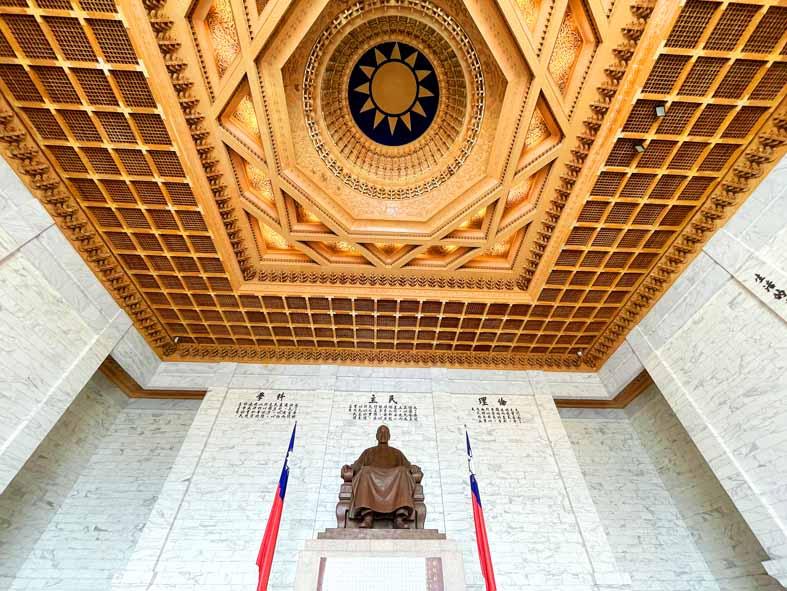
Photo: CNA
The plan aims to turn the site into a public park with “reflections on Taiwan’s authoritarian history” as its main theme.
To achieve that goal, the statue of Chiang is to be removed and renovations are to be made to eliminate authoritarian elements from the design of the hall, the plan says.
The commission said at the time that a more detailed proposal, including an amendment to the Organization Act of National Chiang Kai-shek Memorial Management Office (國立中正紀念堂管理處組織法), would be submitted to the Cabinet in May next year.
At the news conference, Chou said Chiang ordered the execution of 259 political prisoners who had originally been handed jail terms following military trials during the White Terror era, citing a commission report released in February.
She said that the issue regarding the removal of the statue, which remains the biggest authoritarian statue in Taiwan, must be addressed to achieve the goal of transitional justice, and consolidate human rights and the rule of law in the nation.
The groups also called for the changing of the guard ceremony, which takes place on a regular basis in the main chamber, to be scrapped or moved outside the main building, so it no longer reflects the act of “worshiping” Chiang.
Cherry Ho (何語蓉), secretary-general of the Taiwan Obasan Political Equality Party, comprised mostly of mothers, said that in a democratic society, no politician or political leader should be worshiped like a hero.
Removing objects that carry authoritarian imagery is key to bolstering democracy, Ho said, adding that “how history is documented and presented to our children reflects the values we believe in.”

NATIONAL SECURITY: Authorities are working to confirm the identities of the military personnel involved and investigating possible illegal conduct and regulatory violations Authorities are probing possible national security implications after Kinmen police and immigration officers on Sunday found a Chinese woman allegedly posing as a tourist while engaging in prostitution involving more than 10 military personnel. The woman, surnamed Chen (陳), has since been deported, authorities said, adding that investigators are still working to confirm the identities of those implicated, as the records only listed code names and aliases. The case stemmed from a report received by the Kinmen District Prosecutors’ Office on Friday last week from the Jinhu Precinct of the Kinmen County Police Bureau. On Sunday, police, along with the National Immigration

GLOBALGIVING: ‘ Caving to external pressure is not acceptable for an organization that has cultivated justice reform and human rights for 30 years,’ one NGO said A slew of non-government organizations (NGOs) have withdrawn from the GlobalGiving fundraising platform after it announced it would use “Chinese Taipei” instead of “Taiwan” from next month. The Taiwan Good Rice Association wrote on Facebook on Friday that it was informed on April 28 via a teleconference call of the change, which was made because the platform wanted to operate in China. Taiwan Good Rice is to terminate all cooperative relationships with GlobalGiving in response to the platform’s “unilateral and non-negotiable” decision to remove references to Taiwan, the NGO said. “Taiwan is in the official name of Taiwan Good Rice Association and the

HEAVY WEATHER: Typhoon Jangmi is due to crash straight into the Ryukyus as airlines look to shift flights to larger aircraft or cancel flights to Okinawa entirely Taiwan’s international air carriers announced flight adjustments over the weekend as Typhoon Jangmi is forecast to hit the Ryukyu Islands today and tomorrow. The Central Weather Administration (CWA) upgraded Jangmi from a tropical storm to a typhoon at 8am yesterday, with the eye located 580km south of Naha city. It was moving north at 19kph. Today, China Airlines’ CI-120, CI-121, CI-122 and CI-123 flights between Taoyuan and Naha, Okinawa, have been canceled as well as CI-132 and CI-133 between Kaohsiung and Naha. EVA Air’s BR-112, BR-113, BR-186 and BR-185 flights between Taoyuan and Naha are also canceled. Low-cost carrier Tigerair Taiwan canceled IT-230,
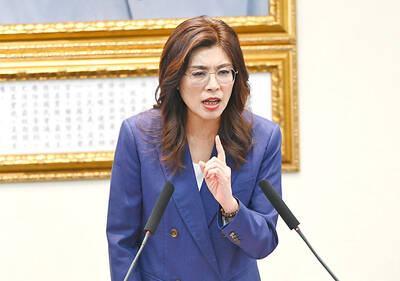
Chinese Nationalist Party (KMT) Chairwoman Cheng Li-wun (鄭麗文) yesterday briefed her party’s Central Standing Committee regarding her scheduled visit to the US between Monday next week and June 16, saying that her purpose would be to persuade the US that the Republic of China (ROC) Constitution was a “one China” constitution that would foster stable and peaceful cross-strait relations. The ROC Constitution is the most important defense for all Taiwanese citizens, as it upholds our democracy and has contributed to our robust economy, which aligns with international and US interests, she said. “We would not be troublemakers and drag the US under,”


 RSS
RSS