


Lee Tseng-chang (李增昌), a 95-year-old photographer and chronicler of the history of Hsinchu County’s Jhudong Township (竹東), is soon to publish the country’s first photography book in the Hailu (海陸) dialect of the Hakka language.
The book titled Child Laborer, Hsinchu Glass Co., Jhudong, and Lee Tseng-chang (少年工.新玻.竹東.李增昌), consists of 400 images taken by Lee, as well as essays on the history of the township’s Hakka community, Lee’s coauthor, Ku Shao-chi (古少騏), said on Friday.
The book received funding under the Ministry of Culture’s program to promote books written in local languages spoken in Taiwan that are not Mandarin.
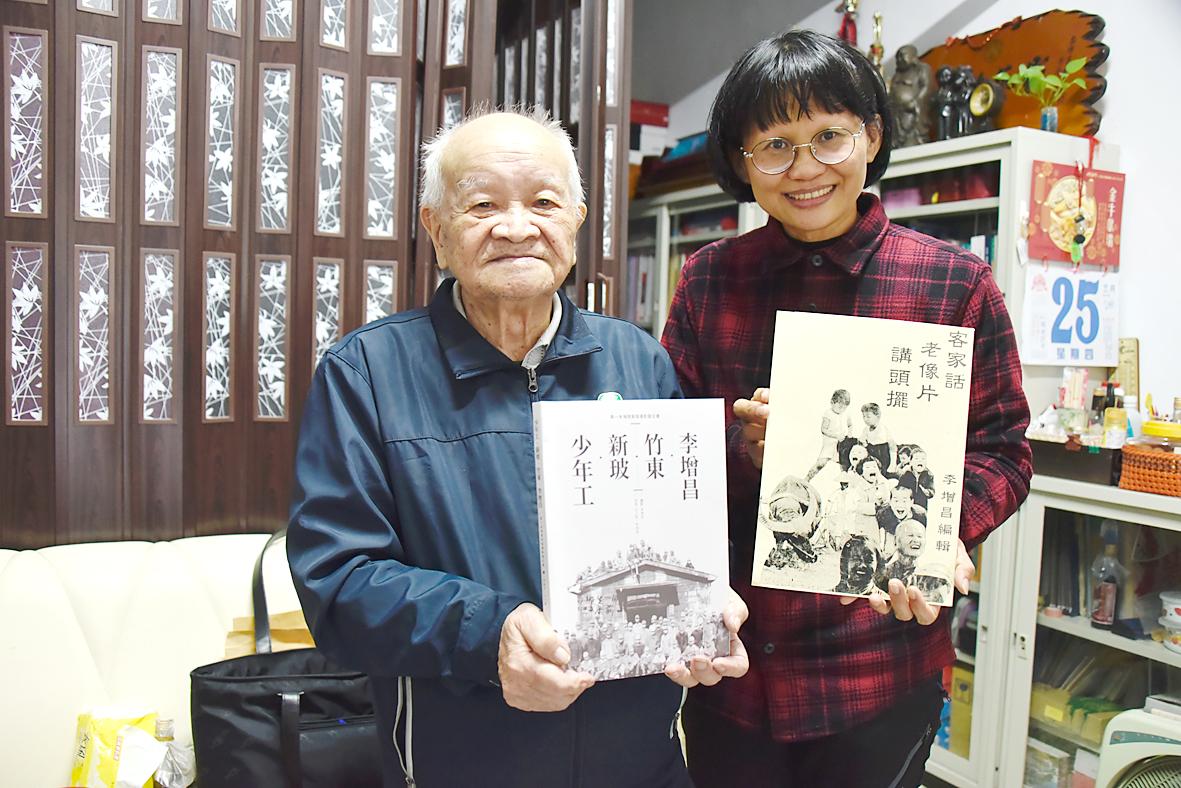
Photo: Liao Hsueh-ju, Taipei Times
Lee’s photography captures the history of Jhudong and the daily life of its residents, and some of his work has seen print thanks to the Hakka Affairs Council and the Hsinchu County Cultural Affairs Bureau, Ku said.
The book covers Lee’s life, which is entwined with local history, including when he worked in a tea factory as a child laborer in Japanese-ruled Taiwan and was conscripted to work at a fighter aircraft factory in Japan during World War II, Ku said.
Lee returned to Taiwan after the end of the war and was unemployed during the post-war slump until he was recruited to work in Hsinchu at the first-ever pane glass manufacturing facility in Taiwan, she said.
The book contains Lee’s recollections and photographs of the glass factory — including clashes between management and the workers that occurred during the Martial Law period — the ravages of Typhoon Gloria, Hsinchu’s variance of the Hakka Lion Dance and the Taiwan Hakka Mountain Song Contest, she said.
Born in 1927, Lee took up photography as a hobby in the 1950s, in addition to collecting and restoring antique cameras, Ku said, adding that he has worked on more than 1,000 cameras in his life.
Ku said that she met Lee at a function that presented historical images held by the ministry in 2014, and she was impressed by the richness and thoroughness of his photographic documentation of Jhudong.
To ensure the accuracy of the text, Ku cross-referenced Lee’s photographs and verbal accounts with historical documents and interviews with living witnesses, she said.
A challenge during the book’s writing was that she did not know many of the Hailu words Lee used in his account, and they cannot be found in Hakka dictionaries, Ku said, urging the Hakka Affairs Council to create an official dictionary of the Hakka language.

The Centers for Disease Control (CDC) yesterday reported the first case of a new COVID-19 subvariant — BA.3.2 — in a 10-year-old Singaporean girl who had a fever upon arrival in Taiwan and tested positive for the disease. The girl left Taiwan on March 20 and the case did not have a direct impact on the local community, it said. The WHO added the BA.3.2 strain to its list of Variants Under Monitoring in December last year, but this was the first imported case of the COVID-19 variant in Taiwan, CDC Deputy Director-General Lin Ming-cheng (林明誠) said. The girl arrived in Taiwan on

South Korea is planning to revise its controversial electronic arrival card, a step Taiwanese officials said prompted them to hold off on planned retaliatory measures, a South Korean media report said yesterday. A Yonhap News Agency report said that the South Korean Ministry of Foreign Affairs is planning to remove the “previous departure place” and “next destination” fields from its e-arrival card system. The plan, reached after interagency consultations, is under review and aims to simplify entry procedures and align the electronic form with the paper version, a South Korean ministry official said. The fields — which appeared only on the electronic form

The Ministry of Foreign Affairs (MOFA) is suspending retaliation measures against South Korea that were set to take effect tomorrow, after Seoul said it is updating its e-arrival system, MOFA said today. The measures were to be a new round of retaliation after Taiwan on March 1 changed South Korea's designation on government-issued alien resident certificates held by South Korean nationals to "South Korea” from the "Republic of Korea," the country’s official name. The move came after months of protests to Seoul over its listing of Taiwan as "China (Taiwan)" in dropdown menus on its new online immigration entry system. MOFA last week

A bipartisan group of US senators has introduced a bill to enhance cooperation with Taiwan on drone development and to reduce reliance on supply chains linked to China. The proposed Blue Skies for Taiwan Act of 2026 was introduced by Republican US senators Ted Cruz and John Curtis, and Democratic US senators Jeff Merkley and Andy Kim. The legislation seeks to ease constraints on Taiwan-US cooperation in uncrewed aerial systems (UAS), including dependence on China-sourced components, limited access to capital and regulatory barriers under US export controls, a news release issued by Cruz on Wednesday said. The bill would establish a "Blue UAS


 RSS
RSS