


The 58th Golden Horse Awards ceremony is taking place at National Sun Yat-sen Memorial Hall in Taipei today, with Singaporean comedian Mark Lee (李國煌) and Chinese-American actress Bai Ling (白靈) presenting awards.
Known for his wit and colorful antics, Lee was nominated for best leading actor for the comedy drama Number 1 (男兒王) at the awards last year, while Bai was also nominated last year as best leading actress for the drama The Abortionist (墮胎師).
The annual Golden Horse Awards, established in 1962, is considered one of the most prestigious film awards in the Chinese-language world.
A total of 573 entries were submitted to this year’s awards, up from last year’s 465, with a new category — best documentary short film — added this year.
Hong Kong film Drifting (濁水漂流), based on a real-life incident that involved homeless people in the territory, received the most nominations — 12 — this year.
Three other films — The Soul (緝魂), The Falls (瀑布) and Till We Meet Again (月老), all made in Taiwan, received 11 nominations each.
In other news, English-language video streaming service Taiwan+ is showcasing Taiwan’s classic cinematic stories through its online “Taiwan+ Film Festival 2021,” which runs until the end of the year.
Taiwan+ is holding the film festival, featuring a selection of 10 movies including Golden Horse Film Festival awardees, to increase international awareness about Taiwan, its chief executive officer Joanne Tsai (蔡秋安) said.
Awareness can be promoted because it links to the upcoming Golden Horse Awards, she added.
The 10 films were uploaded on Taiwan+’s Web site on Nov. 15 and most are free to watch around the world until Dec. 31.
Among them is award-winning director Ang Lee’s (李安) Father Knows Best Trilogy (父親三部曲), which features family tension and tender comedic moments — Pushing Hands (推手, 1991), Eat Drink Man Woman (飲食男女, 1994), and The Wedding Banquet (囍宴, 1993).
However, the three movies will not be available to viewers in the US, Canada, Mexico, Germany and France, Taiwan+ said.
The other seven films include some Taiwanese classics, three of which are restored films. They include two cult favorite black-and-white movies from the Taiwan Hollywood era of the 1960s, The Fantasy of Deer Warrior (大俠梅花鹿, 1961) and Vengeance of the Phoenix Sisters (三鳳震武林, 1968).
The third restored film is Wheel of Life (大輪迴, 1983), the stories of three souls that continually metamorphose into different characters while continuing their twisted romance.
Taiwan needs more attention on the global stage and Taiwan+ aims to help achieve that, Tsai said, adding that the “+” in the platform’s name is about linking Taiwan with fields such as movies and music.
Taiwan+ was launched on Aug. 30 as the nation’s first English-language video news and programming platform aimed at an international audience.

AGING: While Japan has 22 submarines, Taiwan only operates four, two of which were commissioned by the US in 1945 and 1946, and transferred to Taiwan in 1973 Taiwan would need at least 12 submarines to reach modern fleet capabilities, CSBC Corp, Taiwan chairman Chen Cheng-hung (陳政宏) said in an interview broadcast on Friday, citing a US assessment. CSBC is testing the nation’s first indigenous defense submarine, the Hai Kun (海鯤, Narwhal), which is scheduled to be delivered to the navy next month or in July. The Hai Kun has completed torpedo-firing tests and is scheduled to undergo overnight sea trials, Chen said on an SET TV military affairs program. Taiwan would require at least 12 submarines to establish a modern submarine force after assessing the nation’s operational environment and defense

Yangmingshan National Park authorities yesterday urged visitors to respect public spaces and obey the law after a couple was caught on a camera livestream having sex at the park’s Qingtiangang (擎天崗) earlier in the day. The Shilin Police Precinct in Taipei said it has identified a suspect and his vehicle registration number, and would summon him for questioning. The case would be handled in accordance with public indecency charges, it added. The couple entered the park at about 11pm on Thursday and began fooling around by 1am yesterday, the police said, adding that the two were unaware of the park’s all-day live
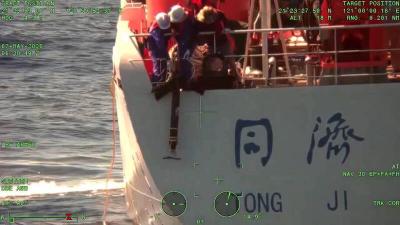
The coast guard today said that it had disrupted "illegal" operations by a Chinese research ship in waters close to the nation and driven it away, part of what Taipei sees a provocative pattern of China's stepped up maritime activities. The coast guard said that it on Thursday last week detected the Chinese ship Tongji (同濟號), which was commissioned only last year, 29 nautical miles (54km) southeast of the southern tip of Taiwan, although just outside restricted waters. The ship was observed lowering ropes into the water, suspected to be the deployment of scientific instruments for "illegal" survey operations, and the coast

A former soldier and an active-duty army officer were yesterday indicted for allegedly selling classified military training materials to a Chinese intelligence operative for a total of NT$79,440. The Taipei District Prosecutors’ Office indicted Chen Tai-yin (陳泰尹) and Lee Chun-ta (李俊達) for contravening the National Security Act (國家安全法) and the Anti-Corruption Act (貪污治罪條例). Chen left the military in September 2013 after serving alongside then-staff sergeant Lee, now an army lieutenant, at the 21st Artillery Command of the army’s Sixth Corps from 2011 to 2013, according to the indictment. Chen met a Chinese intelligence operative identified as “Wang” (王) through a friend in November


 RSS
RSS