


China needs to realize that Western countries do not view Taiwan in a similar way to the semi-autonomous territory of Hong Kong, former British prime minister Tony Blair said.
“It’s important that we understand what China’s position is in relation to Taiwan, how deep this ‘one China’ policy is,” Blair said on Thursday in Singapore. “They have to understand that Taiwan is not the same as Hong Kong, and there are very strong views on this in the West.”
Blair added that the potential for conflict between the US and China over Taiwan is a “big anxiety,” and that the West needs to strengthen its own ability to deal with Beijing, while also being willing to cooperate when possible.

Photo: Bloomberg
His comments at the Bloomberg New Economy Forum came the same week that Chinese President Xi Jinping (習近平) reasserted Beijing’s “red line” with regard to “separatist forces” in Taiwan in a virtual meeting with US President Joe Biden.
Biden subsequently, although briefly, caused some confusion by describing Taiwan as “independent” to reporters, before walking back his comment.
Blair praised the meeting between Xi and Biden, and said the US position on China was clearly changing.
“The Americans are actually coming to the right type of policy posture towards China,” he said. “None of that means that there is not going to still be some pretty fierce action on both sides, and there are all sorts of risks and dangers with this relationship, but it remains the key to 21st-century stability.”
Part of the problem in dealing with Beijing is that “no one quite knows what China really wants to achieve,” and whether it is only seeking to develop its own nation or to achieve “supremacy” over the West, he said.
It is clear that in the past few years, China has adopted a newly assertive posture, domestically and on the world stage, and this means the West needs to become stronger in relation to Beijing, while also being willing to work with China when possible, he said.
“We have to be strong enough to do whatever is necessary,” Blair said.
“We need to engage, to understand, to be able to work with China and to ensure that the relationship isn’t subject to mistakes” that could prompt confrontation, he added.

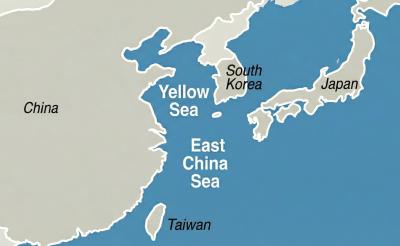
China has reserved offshore airspace in the Yellow Sea and East China Sea from March 27 to May 6, issuing alerts usually used to warn of military exercises, although no such exercises have been announced, the Wall Street Journal (WSJ) reported yesterday. Reserving such a large area for 40 days without explanation is an “unusual step,” as military exercises normally only last a few days, the paper said. These alerts, known as Notice to Air Missions (Notams), “are intended to inform pilots and aviation authorities of temporary airspace hazards or restrictions,” the article said. The airspace reserved in the alert is
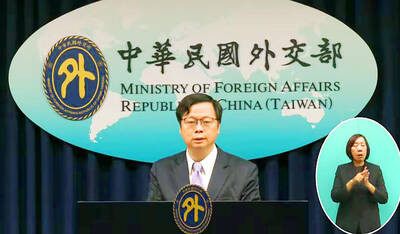
NAMING SPAT: The foreign ministry called on Denmark to propose an acceptable solution to the erroneous nationality used for Taiwanese on residence permits Taiwan has revoked some privileges for Danish diplomatic staff over a Danish permit that lists “Taiwan” as “China,” Eric Huang (黃鈞耀), head of the Ministry of Foreign Affairs’ Department of European Affairs, told a news conference in Taipei yesterday. Reporters asked Huang whether the Danish government had responded to the ministry’s request that it correct the nationality on Danish residence permits of Taiwanese, which has been listed as “China” since 2024. Taiwan’s representative office in Denmark continues to communicate with the Danish government, and the ministry has revoked some privileges previously granted to Danish representatives in Taiwan and would continue to review
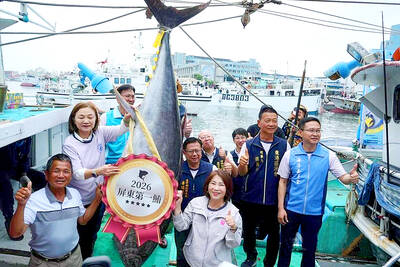
The first bluefin tuna of the season, brought to shore in Pingtung County and weighing 190kg, was yesterday auctioned for NT$10,600 (US$333.5) per kilogram, setting a record high for the local market. The auction was held at the fish market in Donggang Fishing Harbor, where the Siaoliouciou Island-registered fishing vessel Fu Yu Ching No. 2 delivered the “Pingtung First Tuna” it had caught for bidding. Bidding was intense, and the tuna was ultimately jointly purchased by a local restaurant and a local company for NT$10,600 per kilogram — NT$300 ,more than last year — for a total of NT$2.014 million. The 67-year-old skipper
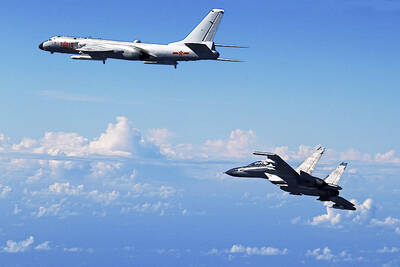
China has reserved offshore airspace over the Yellow Sea and East China Sea from March 27 to May 6, issuing alerts that are usually used to warn of military exercises, although no such exercises have been announced, the Wall Street Journal (WSJ) reported on Sunday. Reserving such a large area for 40 days without explanation is an “unusual step,” as military exercises normally only last a few days, the paper said. The alerts, known as notice to air missions (NOTAMs), “are intended to inform pilots and aviation authorities of temporary airspace hazards or restrictions,” the article said. The airspace reserved in the alert


 RSS
RSS