


A “5D” smart city disaster prevention system that aims to help minimize damage to buildings from earthquakes yesterday was introduced by the National Center for Research on Earthquake Engineering.
The center's previous 4D system has integrated the Central Weather Bureau's data, while the 5D system shows estimates of damage that buildings might sustain during a quake, center research fellow Wang Ren-zuo (王仁佐) told a news conference in Taipei.
The levels of damage are divided into five tiers from “undamaged” to “collapse,” Wang said.
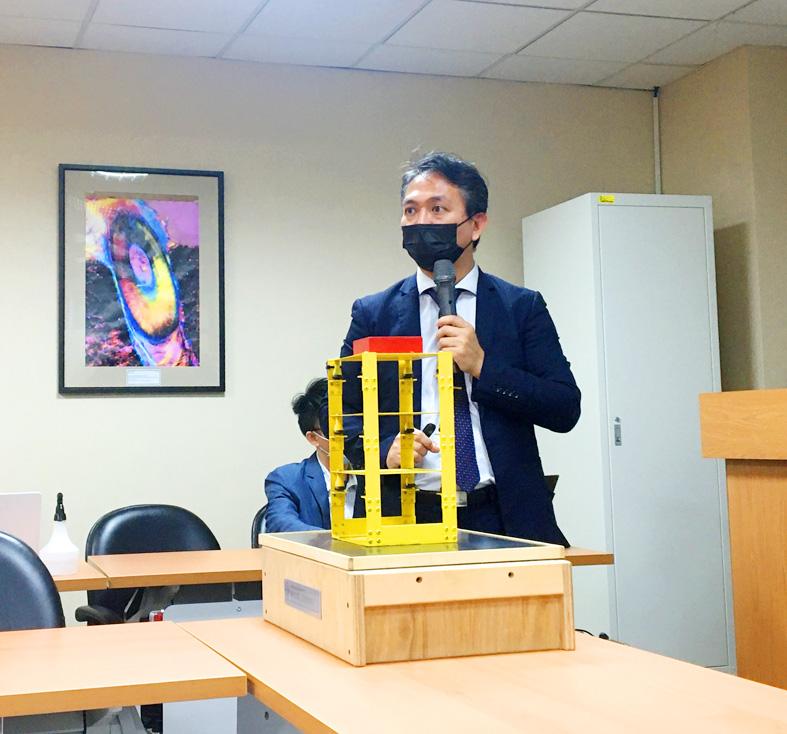
Photo: Lin Chia-nan, Taipei Times
The system can forecast which buildings in a region are more likely to collapse, he said.
During a tremor, the system can swiftly gather seismic data and when the shaking is finished, it can indicate the best routes for rescue workers and evacuations, he said.
If authorities employ uncrewed aerial vehicles to inspect damaged regions, images they take can be incorporated into the system, which has image recognition algorithms, he said, adding that this would enable authorities to assess the scope of losses.
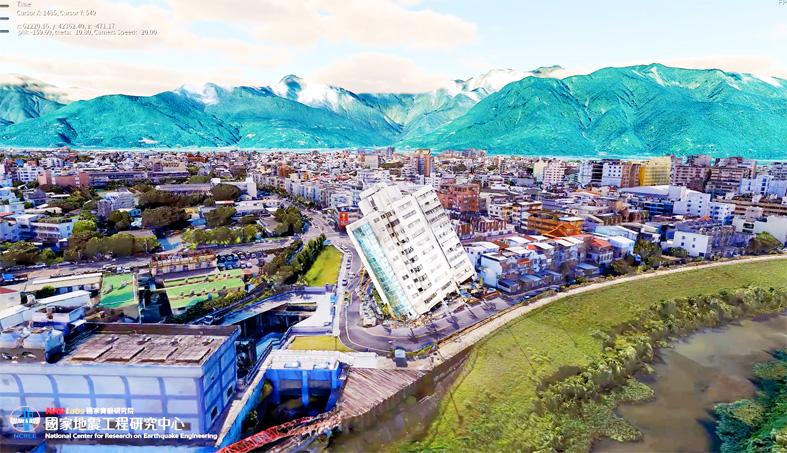
Photo: Screen grab from a video provided by National Center for Research on Earthquake Engineering
For example, if a building partially falls over — as the Yun Men Tsui Ti (雲門翠堤) building in Hualien City did following liquefaction amid a magnitude 6.2 earthquake in 2018 — the system can compute the best way to prop it up to help prevent further damage if there are aftershocks, Wang said.
If there is a power outage, the system can be supported by an emergency power system, center director-general Chou Chung-che (周中哲) said.
So far, the center has only finished building spatial models for Hualien City, Wang said, adding that it hopes to collect more architectural data from other local governments.
Other features of the system are integrated subsystems for structural health monitoring, estimates of the cost from damage, an assessment of damage to water supplies and analysis from remote-sensing data collected by the Formosat-5, which was launched in 2017, he said.
It is significant that the center has full control over the system’s infographics, given that it was developed entirely in Taiwan, he said.
The center hopes to initially deploy the system in the social housing units in Taoyuan and the Shalun Smart Green Energy Science City in Tainan, he said.
In addition, the center is partnering with the Ministry of the Interior’s Construction and Planning Agency to strengthen the structures of old buildings across Taiwan, as many are vulnerable to earthquakes, Chou said.
However, members of the public are normally not willing to share information about their homes online, he said.
Hopefully, people can work with the government to improve building safety, he added.

Considering that most countries issue more than five denominations of banknotes, the central bank has decided to redesign all five denominations, the bank said as it prepares for the first major overhaul of the banknotes in more than 24 years. Central bank Governor Yang Chin-lung (楊金龍) is expected to report to the Legislative Yuan today on the bank’s operations and the redesign’s progress. The bank in a report sent to the legislature ahead of today’s meeting said it had commissioned a survey on the public’s preferences. Survey results showed that NT$100 and NT$1,000 banknotes are the most commonly used, while NT$200 and NT$2,000

The Centers for Disease Control (CDC) yesterday reported the first case of a new COVID-19 subvariant — BA.3.2 — in a 10-year-old Singaporean girl who had a fever upon arrival in Taiwan and tested positive for the disease. The girl left Taiwan on March 20 and the case did not have a direct impact on the local community, it said. The WHO added the BA.3.2 strain to its list of Variants Under Monitoring in December last year, but this was the first imported case of the COVID-19 variant in Taiwan, CDC Deputy Director-General Lin Ming-cheng (林明誠) said. The girl arrived in Taiwan on

ANNUAL EVENT: Two massive Pokemon balloons are to be set up in Daan Park, with an event zone operating from 10am to 6pm This year’s Taipei Floral Picnic is to be held at Daan Park today and tomorrow, featuring an exclusive Pokemon Go event, a themed food market, a coffee rave picnic area and stage performances, the Taipei Department of Information and Tourism said yesterday. Two massive Pokemon balloons are to be set up in the park as attractions, with an exclusive event zone operating from 10am to 6pm, it said. Participants who complete designated tasks on-site would have a chance to receive limited-edition souvenirs, it added. People could also try the newly launched game Pokemon Pokopia in the trial area, the department said. Three PokeStops are

South Korea is planning to revise its controversial electronic arrival card, a step Taiwanese officials said prompted them to hold off on planned retaliatory measures, a South Korean media report said yesterday. A Yonhap News Agency report said that the South Korean Ministry of Foreign Affairs is planning to remove the “previous departure place” and “next destination” fields from its e-arrival card system. The plan, reached after interagency consultations, is under review and aims to simplify entry procedures and align the electronic form with the paper version, a South Korean ministry official said. The fields — which appeared only on the electronic form


 RSS
RSS