


Construction for a hospital offering “smart care” for the elderly, the first medical center to offer such services, has begun at Tainan’s National Cheng Kung University (NCKU).
The building, expected to be 12 stories tall with an additional five levels underground, was designed by Bio-Architecture Formosana founder Chang Ching-hua (張清華) and is to be completed by 2025.
In addition to being the first medical facility to offer smart care services to the elderly, the building will also boast of being Taiwan’s first green building for medical use.
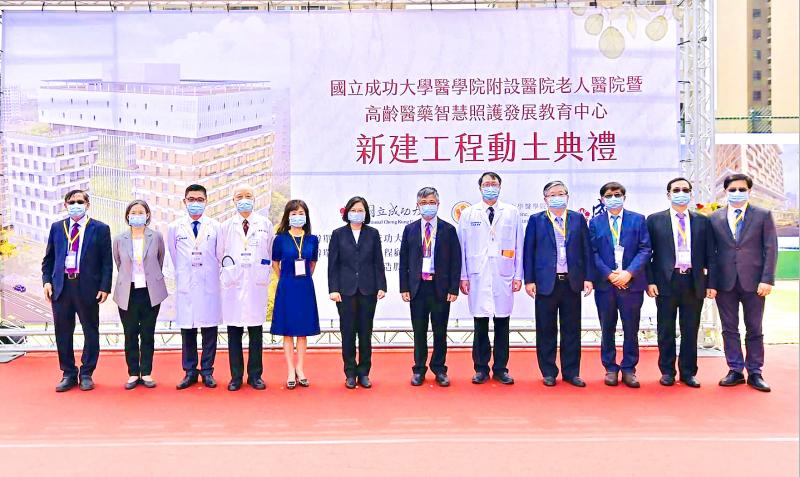
Photo courtesy of National Cheng Kung University
The building’s interior design seeks to emulate the meandering alley and paths of Tainan city, and the individual rooms, such as sunrooms or other chambers, are to emulate the traditional Minnan-styled buildings in the city.
GREEN SCHEME
Chang and her architecture firm are well-known for constructing “green buildings,” including the Beitou Library, and for designing for Shalun’s Green Energy Science Park.
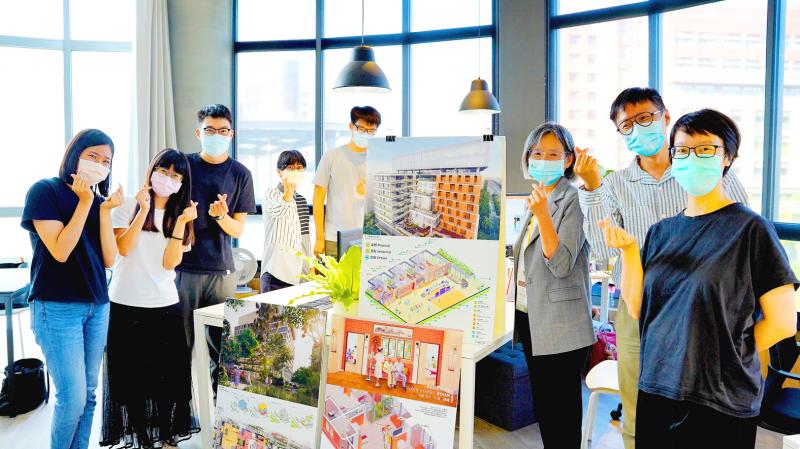
Photo courtesy of National Cheng Kung University
Both buildings share great renown as “green buildings” and are also favorite photo landmarks for tourists and visitors.
The hospital’s design and color scheme are intended to help visitors to forget that the establishment is a hospital and feel that they are a part of the local community, Chang said.
Maintaining a bright, light-filled environment filled with greenery can serve to lighten the patients’ mood and facilitate their recovery, she said.
The hospital is being constructed at the intersection of Dongfong and Linsen roads, near a park in Tainan renowned for its “golden shower” trees. Directly across from the area is Siaodong Park.
Each floor will ensure that all levels have ample sunlight and gardens for the patients to walk through, Chang said, adding that this would also afford patients with fantastic views of the nearby area.
The hospital has also designed spaces around nursing stations for patients to socialize and interact with each other to relieve pressure, she said.
NCKU president Su Huey-jen (蘇慧真) said the hospital hopes to collaborate with schools and colleges within the university, and work with the Tainan Science Park to provide a greater quality of care for the elderly.
The hospital also hopes to facilitate the integration of smart medicine in the region and contribute to the government’s “Greater South” initiative, as well as becoming a model center for the development of smart medicine.
MAKING USERS HAPPY
Born and raised in Tainan, Chang said she was intimately aware of how Tainan’s unique culture had furthered her creativity.
“The university had taught me how to express my ideas on paper, how to care for the clients and to embrace nature in my design,” Chang said.
When she sees people’s expressions of happiness, amazement, or feelings of being honored to live or spend time in her buildings, she feels motivated and encouraged in her work, Chang said.
Having designed multiple buildings of renown to date, Chang said that each assignment is a new experience, as some jobs are ones that an architect might only have once in a lifetime, citing the High Court and the Taichung Arena as two examples.
These buildings take years, even decades, to complete, she added.
When asked what work she had completed that she was the most satisfied with, Chang said: “It will always be the next one.”
The NCKU will launch its 90th anniversary celebrations starting this month.
More information can be found on the university’s Web site, which can be viewed at: https://90th.ncku.edu.tw/.

NATIONAL SECURITY: Authorities are working to confirm the identities of the military personnel involved and investigating possible illegal conduct and regulatory violations Authorities are probing possible national security implications after Kinmen police and immigration officers on Sunday found a Chinese woman allegedly posing as a tourist while engaging in prostitution involving more than 10 military personnel. The woman, surnamed Chen (陳), has since been deported, authorities said, adding that investigators are still working to confirm the identities of those implicated, as the records only listed code names and aliases. The case stemmed from a report received by the Kinmen District Prosecutors’ Office on Friday last week from the Jinhu Precinct of the Kinmen County Police Bureau. On Sunday, police, along with the National Immigration

GLOBALGIVING: ‘ Caving to external pressure is not acceptable for an organization that has cultivated justice reform and human rights for 30 years,’ one NGO said A slew of non-government organizations (NGOs) have withdrawn from the GlobalGiving fundraising platform after it announced it would use “Chinese Taipei” instead of “Taiwan” from next month. The Taiwan Good Rice Association wrote on Facebook on Friday that it was informed on April 28 via a teleconference call of the change, which was made because the platform wanted to operate in China. Taiwan Good Rice is to terminate all cooperative relationships with GlobalGiving in response to the platform’s “unilateral and non-negotiable” decision to remove references to Taiwan, the NGO said. “Taiwan is in the official name of Taiwan Good Rice Association and the

HEAVY WEATHER: Typhoon Jangmi is due to crash straight into the Ryukyus as airlines look to shift flights to larger aircraft or cancel flights to Okinawa entirely Taiwan’s international air carriers announced flight adjustments over the weekend as Typhoon Jangmi is forecast to hit the Ryukyu Islands today and tomorrow. The Central Weather Administration (CWA) upgraded Jangmi from a tropical storm to a typhoon at 8am yesterday, with the eye located 580km south of Naha city. It was moving north at 19kph. Today, China Airlines’ CI-120, CI-121, CI-122 and CI-123 flights between Taoyuan and Naha, Okinawa, have been canceled as well as CI-132 and CI-133 between Kaohsiung and Naha. EVA Air’s BR-112, BR-113, BR-186 and BR-185 flights between Taoyuan and Naha are also canceled. Low-cost carrier Tigerair Taiwan canceled IT-230,

Chinese Nationalist Party (KMT) Chairwoman Cheng Li-wun (鄭麗文) yesterday briefed her party’s Central Standing Committee regarding her scheduled visit to the US between Monday next week and June 16, saying that her purpose would be to persuade the US that the Republic of China (ROC) Constitution was a “one China” constitution that would foster stable and peaceful cross-strait relations. The ROC Constitution is the most important defense for all Taiwanese citizens, as it upholds our democracy and has contributed to our robust economy, which aligns with international and US interests, she said. “We would not be troublemakers and drag the US under,”


 RSS
RSS