


People would be allowed to temporarily take off their masks on Taipei’s MRT metropolitan railway system, Taipei Rapid Transit Corp said yesterday.
People would be allowed to remove their masks for eating or drinking in areas where that is permitted, as long as they can keep a safe social distance from others, the MRT operator said.
In general, mask wearing would still be required inside stations and trains, and those who contravene the rule would be fined up to NT$15,000 and banned from the premises, it said, adding that the rule update is in line with policies by the Central Epidemic Command Center and the Taipei City Government.
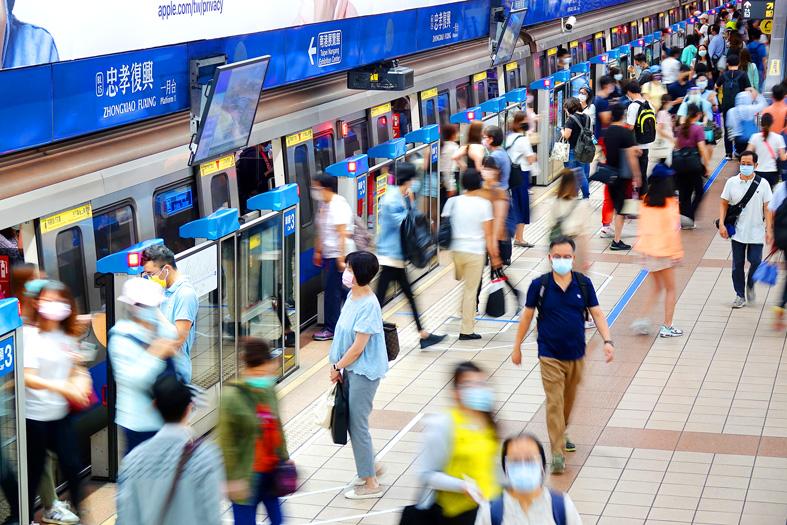
Photo: CNA
Designated street dance areas in MRT stations and MRT malls would be divided into segments to help people maintain social distance, the operator said.
Users of the areas would only be allowed to take off their masks while dancing, it said, adding that they would be required to scan a contact tracing QR code before entering.
Water fountains and some facilities for charging mobile devices inside stations would be reopened, with a limit of one user per charging station to avoid crowding, it said.
The Taipei Children’s Amusement Park, which is run by the MRT firm, would operate at a capacity of 16,000 people, it said.
The firm has added a “crowd traffic light” system to the park’s Web site, which would flash “orange” when the facility has 9,600 visitors, or 60 percent of capacity, and “red” when the crowd size limit has been reached, it said.
Visitors would have to scan the contact tracing QR code before entering, it said, urging visitors to comply with body temperature measurement and social distancing requirements.
Visitors would only be allowed to take off their masks when eating, drinking or taking a picture, it added.
The Taipei Arena Ice Land and the Taipei Metro Beitou Resort have removed their crowd size limits, but the resort would continue to operate on a reservation-only basis, the MRT operator said.
Visitors to the two sites would have to wear masks, except for when exercising, it added.

FUKUOKA SITUATION: Japanese media reported that the pathogen is expected to be identified by the summer, while the CDC downplayed the idea that it was hMPV A “mysterious cold-like illness” reported in Japan’s Fukuoka Prefecture does not seem to be a new disease, but Japanese authorities have been asked about the situation, the Centers for Disease Control (CDC) said yesterday. The Fukuoka Prefectural Medical Association on Wednesday told a news conference that a “mystery cold” that has become a hot topic on social media is “highly likely to be caused by some kind of viral infection,” Japan’s KBC News reported. “Many people are experiencing symptoms starting with a sore throat, followed by a runny nose, phlegm and a severe cough,” KBC News reported, citing association officials. Health authorities are

Nvidia Corp CEO Jensen Huang (黃仁勳) arrived in Taiwan yesterday ahead of upcoming AI and technology events, saying he plans to meet with clients and Taiwan Semiconductor Manufacturing Co Chairman C.C. Wei (魏哲家) during his visit. After landing at Taipei Songshan Airport, Huang posed for photos with fans and handed out Yakult drinks to reporters and supporters waiting at the scene, saying he has “a lot to do” during the trip. Asked about reports that Nvidia’s planned headquarters site in Taipei’s Beitou Shilin Technology Park could break ground on May 27, Huang said that if the company holds an event, he would

The Ministry of Finance this afternoon announced the winning numbers for the March-April uniform invoice lottery. The winning number for the NT$10 million (US$318,060) special prize is 19531471, and the winning number for the NT$2 million grand prize is 85941329. Three numbers were drawn for the NT$200,000 first prize: 07225810, 20231230 and 83518781. Those with receipts matching the last seven digits of any of the first-prize numbers will win the NT$40,000 second prize, while those matching the last six digits will win the NT$10,000 third prize. Those whose receipts match the last five digits of the first-prize numbers can claim the NT$4,000 fourth prize,
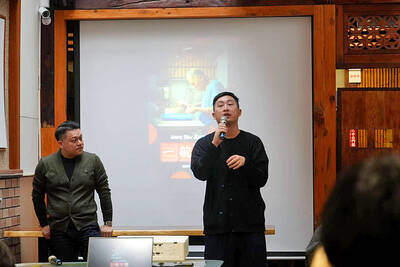
Taiwan Travelogue (臺灣漫遊錄), which earlier this week became the first Taiwanese novel to win the International Booker Prize, is to be adapted into a television series through a Taiwan-Japan coproduction, producer Chang Chen-yu (張辰漁) said yesterday. Chang, a producer at World Softest Production Film Co, wrote on Facebook that the company had been searching for projects with international appeal that retain a strong Taiwanese identity after colleagues and Japanese partners strongly recommended the novel. After reading the book, Chang said he immediately decided to pursue the screen rights. “A great story has the power to transcend time and borders, and connect countless people,”


 RSS
RSS