


A Ministry of National Defense initiative to obtain US-made Harpoon missiles is plagued by cost overruns, poor coordination with contractors and procedural irregularities, the Legislative Yuan’s Budget Center said.
In a report released this month, the center said the ministry made changes to the program without resubmitting a proposal to the Executive Yuan, adding that such incidents “call [the program’s] propriety into question.”
In October last year, the US approved the sale to Taiwan of 100 Harpoon Coastal Defense Systems, a package comprising launch vehicles, 400 missiles and other components.
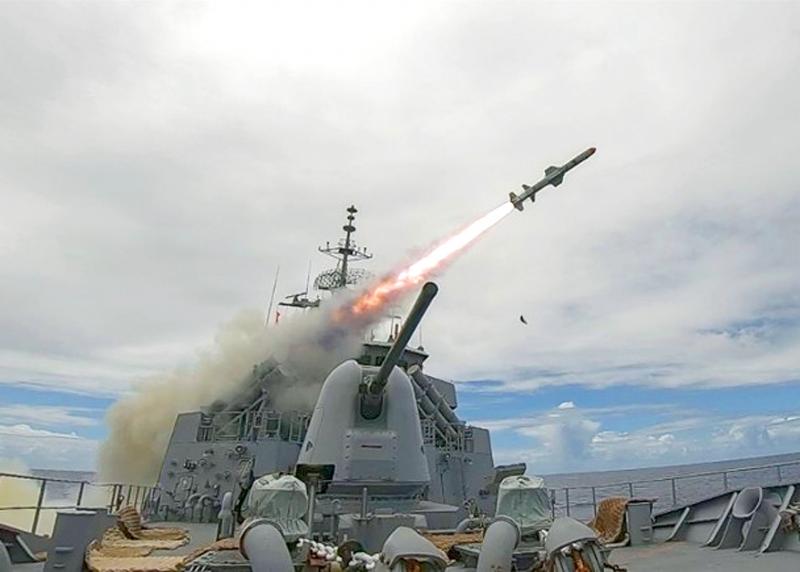
Screen grab from the US Pacific Fleet’s Facebook page
While the ministry planned to buy the equipment in separate batches from this year to 2025, it on Oct. 19 issued an update to the bid notice, saying that it intended to procure all of the systems, munitions and components in a single purchase, citing the rising military threat from China.
In separate documents submitted to the legislature in May and August, the ministry increased the program’s overall cost estimate from NT$52.3 billion (US$1.88 billion) to NT$86.6 billion, while the end date was moved from 2025 to 2030, it said.
The surge in estimated costs exceeded a 20 percent limit stipulated by regulations and should have triggered an automatic mechanism for the ministry to resubmit the program to the Cabinet, but it did not, it added.
Instead, the ministry gave the program to the Cabinet days before it was to submit the overall budget report, the report said.
Although the ministry claimed an urgent operational need for the missiles, its failure to make any plans to coordinate with defense contractors in Taiwan and the US over the deal could lead to the nation losing out on opportunities to obtain defense technologies, it said.
The center also highlighted the ministry’s failure to meet enlistment goals and added that some combat units are more than 20 percent understaffed while reporting a high ratio of volunteer soldiers who failed to meet standards.
As of August, Taiwan had 162,282 volunteer soldiers, which falls short of the 169,000 goal for the volunteer component of the military, the center said.
Since 2016, 2,588 troops were discharged from military service for failing to meet standards, which is 18.36 percent of all men and women who volunteer, it said.
Substantial ministry staff and funding had been consumed in connection to processing troops who were found to be unfit for service and compensating them where payouts are appropriate, it added.
The number of understaffed combat units and the high number of volunteers who left military service after being found to be unfit for service are concerning, it said.
The growth rate of the volunteer force has slowed annually from 5.88 percent in 2018 to 1.09 percent in the first eight months of this year, the report said.
The lukewarm growth of the all-volunteer military suggests that the government’s incentive package to encourage enlistment of career soldiers might not be working, it added.

The Centers for Disease Control (CDC) yesterday reported the first case of a new COVID-19 subvariant — BA.3.2 — in a 10-year-old Singaporean girl who had a fever upon arrival in Taiwan and tested positive for the disease. The girl left Taiwan on March 20 and the case did not have a direct impact on the local community, it said. The WHO added the BA.3.2 strain to its list of Variants Under Monitoring in December last year, but this was the first imported case of the COVID-19 variant in Taiwan, CDC Deputy Director-General Lin Ming-cheng (林明誠) said. The girl arrived in Taiwan on

South Korea is planning to revise its controversial electronic arrival card, a step Taiwanese officials said prompted them to hold off on planned retaliatory measures, a South Korean media report said yesterday. A Yonhap News Agency report said that the South Korean Ministry of Foreign Affairs is planning to remove the “previous departure place” and “next destination” fields from its e-arrival card system. The plan, reached after interagency consultations, is under review and aims to simplify entry procedures and align the electronic form with the paper version, a South Korean ministry official said. The fields — which appeared only on the electronic form

The Ministry of Foreign Affairs (MOFA) is suspending retaliation measures against South Korea that were set to take effect tomorrow, after Seoul said it is updating its e-arrival system, MOFA said today. The measures were to be a new round of retaliation after Taiwan on March 1 changed South Korea's designation on government-issued alien resident certificates held by South Korean nationals to "South Korea” from the "Republic of Korea," the country’s official name. The move came after months of protests to Seoul over its listing of Taiwan as "China (Taiwan)" in dropdown menus on its new online immigration entry system. MOFA last week

A bipartisan group of US senators has introduced a bill to enhance cooperation with Taiwan on drone development and to reduce reliance on supply chains linked to China. The proposed Blue Skies for Taiwan Act of 2026 was introduced by Republican US senators Ted Cruz and John Curtis, and Democratic US senators Jeff Merkley and Andy Kim. The legislation seeks to ease constraints on Taiwan-US cooperation in uncrewed aerial systems (UAS), including dependence on China-sourced components, limited access to capital and regulatory barriers under US export controls, a news release issued by Cruz on Wednesday said. The bill would establish a "Blue UAS


 RSS
RSS