

G20 nations “will pay a price” for backing Taiwan’s bid to participate in the UN, Chinese Minister of Foreign Affairs Wang Yi (王毅) said on Friday.
Wang’s comments came three days after US Secretary of State Anthony Blinken urged UN member states to support Taiwan’s “robust, meaningful participation throughout the UN system” at a news conference in Washington on Tuesday.
In a statement issued hours before Wang was to join a G20 leaders’ summit in Rome, he said that the US and its allies “could not stop the ‘one China’ principle 50 years ago, it is even more impossible in today’s world in the 21st century.”
“If they forge ahead regardless, they will definitely pay a price accordingly,” he added.
Wang reiterated Beijing’s “one China” principle, saying that there is only “one China” in the world, that the People’s Republic of China (PRC) is its legitimate government and that Taiwan is a part of China’s territory.
He said that the “one China” principle is a historical and legal fact that cannot be challenged, adding that 1.4 billion Chinese cannot be stopped in their pursuit of the “peaceful reunification” of Taiwan.
UN General Assembly Resolution 2758, which recognized the PRC as China’s representative in that international body, has established the legal precedent for Beijing’s claims and showed the consensus of the member states, he said.
The resolution does not mention the Republic of China or Taiwan, and does not state that the PRC represents Taiwan.
Meanwhile, Minister of Foreign Affairs Joseph Wu (吳釗燮), who has been on a diplomatic trip to Europe since last week, wrote on Twitter that he had a “rewarding meeting” with EU lawmakers.
The group discussed issues including a proposed bilateral investment agreement with Taiwan and the nation’s pursuit for inclusion in the UN, he said, adding: “Taiwan is not alone.”
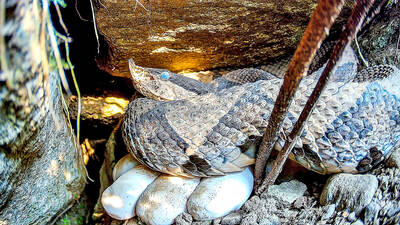
NATURE TAKES ITS COURSE: The agency’s head said he felt a sense of loss watching red-banded snakes eat the babies, as they had decided on non-intervention The Forestry and Nature Conservation Agency yesterday released a documentary on a hundred-pace viper that had incubated 16 eggs, all of which hatched, but only a baby viper escaped after they were attacked by red-banded snakes. The agency’s Taichung branch last year launched the viper reproduction monitoring project soon after forest rangers Lin Chun-yu (林俊佑) and Chou Chia-cheng (周家成) spotted a pregnant hundred-pace viper in a grass-covered burrow near a parking lot in Tbulan Village (松鶴部落). The Atayal village, in Taichung’s Heping District (和平), is headed by Ecyang Yapu, who was positive about the project and assisted in access control and power
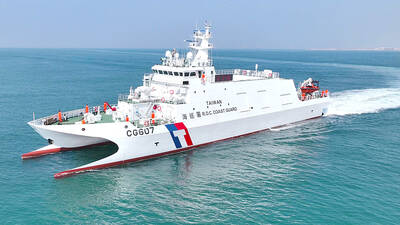
The Coast Guard Administration (CGA) yesterday said that it had deployed vessels to “monitor” Chinese ships operating in waters off the east coast. The CGA said it dispatched vessels in response to a China Coast Guard announcement that it had carried out another “routine law-enforcement patrol” in waters off the east coast. “The CGA firmly rejects China’s cognitive warfare campaign of ‘law enforcement in name, jurisdictional expansion in practice,’” it said on X. As of 11am yesterday, two China Coast Guard ships were “loitering and drifting” about 105 nautical miles (195km) and 74 nautical miles east of Green Island (綠島) respectively, it said. It
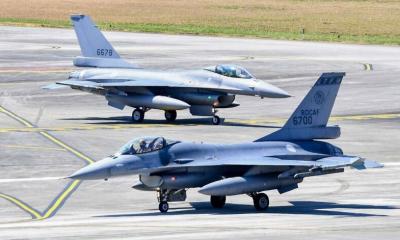
The first two F-16V Block 70 jets Taiwan purchased from the US were spotted unexpectedly turning back after departing from Hawaii yesterday, potentially further delaying delivery of the aircraft. Taiwan has purchased 66 of the F-16 C/D Block 70 jets to be deployed at Chihhang Air Base (志航基地) in Taitung County and operated by the air force's 7th Tactical Fighter Wing to defend Taiwan’s eastern region. Two single-seat jets, bearing serial No. 6727 and 6728, were spotted taking off from Hickam Field in Hawaii yesterday, observers said. Based on the precedent set during the delivery of Taiwan's older F-16 Block 20s, the new
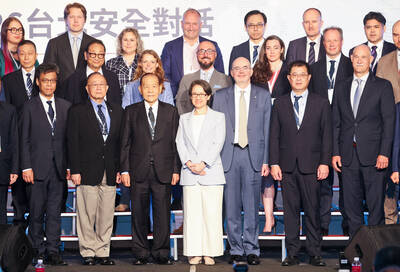
Taiwan’s growing defense preparations might be sending a stronger signal to the US than to Beijing, highlighting the need for Taipei to tailor its deterrence efforts to different audiences, a US security academic said yesterday. Stanford University Freeman Spogli Institute for International Studies fellow Oriana Skylar Mastro made the comment during a Taipei Security Dialogue panel examining lessons Taiwan could draw from the wars in Ukraine and the Middle East. Mastro said she was impressed by Taiwan’s increased defense spending, emphasis on asymmetric capabilities and efforts to prepare society for conflict, but questioned whom those initiatives were influencing. She said when she asked


 RSS
RSS