


Taiwan and Slovakia have much to gain from enhanced cooperation on trade, investment and industry, Minister of Foreign Affairs Joseph Wu (吳釗燮) said in Bratislava yesterday.
Wu made the remarks during a speech at a Taiwan Forum hosted by Slovak think tank GLOBSEC, the Ministry of Foreign Affairs said in a statement, adding that it was his second speech in Europe since his last one at the Copenhagen Democracy Summit in 2019.
“The conference aims to initiate and facilitate dialogue between government officials, experts and businesses from Taiwan and the wider V4 region on some of the most imminent threats central Europe is facing after the [COVID-19] pandemic,” the think tank said in a news release.
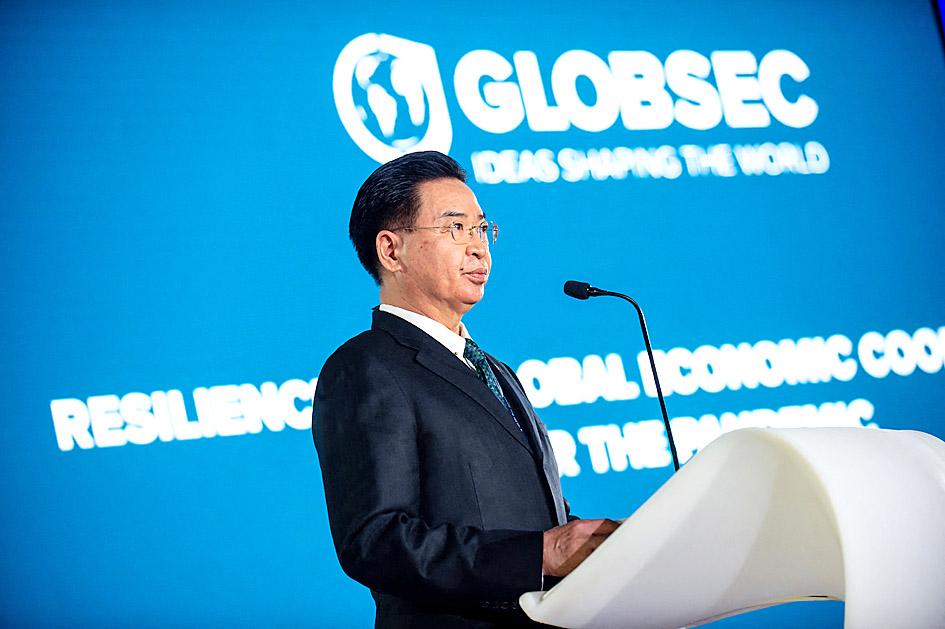
Photo: AFP
The V4, or Visegrad Group, is a cultural and political alliance of the four central European countries of the Czech Republic, Hungary, Poland and Slovakia.
The pandemic has brought Taiwan and Slovakia closer, Wu said, underscoring the two countries’ democratic transformations.
“The Nationalist government of the Republic of China relocated itself to Taiwan in 1949. For the past 72 years, the hardworking 23.5 million people transformed the institution, economy and our ways of life, from poverty to prosperity, from authoritarianism to democracy, and from uniformity to diversity,” he said.
Likewise,”the Velvet Revolution in 1989 showed the whole world that Slovaks and Czechs were equally eager to embrace democracy and freedom, and the world watched with admiration as the two peoples peacefully dissolved their country,” he said.
Wu thanked Slovakia for having donated 160,000 doses of the AstraZeneca COVID-19 vaccine to Taiwan, adding that the foreign affairs committee of Slovakia’s National Council this year also for the first time passed a motion backing Taiwan’s participation in the World Health Assembly.
“Throughout the outbreak, authoritarian states have continued to discredit democratic governments through disinformation campaigns, spreading rhetoric that democracy is an ineffective form of governance in the face of a major challenge like COVID,” he said.
“Hostile forces initiate aggressive disinformation campaigns, attempting to divide us and weaken our democracy from within. Cooperation and solidarity remain the keys to combating the pandemic and addressing many shared problems,” he added.
Wu announced that Slovakia next month would be cohosting a workshop on fighting disinformation and hybrid warfare under the Global Cooperation and Training Framework (GCTF) created by Taiwan and the US, after it first cohosted a GCTF workshop on post-pandemic recovery and labor issues last month.
The ministry’s Taiwan-Europe Connectivity Scholarship is to be extended to Slovak students interested in pursuing degrees in key industries, Wu added.
“Meanwhile, we are looking forward to receiving the Slovak vice-ministerial delegation in December. It is sure to break new ground in our bilateral relationship,” he said, referring to a delegation that might be led by Slovak Deputy Economy Minister Karol Galek.
“Now more than ever before, forces for good must stand as one and draw a line in the sand,” Wu said. “Liberty will not be sacrificed. Freedom will not be surrendered. And democracy will not be defeated.”
Taiwan and Slovakia have signed several agreements, including on preventing double taxation, exchange of drivers’ licenses, working holidays and economic cooperation, the ministry said.
Another 66-person Taiwanese delegation visiting Slovakia last week signed seven memorandums of understanding with Slovak public and private entities in areas such as electric cars, space technology, smart cities, business digitalization, tourism and science park cooperation.

FUKUOKA SITUATION: Japanese media reported that the pathogen is expected to be identified by the summer, while the CDC downplayed the idea that it was hMPV A “mysterious cold-like illness” reported in Japan’s Fukuoka Prefecture does not seem to be a new disease, but Japanese authorities have been asked about the situation, the Centers for Disease Control (CDC) said yesterday. The Fukuoka Prefectural Medical Association on Wednesday told a news conference that a “mystery cold” that has become a hot topic on social media is “highly likely to be caused by some kind of viral infection,” Japan’s KBC News reported. “Many people are experiencing symptoms starting with a sore throat, followed by a runny nose, phlegm and a severe cough,” KBC News reported, citing association officials. Health authorities are

Nvidia Corp CEO Jensen Huang (黃仁勳) arrived in Taiwan yesterday ahead of upcoming AI and technology events, saying he plans to meet with clients and Taiwan Semiconductor Manufacturing Co Chairman C.C. Wei (魏哲家) during his visit. After landing at Taipei Songshan Airport, Huang posed for photos with fans and handed out Yakult drinks to reporters and supporters waiting at the scene, saying he has “a lot to do” during the trip. Asked about reports that Nvidia’s planned headquarters site in Taipei’s Beitou Shilin Technology Park could break ground on May 27, Huang said that if the company holds an event, he would

The Ministry of Finance this afternoon announced the winning numbers for the March-April uniform invoice lottery. The winning number for the NT$10 million (US$318,060) special prize is 19531471, and the winning number for the NT$2 million grand prize is 85941329. Three numbers were drawn for the NT$200,000 first prize: 07225810, 20231230 and 83518781. Those with receipts matching the last seven digits of any of the first-prize numbers will win the NT$40,000 second prize, while those matching the last six digits will win the NT$10,000 third prize. Those whose receipts match the last five digits of the first-prize numbers can claim the NT$4,000 fourth prize,
Taiwan Travelogue (臺灣漫遊錄), which earlier this week became the first Taiwanese novel to win the International Booker Prize, is to be adapted into a television series through a Taiwan-Japan coproduction, producer Chang Chen-yu (張辰漁) said yesterday. Chang, a producer at World Softest Production Film Co, wrote on Facebook that the company had been searching for projects with international appeal that retain a strong Taiwanese identity after colleagues and Japanese partners strongly recommended the novel. After reading the book, Chang said he immediately decided to pursue the screen rights. “A great story has the power to transcend time and borders, and connect countless people,”


 RSS
RSS