


Democratic Progressive Party Legislator Kao Chia-yu (高嘉瑜) and independent Kaohsiung City Councilor Huang Jie (黃捷) yesterday called for more severe punishment for people convicted of producing “deepfake” pornographic videos.
Kao and Huang are two of the victims in an ongoing investigation into a “deepfake video” case, in which YouTuber Chu Yu-chen (朱玉宸), 26, also known as Xiaoyu (小玉), was last week listed as a suspect for allegedly using deepfake technology to create and sell sexual videos featuring the likenesses of female politicians, online influencers and celebrities.
Deepfake pornography is made by superimposing facial images of people onto existing pornographic videos using deep learning technology, a type of artificial intelligence.

Photo: Peter Lo, Taipei Times
“This is a very serious case of producing porn videos for profit and promoting sexual violence against women in the digital landscape. This could also undermine national security,” Kao told a news conference at the Legislative Yuan.
She denounced Chu’s action, who, along with two other suspects, allegedly made about NT$11 million (US$394,605) from selling deepfake videos.
“Public figures should not be humiliated in such ways,” Huang said.
“While viewing it, I got very angry at first, then felt very disgusted, and nauseated, and almost threw up,” she said. “It is a sexual assault on women. We hope all victims will have courage to sue the offenders and punish them through the courts.”
Lawmakers must amend related laws to stop deepfake videos, as they could become tools for revenge porn, she said.
“It could undermine national security,” she added. “Taiwan is a democratic society, and malevolent forces could use deepfake technology to circulate fake videos during election campaigns to manipulate the vote.”
Kao and Huang said that Taiwanese lawmakers should learn from the US, South Korea and other countries and enact a “revenge porn act” that would mete out more severe punishments on producers of deepfake porn.
They also called on the Ministry of Justice and other government agencies to focus on the issue and come up with proposals to amend the law.
Ministry official Chi Chih-kuang (紀志光) told the news conference that the case was a reflection of the rapid developments in information technology and exposed how the expense of engaging in such crimes has fallen, further encouraging sexual violence and breaches of privacy rights.
The ministry is looking at regulations, examples and experiences from other countries relating to deepfake exploitation, and will hold discussions with professionals in the field to propose amendments as soon as possible, Chi said.
Additional reporting by Jason Pan and CNA
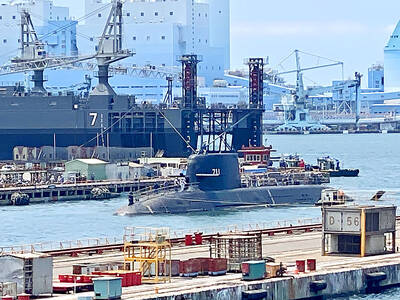
AGING: While Japan has 22 submarines, Taiwan only operates four, two of which were commissioned by the US in 1945 and 1946, and transferred to Taiwan in 1973 Taiwan would need at least 12 submarines to reach modern fleet capabilities, CSBC Corp, Taiwan chairman Chen Cheng-hung (陳政宏) said in an interview broadcast on Friday, citing a US assessment. CSBC is testing the nation’s first indigenous defense submarine, the Hai Kun (海鯤, Narwhal), which is scheduled to be delivered to the navy next month or in July. The Hai Kun has completed torpedo-firing tests and is scheduled to undergo overnight sea trials, Chen said on an SET TV military affairs program. Taiwan would require at least 12 submarines to establish a modern submarine force after assessing the nation’s operational environment and defense

A white king snake that frightened passengers and caused a stir on a Taipei MRT train on Friday evening has been claimed by its owner, who would be fined, Taipei Rapid Transit Corp (TRTC) said yesterday. A person on Threads posted that he thought he was lucky to find an empty row of seats on Friday after boarding a train on the Bannan (Blue) Line, only to spot a white snake with black stripes after sitting down. Startled, he jumped up, he wrote, describing the encounter as “terrifying.” “Taipei’s rat control plan: Release snakes on the metro,” one person wrote in reply, referring
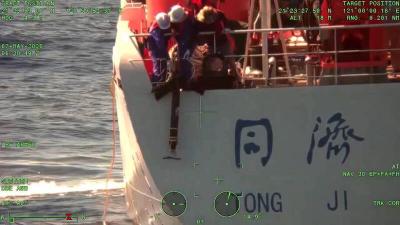
The coast guard today said that it had disrupted "illegal" operations by a Chinese research ship in waters close to the nation and driven it away, part of what Taipei sees a provocative pattern of China's stepped up maritime activities. The coast guard said that it on Thursday last week detected the Chinese ship Tongji (同濟號), which was commissioned only last year, 29 nautical miles (54km) southeast of the southern tip of Taiwan, although just outside restricted waters. The ship was observed lowering ropes into the water, suspected to be the deployment of scientific instruments for "illegal" survey operations, and the coast
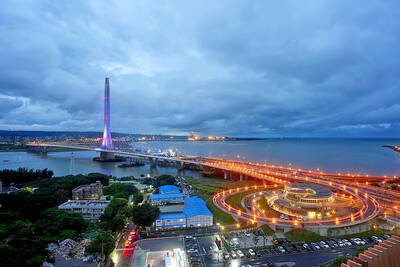
An inauguration ceremony was held yesterday for the Danjiang Bridge, the world’s longest single-mast asymmetric cable-stayed bridge, ahead of its official opening to traffic on Tuesday, marking a major milestone after nearly three decades of planning and construction. At the ceremony in New Taipei City attended by President William Lai (賴清德), Premier Cho Jung-tai (卓榮泰), Minister of Transportation and Communications Chen Shih-kai (陳世凱) and New Taipei City Mayor Hou Yu-ih (侯友宜), the bridge was hailed as both an engineering landmark and a long-awaited regional transport link connecting Tamsui (淡水) and Bali (八里)


 RSS
RSS