


Breezy Blue, the Taiwan Railways Administration’s (TRA) tourism train, is to be launched on the South Link Line on Saturday.
The railway operator spent about 10 months restoring the blue diesel-powered train, which first provided service to students and commuters before being outsourced to Lion Travel, which organizes railway tour packages.
TRA Director-General Du Wei (杜微) told reporters on the sidelines of a ceremony in Pingtung County’s Fangliao Township (枋寮) that the agency hopes that the restored Breezy Blue would provide an authentic experience to railway fans as well as those with fond memories of riding the blue trains to work or school.
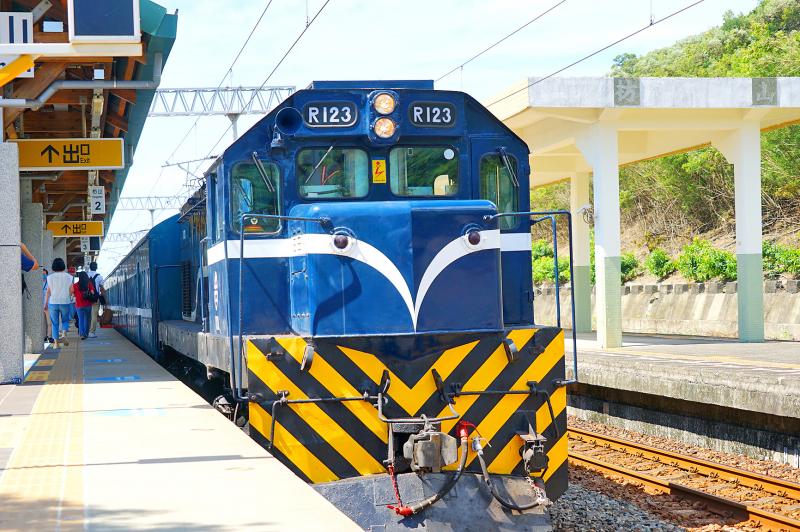
Photo: Chen Yen-ting, Taipei Times
“The restored blue train is the only train service in the country that allows passengers to open train windows and is equipped with electric fans. When the train passes through a tunnel, one can catch the light smell of diesel fuel in the air. You cannot have such an experience if you take the high-speed rail or light rails,” Du said, responding to criticisms of the service.
The Breezy Blue tourism train service is to be launched on the South Link Line because it is known as the “scenic railway,” he added.
Certain railway stations on the line are also gateways to other tourist attractions, he said.
“The railway station in Fangshan (枋山) provides access to a little known spot with a better view of the sea, while the station in Jinlun (金崙) gives access to a hot spring town,” he said.
The agency recruited experts on railway culture and aesthetics to restore the train, which is why so much time has passed before the launch, Du said.
Lion Travel managing director Andy Huang (黃信川) said that as of last week, 3,000 people had reserved seats on Breezy Blue tours.
About 80 percent of the reservations are for multiple-day tours, while the remaining reservations are for a train ticket and a guided tour, he said.
The tour guides are to wear khaki pants, which boys used to wear as part of their school uniform, he said.
Breezy Blue tours are likely to significantly boost hotel occupancy rates in Pingtung and Taitung counties, and drive growth in the tourism industry, Huang said.
“We have shown videos of the ... Breezy Blue train to Taiwanese living in the US, and they told us that they want to return and take the trains as soon as the COVID-19 pandemic shows signs of easing,” he said.
National Kaohsiung University of Hospitality and Tourism instructor Su Chao-hsu (蘇昭旭) said that Breezy Blue’s launch is significant, as the nation is to celebrate the 30th anniversary of the South Link Line at the end of this year.
It symbolizes that the nation is entering a new era of railway service, he added.
Su recommended that the TRA transform the Breezy Blue tours into a sustainable business.
“People in their 50s and 60s might enjoy sweating a lot on the blue-colored train, because that is a memory they share, but younger passengers who are used to trains with air-conditioning might not enjoy the experience, especially when temperatures in southern Taiwan can reach 37°C or higher,” he said.
“The TRA has blue-colored carriages equipped with air-conditioning and it should use them in the summer,” Su said.
Besides the South Link Line, the agency should offer the Breezy Blue tours on other scenic routes, Su said.
“In addition to guided tours, the tourism train service should offer more refined services so that travelers think the trip is worth every penny they spend,” he added.

Considering that most countries issue more than five denominations of banknotes, the central bank has decided to redesign all five denominations, the bank said as it prepares for the first major overhaul of the banknotes in more than 24 years. Central bank Governor Yang Chin-lung (楊金龍) is expected to report to the Legislative Yuan today on the bank’s operations and the redesign’s progress. The bank in a report sent to the legislature ahead of today’s meeting said it had commissioned a survey on the public’s preferences. Survey results showed that NT$100 and NT$1,000 banknotes are the most commonly used, while NT$200 and NT$2,000

The Centers for Disease Control (CDC) yesterday reported the first case of a new COVID-19 subvariant — BA.3.2 — in a 10-year-old Singaporean girl who had a fever upon arrival in Taiwan and tested positive for the disease. The girl left Taiwan on March 20 and the case did not have a direct impact on the local community, it said. The WHO added the BA.3.2 strain to its list of Variants Under Monitoring in December last year, but this was the first imported case of the COVID-19 variant in Taiwan, CDC Deputy Director-General Lin Ming-cheng (林明誠) said. The girl arrived in Taiwan on

South Korea is planning to revise its controversial electronic arrival card, a step Taiwanese officials said prompted them to hold off on planned retaliatory measures, a South Korean media report said yesterday. A Yonhap News Agency report said that the South Korean Ministry of Foreign Affairs is planning to remove the “previous departure place” and “next destination” fields from its e-arrival card system. The plan, reached after interagency consultations, is under review and aims to simplify entry procedures and align the electronic form with the paper version, a South Korean ministry official said. The fields — which appeared only on the electronic form

The Ministry of Foreign Affairs (MOFA) is suspending retaliation measures against South Korea that were set to take effect tomorrow, after Seoul said it is updating its e-arrival system, MOFA said today. The measures were to be a new round of retaliation after Taiwan on March 1 changed South Korea's designation on government-issued alien resident certificates held by South Korean nationals to "South Korea” from the "Republic of Korea," the country’s official name. The move came after months of protests to Seoul over its listing of Taiwan as "China (Taiwan)" in dropdown menus on its new online immigration entry system. MOFA last week


 RSS
RSS