


Taiwan Statebuilding Party Legislator Chen Po-wei’s (陳柏惟) bid to avoid being recalled yesterday received a boost from medical professionals led by former Democratic Progressive Party legislator Lin Ching-yi (林靜儀).
“We have collected more than 100 signatures from medical professionals who endorse Chen,” said Lin, a gynecologist.
“Most of them are based in Taichung or central Taiwan, while some are from other regions,” she said.
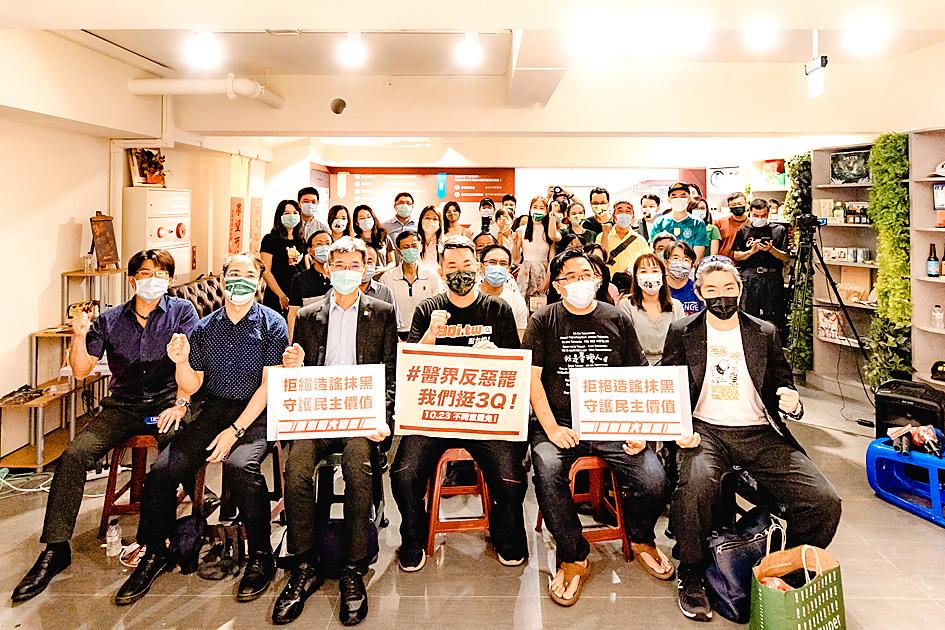
Photo courtesy of Chen Po-wei’s service center via CNA
The vote to recall Chen from his constituency — Taichung’s second electoral district — is to be held on Oct. 23.
People at yesterday’s event in the city’s Wurih District (烏日) held signs with slogans such as: “We oppose the revenge recall and support 3Q,” a nickname for Chen.
Other signs read: “Reject vilification — defend values of democracy.”
Lin said that the Chinese Nationalist Party (KMT) is attempting to “assassinate Chen’s character.”
“The KMT has distorted the facts and is circulating misinformation to portray Chen as a bad person, painting a highly negative image to mislead voters,” she said.
“The KMT’s smear campaign has perverted the politics of our democratic society,” she said.
Chen is an earnest and hardworking legislator with a 100 percent attendance record at legislative sessions and committee meetings, Lin said, adding that his office has handled more than 2,300 requests from members of the public over the past two years.
Chen broke down in tears while speaking at the event.
Chien Chen-yu (錢震宇) — a spokesman for Sean Lien (連勝文), who is vice chairman of the KMT-affiliated National Policy Foundation — on Friday accused Chen of financial impropriety.
Chen owns a property in Kaohsiung and there has been a “big surge” in his savings, which have increased to NT$4.41 million (US$157,242) over the past year, Chien said.
Chen said that most of his savings come from election subsidies, which are paid to legislative candidates who garner a certain share of the votes in their district, as well as from a former job in the movie production sector.
“I am in my mid-30s. Having this much savings and owning property is not unusual at my age,” he said.

FUKUOKA SITUATION: Japanese media reported that the pathogen is expected to be identified by the summer, while the CDC downplayed the idea that it was hMPV A “mysterious cold-like illness” reported in Japan’s Fukuoka Prefecture does not seem to be a new disease, but Japanese authorities have been asked about the situation, the Centers for Disease Control (CDC) said yesterday. The Fukuoka Prefectural Medical Association on Wednesday told a news conference that a “mystery cold” that has become a hot topic on social media is “highly likely to be caused by some kind of viral infection,” Japan’s KBC News reported. “Many people are experiencing symptoms starting with a sore throat, followed by a runny nose, phlegm and a severe cough,” KBC News reported, citing association officials. Health authorities are

Nvidia Corp CEO Jensen Huang (黃仁勳) arrived in Taiwan yesterday ahead of upcoming AI and technology events, saying he plans to meet with clients and Taiwan Semiconductor Manufacturing Co Chairman C.C. Wei (魏哲家) during his visit. After landing at Taipei Songshan Airport, Huang posed for photos with fans and handed out Yakult drinks to reporters and supporters waiting at the scene, saying he has “a lot to do” during the trip. Asked about reports that Nvidia’s planned headquarters site in Taipei’s Beitou Shilin Technology Park could break ground on May 27, Huang said that if the company holds an event, he would

The Ministry of Finance this afternoon announced the winning numbers for the March-April uniform invoice lottery. The winning number for the NT$10 million (US$318,060) special prize is 19531471, and the winning number for the NT$2 million grand prize is 85941329. Three numbers were drawn for the NT$200,000 first prize: 07225810, 20231230 and 83518781. Those with receipts matching the last seven digits of any of the first-prize numbers will win the NT$40,000 second prize, while those matching the last six digits will win the NT$10,000 third prize. Those whose receipts match the last five digits of the first-prize numbers can claim the NT$4,000 fourth prize,
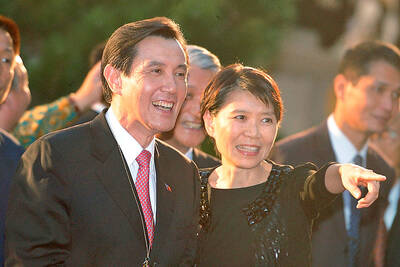
Former president Ma Ying-jeou (馬英九) yesterday expressed “shock and regret” over a statement issued by his wife without his consent, and rejected her assertion that his eldest sister, Ma Yi-nan (馬以南), would manage his medical care or act as his spokesperson amid an ongoing embezzlement probe into his foundation. Ma Ying-jeou in a statement said he was shocked by a statement by his wife, Chou Mei-ching (周美青), regarding his affairs. Ma Yi-nan “must not” be in charge of his healthcare and other personal affairs, nor can she be allowed to represent the Ma family, the former president said. He said he was also


 RSS
RSS