


A poll conducted by the New Power Party (NPP) showed that a majority of respondents want authorities to crack down on Chinese investment in Taiwan’s science parks and ports, the party said yesterday.
Chinese investment in science parks and port areas is viewed as a national security concern, the NPP told a media briefing in Taipei.
Asked whether authorities should reopen investigations into Science Park Logistics — a Taiwanese company that came under majority Chinese ownership — 52.9 percent strongly agreed and 23.8 percent moderately agreed, the NPP said.
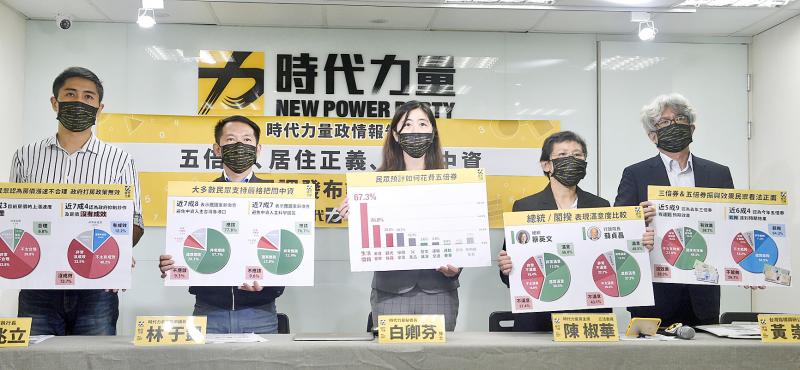
Photo: George Tsorng, Taipei Times
Only 6.6 percent disagreed and 3 percent strongly disagreed, it said, adding that 13.7 percent expressed no opinion.
On whether authorities should reopen investigations into Chinese investments in Kaohsiung’s two major ports, 57.7 percent strongly agreed, 20.1 percent moderately agreed, 6.5 percent disagreed and 2.8 percent strongly disagreed, it said, adding that 12.9 percent expressed no opinion.
The survey also asked respondents to comment on surging real-estate prices throughout the COVID-19 pandemic. Asked whether the rise was reasonable, 82.6 percent said it was not, while only 6.8 percent said it was.
Asked whether government measures introduced at the end of last year to bring real-estate prices under control were effective, 73.7 said they were not, while 12.2 percent said they were.
Citing statistics from the Ministry of the Interior, NPP think tank executive director Lee Chao-li (李兆立) said housing prices in five of the country’s six special municipalities had reached record highs over the past year.
The majority of those expressing discontent over current housing prices were aged 20 to 49, with 90 percent in the 30 to 39 age group, he said.
While the majority who expressed discontent with the real-estate market said that Taipei and New Taipei City would be their target markets, 88 percent of respondents living in Yunlin, Chiayi and Nantou counties also expressed discontent, he said.
“Even among Democratic Progressive Party [DPP] supporters, we saw about 80 percent express concerns about housing prices, and 63 percent said government measures were ineffective,” Lee said.
The DPP had not listened to the NPP’s suggestion of increasing housing taxes for those with multiple properties, which would likely have helped curb prices, NPP Chairwoman Chen Jiau-hua (陳椒華) said.
The survey also asked respondents how satisfied they were with the performance of President Tsai Ing-wen (蔡英文) and Premier Su Tseng-chang (蘇貞昌).
The poll showed that 56 percent were satisfied with Tsai’s performance and 37.4 percent were dissatisfied, while 49.5 percent were satisfied with Su and 43.1 percent dissatisfied.
“The DPP was not transparent enough with their response measures to the COVID-19 pandemic, which made the public lose confidence,” Chen said. “For example, there were no meeting records related to the reduced quarantine policy for airline crew that led to the COVID-19 outbreak in May.”
The poll also showed that 42 percent thought the Cabinet’s latest COVID-19 bailout plan had been effective, with 40.4 percent disagreeing.
However, 64.3 percent of respondents believed that the upcoming NT$5,000 stimulus voucher program, set to start on Friday, would produce the desired results.
Meanwhile, 69.9 percent said they would opt for physical vouchers, while 22.3 percent expressed a preference for digital vouchers.
The poll also showed 67.3 percent said they would use the vouchers to cover living expenses, while 26.8 percent and 20 percent indicated they would spend the vouchers on food-and-beverage items or tourist accommodation services respectively.
The survey was conducted from Sept. 23 to Wednesday, and collected 1,069 valid telephone samples from across Taiwan, with a margin of error of 3 percentage points.
Additional reporting by CNA

The Centers for Disease Control (CDC) yesterday reported the first case of a new COVID-19 subvariant — BA.3.2 — in a 10-year-old Singaporean girl who had a fever upon arrival in Taiwan and tested positive for the disease. The girl left Taiwan on March 20 and the case did not have a direct impact on the local community, it said. The WHO added the BA.3.2 strain to its list of Variants Under Monitoring in December last year, but this was the first imported case of the COVID-19 variant in Taiwan, CDC Deputy Director-General Lin Ming-cheng (林明誠) said. The girl arrived in Taiwan on

South Korea is planning to revise its controversial electronic arrival card, a step Taiwanese officials said prompted them to hold off on planned retaliatory measures, a South Korean media report said yesterday. A Yonhap News Agency report said that the South Korean Ministry of Foreign Affairs is planning to remove the “previous departure place” and “next destination” fields from its e-arrival card system. The plan, reached after interagency consultations, is under review and aims to simplify entry procedures and align the electronic form with the paper version, a South Korean ministry official said. The fields — which appeared only on the electronic form

The Ministry of Foreign Affairs (MOFA) is suspending retaliation measures against South Korea that were set to take effect tomorrow, after Seoul said it is updating its e-arrival system, MOFA said today. The measures were to be a new round of retaliation after Taiwan on March 1 changed South Korea's designation on government-issued alien resident certificates held by South Korean nationals to "South Korea” from the "Republic of Korea," the country’s official name. The move came after months of protests to Seoul over its listing of Taiwan as "China (Taiwan)" in dropdown menus on its new online immigration entry system. MOFA last week
A bipartisan group of US senators has introduced a bill to enhance cooperation with Taiwan on drone development and to reduce reliance on supply chains linked to China. The proposed Blue Skies for Taiwan Act of 2026 was introduced by Republican US senators Ted Cruz and John Curtis, and Democratic US senators Jeff Merkley and Andy Kim. The legislation seeks to ease constraints on Taiwan-US cooperation in uncrewed aerial systems (UAS), including dependence on China-sourced components, limited access to capital and regulatory barriers under US export controls, a news release issued by Cruz on Wednesday said. The bill would establish a "Blue UAS


 RSS
RSS