


Japanese support would go a long way toward helping Taiwan join the Comprehensive and Progressive Agreement for Trans-Pacific Partnership (CPTPP), the Ministry of Foreign Affairs said yesterday in an appeal to the incoming administration in Tokyo.
Former Japanese minister of foreign affairs Fumio Kishida, 64, won the leadership election of the ruling Liberal Democratic Party (LDP) early on Wednesday in the second round of voting, which positioned him to take over the reins of the country from Prime Minister Yoshihide Suga early next month.
At an online news conference, Taiwan-Japan Relations Association Secretary-General Chou Shyue-yow (周學佑) extended his congratulations to Kishida.
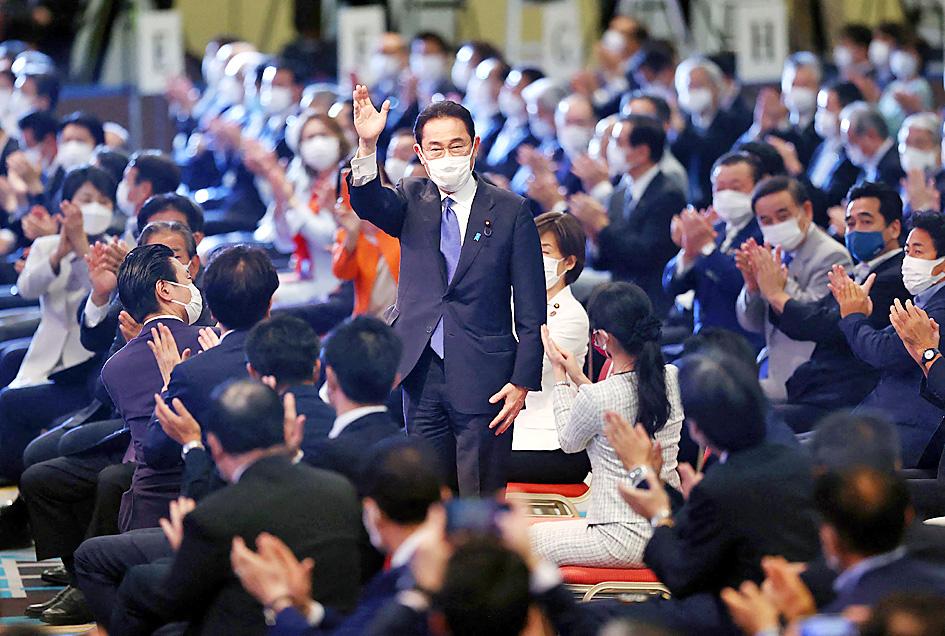
Photo: AFP
The outcome has raised hopes that Kishida would support Taiwan’s bid to join the CPTPP, given his vocal support for Taiwan during the campaign.
Taiwan and Japan both hold strategic positions in the Indo-Pacific region, Chou said.
As one of the most influential economies in the CPTPP, Japan could play an important role in helping Taiwan join the trade pact, he said, adding that Taipei looks forward to working with the new administration on deepening mutually beneficial ties through regional trade arrangements.
As for Taiwan’s continued ban on imports of food products from five Japanese prefectures affected by the 2011 nuclear power plant disaster, Chou reiterated the ministry’s position that it would respect the decision of food safety experts.
The ministry would continue to seek bilateral dialogue on the issue under the premise of ensuring food safety, and in accordance with international norms and data, he added.
In related news, Yuki Tatsumi, a Japanese academic at the Stimson Center think tank in Washington, on Wednesday said that Kishida is unlikely to soften his country’s foreign policy toward Beijing.
While Kishida has long been on the dovish side of the LDP with regard to China policy, he was at the forefront of a more hardline stance on a number of issues during his campaign for the party’s presidency, Tatsumi said during a Webinar titled “Warming Japan-Taiwan Ties: Implications for East Asia,” hosted by the Jamestown Foundation in Washington.
For example, Kishida has proposed appointing a special adviser to Japan’s prime minister on human rights issues in China, she said.
The hawkish stance is a major shift in Tokyo’s policy toward Beijing, and it signals consensus on the importance of Taiwan and the role Japan would play in the event of conflict across the Taiwan Strait, she said.
Japan’s cross-strait policy has changed amid concern over the Chinese military’s increasingly aggressive actions in the seas and air near Taiwan and Japan, and in the South China Sea, she said.
Against that backdrop, Japanese politicians, especially those in the LDP, have revised their stance toward Taipei and are considering further improvement of bilateral relations, she said.

The Centers for Disease Control (CDC) yesterday reported the first case of a new COVID-19 subvariant — BA.3.2 — in a 10-year-old Singaporean girl who had a fever upon arrival in Taiwan and tested positive for the disease. The girl left Taiwan on March 20 and the case did not have a direct impact on the local community, it said. The WHO added the BA.3.2 strain to its list of Variants Under Monitoring in December last year, but this was the first imported case of the COVID-19 variant in Taiwan, CDC Deputy Director-General Lin Ming-cheng (林明誠) said. The girl arrived in Taiwan on

South Korea is planning to revise its controversial electronic arrival card, a step Taiwanese officials said prompted them to hold off on planned retaliatory measures, a South Korean media report said yesterday. A Yonhap News Agency report said that the South Korean Ministry of Foreign Affairs is planning to remove the “previous departure place” and “next destination” fields from its e-arrival card system. The plan, reached after interagency consultations, is under review and aims to simplify entry procedures and align the electronic form with the paper version, a South Korean ministry official said. The fields — which appeared only on the electronic form

The Ministry of Foreign Affairs (MOFA) is suspending retaliation measures against South Korea that were set to take effect tomorrow, after Seoul said it is updating its e-arrival system, MOFA said today. The measures were to be a new round of retaliation after Taiwan on March 1 changed South Korea's designation on government-issued alien resident certificates held by South Korean nationals to "South Korea” from the "Republic of Korea," the country’s official name. The move came after months of protests to Seoul over its listing of Taiwan as "China (Taiwan)" in dropdown menus on its new online immigration entry system. MOFA last week
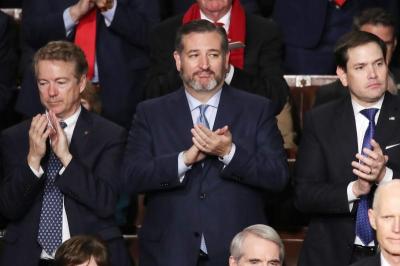
A bipartisan group of US senators has introduced a bill to enhance cooperation with Taiwan on drone development and to reduce reliance on supply chains linked to China. The proposed Blue Skies for Taiwan Act of 2026 was introduced by Republican US senators Ted Cruz and John Curtis, and Democratic US senators Jeff Merkley and Andy Kim. The legislation seeks to ease constraints on Taiwan-US cooperation in uncrewed aerial systems (UAS), including dependence on China-sourced components, limited access to capital and regulatory barriers under US export controls, a news release issued by Cruz on Wednesday said. The bill would establish a "Blue UAS


 RSS
RSS