


A research team at National Chung Hsing University has developed a substance inspired by frog skin to prevent biofouling on ships and offshore equipment.
By observing how frog skin prevented algae from growing, the team developed a material to stop microbes, barnacles and mussels from growing on ships, which not only make the vessels appear dirty, but can cause structural damage, said materials science and engineering associate professor Hsueh Han-yu (薛涵宇), who led the team.
The research is to be published next month in an issue of Advanced Functional Materials, with doctoral student Chen Ting-lun (陳亭綸) as the paper’s first author.
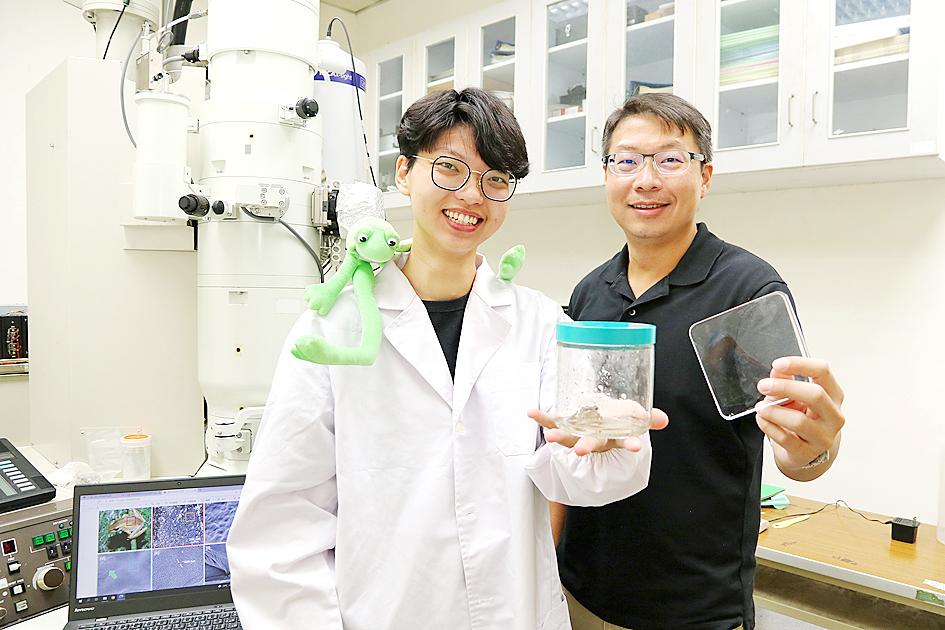
Photo: Su Meng-chuan, Taipei Times
If not regularly scraped off, barnacles and mussels can slow ships and increase fuel consumption, Hsueh said, adding that ships can carry barnacles, mussels and algae native to one region to other parts of the world, which could destabilize local ecosystems.
Some biofouling substances can damage precision electronic equipment if they seep inside a ship, he said.
The team came up with the biofilm after observing frogs endemic to Taiwan, he said.
Observing frog skin magnified 30,000 times, the team saw that there were dots and grooves on the skin that helped store a lubricant, which frogs secrete on their skin, he said.
The team determined that frogs were unaffected by algae or other biofouling substances in the water because of these microscopic orifices that store a lubricant that kept the substances off their skin, Hsueh said.
Using polymeric synthesis technology, the team created a film with microscopic wrinkles and injected silicone into tiny artificially created holes simulating the frogs’ skin, he said.
When tested with different kinds of algae in fresh water and seawater, the team found that the film offered effective, long-term prevention of biofouling substances adhering to it, Hsueh said.
With Taiwan’s humid, subtropical environment, freshwater lakes are prone to algae growth, he said.
The team would next seek to lower the cost of manufacturing the film to allow for mass production, he added.

The Centers for Disease Control (CDC) yesterday reported the first case of a new COVID-19 subvariant — BA.3.2 — in a 10-year-old Singaporean girl who had a fever upon arrival in Taiwan and tested positive for the disease. The girl left Taiwan on March 20 and the case did not have a direct impact on the local community, it said. The WHO added the BA.3.2 strain to its list of Variants Under Monitoring in December last year, but this was the first imported case of the COVID-19 variant in Taiwan, CDC Deputy Director-General Lin Ming-cheng (林明誠) said. The girl arrived in Taiwan on

South Korea is planning to revise its controversial electronic arrival card, a step Taiwanese officials said prompted them to hold off on planned retaliatory measures, a South Korean media report said yesterday. A Yonhap News Agency report said that the South Korean Ministry of Foreign Affairs is planning to remove the “previous departure place” and “next destination” fields from its e-arrival card system. The plan, reached after interagency consultations, is under review and aims to simplify entry procedures and align the electronic form with the paper version, a South Korean ministry official said. The fields — which appeared only on the electronic form

The Ministry of Foreign Affairs (MOFA) is suspending retaliation measures against South Korea that were set to take effect tomorrow, after Seoul said it is updating its e-arrival system, MOFA said today. The measures were to be a new round of retaliation after Taiwan on March 1 changed South Korea's designation on government-issued alien resident certificates held by South Korean nationals to "South Korea” from the "Republic of Korea," the country’s official name. The move came after months of protests to Seoul over its listing of Taiwan as "China (Taiwan)" in dropdown menus on its new online immigration entry system. MOFA last week

A bipartisan group of US senators has introduced a bill to enhance cooperation with Taiwan on drone development and to reduce reliance on supply chains linked to China. The proposed Blue Skies for Taiwan Act of 2026 was introduced by Republican US senators Ted Cruz and John Curtis, and Democratic US senators Jeff Merkley and Andy Kim. The legislation seeks to ease constraints on Taiwan-US cooperation in uncrewed aerial systems (UAS), including dependence on China-sourced components, limited access to capital and regulatory barriers under US export controls, a news release issued by Cruz on Wednesday said. The bill would establish a "Blue UAS


 RSS
RSS