


Senior Democratic Progressive Party (DPP) members gathered in Taipei yesterday to launch a book on the party’s early history.
The launch of photographer Chiu Wan-hsing’s (邱萬興) Taiwan’s Defiant Years: The Rise of the DPP 1986-1987 (台灣關鍵年代 : 民進黨的誕生 1986-1987) was part of a series of activities to mark the 35th anniversary of the party’s founding on Sept. 28, 1986, at the Grand Hotel Taipei.
“We must never forget the DPP’s original spirit and the party’s founding principles. Taiwanese have much expectation for the DPP, and we must remember this responsibility,” President Tsai Ing-wen (蔡英文), who is the DPP’s chairperson, said in her keynote address.
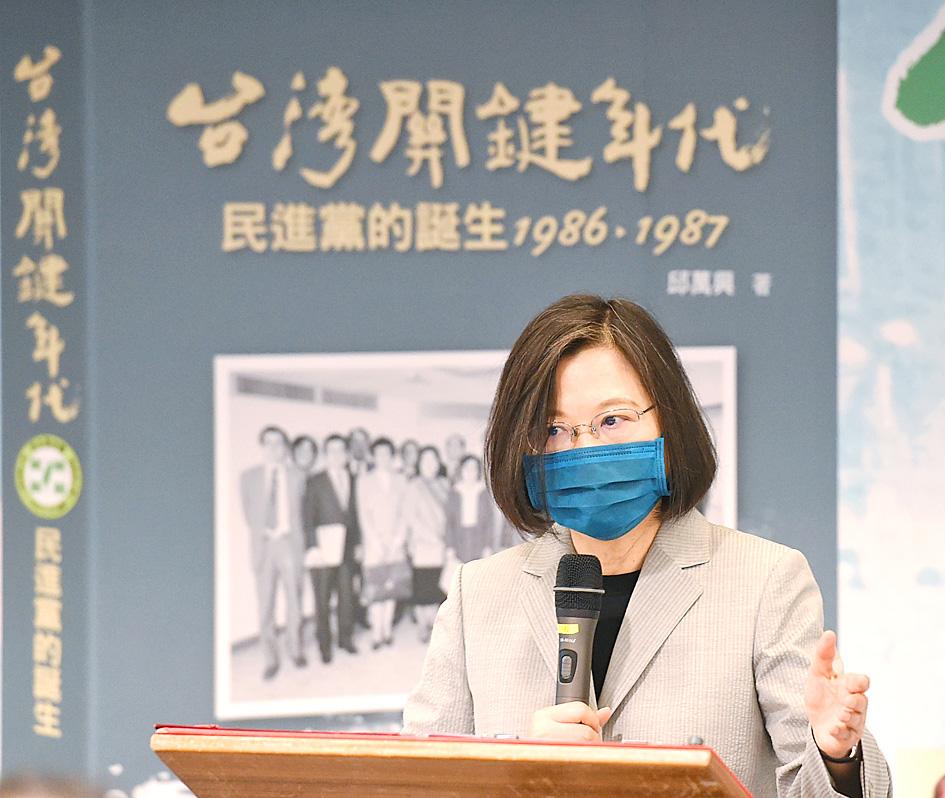
Photo: Fang Pin-chao, Taipei Times
Chiu has for years been associated with the DPP, donating many photographs, early DPP publications and election pamphlets to the party for the establishment of a museum celebrating the the DPP’s history.
Several DPP founding members attended the event, including Legislative Speaker You Si-kun (游錫堃), former Taipei county commissioner You Ching (尤清) and former DPP chairman Yao Chia-wen (姚嘉文).
Those who were present at the DPP’s founding event recalled the tense atmosphere as many feared that then-president Chiang Ching-kuo (蔣經國), who was also the Chinese Nationalist Party (KMT) chairman at the time, might order security forces to crack down on the newly founded party.
There were rumors that opposition leaders would be arrested, they said.
You Ching said that he made calls to foreign news organizations upon arriving home from the event.
It was urgent to announce the party’s founding to the world, he said, adding that it was crucial that foreign media reported the event.
In the party’s early days, DPP members lobbied foreign governments to support Taiwan’s push for democracy and recognize the atrocities committed by the KMT during the waning Martial Law era, he said.
The events led to then-Washington Post publisher Katharine Graham’s trip to Taiwan to interview Chiang on Oct. 6, 1986.
Chiang told Graham that the government would lift martial law and introduce reforms and policies to liberalize Taiwan, You Ching said.
In the interview, Chiang also said that any newly formed party would need to adhere to the Republic of China Constitution and contribute to countering the agenda of communist China, You Ching said.
The interview assured DPP members that “Chiang had come to accept the DPP’s existence,” he said.

The Centers for Disease Control (CDC) yesterday reported the first case of a new COVID-19 subvariant — BA.3.2 — in a 10-year-old Singaporean girl who had a fever upon arrival in Taiwan and tested positive for the disease. The girl left Taiwan on March 20 and the case did not have a direct impact on the local community, it said. The WHO added the BA.3.2 strain to its list of Variants Under Monitoring in December last year, but this was the first imported case of the COVID-19 variant in Taiwan, CDC Deputy Director-General Lin Ming-cheng (林明誠) said. The girl arrived in Taiwan on

South Korea is planning to revise its controversial electronic arrival card, a step Taiwanese officials said prompted them to hold off on planned retaliatory measures, a South Korean media report said yesterday. A Yonhap News Agency report said that the South Korean Ministry of Foreign Affairs is planning to remove the “previous departure place” and “next destination” fields from its e-arrival card system. The plan, reached after interagency consultations, is under review and aims to simplify entry procedures and align the electronic form with the paper version, a South Korean ministry official said. The fields — which appeared only on the electronic form

The Ministry of Foreign Affairs (MOFA) is suspending retaliation measures against South Korea that were set to take effect tomorrow, after Seoul said it is updating its e-arrival system, MOFA said today. The measures were to be a new round of retaliation after Taiwan on March 1 changed South Korea's designation on government-issued alien resident certificates held by South Korean nationals to "South Korea” from the "Republic of Korea," the country’s official name. The move came after months of protests to Seoul over its listing of Taiwan as "China (Taiwan)" in dropdown menus on its new online immigration entry system. MOFA last week

A bipartisan group of US senators has introduced a bill to enhance cooperation with Taiwan on drone development and to reduce reliance on supply chains linked to China. The proposed Blue Skies for Taiwan Act of 2026 was introduced by Republican US senators Ted Cruz and John Curtis, and Democratic US senators Jeff Merkley and Andy Kim. The legislation seeks to ease constraints on Taiwan-US cooperation in uncrewed aerial systems (UAS), including dependence on China-sourced components, limited access to capital and regulatory barriers under US export controls, a news release issued by Cruz on Wednesday said. The bill would establish a "Blue UAS


 RSS
RSS