


The government should prepare contingency plans for a possible Chinese ban on oranges from Taiwan, Democratic Progressive Party (DPP) Legislator Lai Hui-yuan (賴惠員) said yesterday.
Beijing on Monday suspended imports of custard apples and wax apples from Taiwan, citing mealybug infestations in shipments on “multiple occasions” this year.
Lai, who represents Tainan, a major fruit-growing area, said that the Council of Agriculture and Tainan Mayor Huang Wei-che (黃偉哲) must start planning a response to such a ban and not wait until after one has already happened.
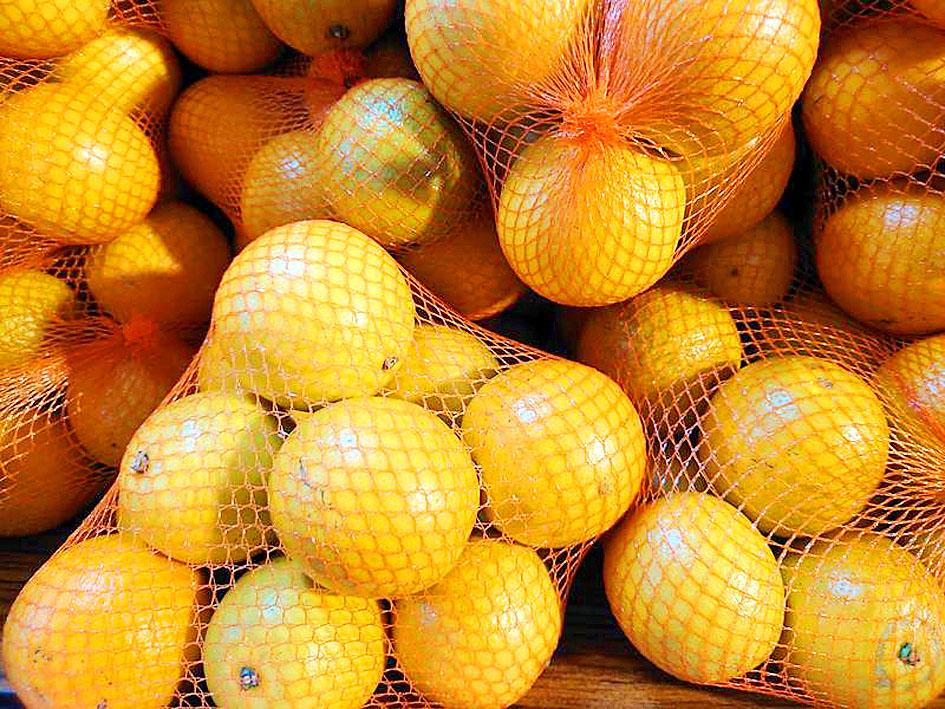
Photo: Taipei Times file
More restrictions by China would hurt Tainan growers, who are already suffering from the effects of water shortages this year, she said.
The mayor should help growers find alternative buyers to diversify the export market, she said.
China’s actions might put more than citrus growers at risk and the council should start a comprehensive review of produce that might be threatened this year, she said.
Tainan is the nation’s biggest orange-producing region, with 1,764 hectares in Dongshan (東山), Baihe (白河) and Lioujia (六甲) districts producing 60,000 tonnes of the fruit per year, she said.
China accounts for 95 percent of Tainan’s orange exports, or 0.5 percent of the overall yield, Lai said.
The special municipality is also the third-biggest producer of ponkans, with 902 hectares in Dongshan and Baihe yielding 27,233 tonnes of the citrus fruit per year, she said.
Tainan’s specialty ponkan, the green-skinned honey orange, is mainly cultivated for the domestic market, but it has been hit hard by the water shortages, she said.
Beijing’s announcement on Sunday of the ban was the second time this year that China has suspended imports of fruits from Taiwan.
In February, China banned imports of pineapples from Taiwan, citing “harmful creatures” that could arrive with the fruit.
Taiwan had said there was nothing wrong with the pineapples and accused Beijing of playing politics.
Additional reporting by Reuters

Considering that most countries issue more than five denominations of banknotes, the central bank has decided to redesign all five denominations, the bank said as it prepares for the first major overhaul of the banknotes in more than 24 years. Central bank Governor Yang Chin-lung (楊金龍) is expected to report to the Legislative Yuan today on the bank’s operations and the redesign’s progress. The bank in a report sent to the legislature ahead of today’s meeting said it had commissioned a survey on the public’s preferences. Survey results showed that NT$100 and NT$1,000 banknotes are the most commonly used, while NT$200 and NT$2,000

The Centers for Disease Control (CDC) yesterday reported the first case of a new COVID-19 subvariant — BA.3.2 — in a 10-year-old Singaporean girl who had a fever upon arrival in Taiwan and tested positive for the disease. The girl left Taiwan on March 20 and the case did not have a direct impact on the local community, it said. The WHO added the BA.3.2 strain to its list of Variants Under Monitoring in December last year, but this was the first imported case of the COVID-19 variant in Taiwan, CDC Deputy Director-General Lin Ming-cheng (林明誠) said. The girl arrived in Taiwan on

South Korea is planning to revise its controversial electronic arrival card, a step Taiwanese officials said prompted them to hold off on planned retaliatory measures, a South Korean media report said yesterday. A Yonhap News Agency report said that the South Korean Ministry of Foreign Affairs is planning to remove the “previous departure place” and “next destination” fields from its e-arrival card system. The plan, reached after interagency consultations, is under review and aims to simplify entry procedures and align the electronic form with the paper version, a South Korean ministry official said. The fields — which appeared only on the electronic form

The Ministry of Foreign Affairs (MOFA) is suspending retaliation measures against South Korea that were set to take effect tomorrow, after Seoul said it is updating its e-arrival system, MOFA said today. The measures were to be a new round of retaliation after Taiwan on March 1 changed South Korea's designation on government-issued alien resident certificates held by South Korean nationals to "South Korea” from the "Republic of Korea," the country’s official name. The move came after months of protests to Seoul over its listing of Taiwan as "China (Taiwan)" in dropdown menus on its new online immigration entry system. MOFA last week


 RSS
RSS