


Members of the Chunghwa Express Union yesterday held a protest in front of the Ministry of Transportation and Communications building, saying that the express delivery firm has not adjusted workers’ salaries for 17 years.
The express delivery firm is a subsidiary of state-run Chunghwa Post, which owns about 50 percent of its shares, with the other half held by private investors.
The protesters said they would not rule out going on strike at the end of this month if Chunghwa Express’ board refuses to approve a raise.
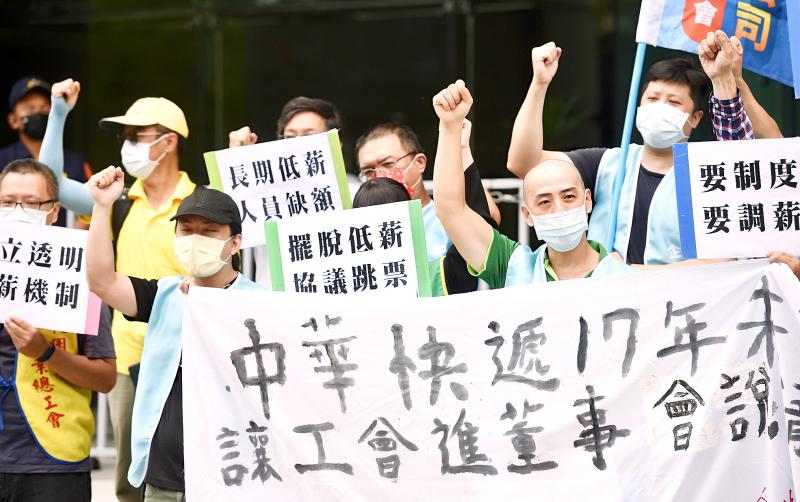
Photo: Peter Lo, Taipei Times
They also asked that union representatives be allowed to attend a board meeting that is to be held at the end of this month to discuss the pay raise proposal with board directors and supervisors.
Chunghwa Express’ financial statements showed that its net profit rose from NT$63 million (US$2.27 million at the current exchange rate) in 2017 to NT$75 million in 2019, the union said, adding that workers’ contributions to this impressive performance should not be ignored.
Directorate-General of Budget, Accounting and Statistics figures showed that the consumer price index rose from 86.3 in 2005 to 104.92 last month, the union said, adding that workers can no longer keep up with the rising cost of living.
Last year, the average monthly salary for workers in the transportation and warehousing industry was NT$55,097, it said, citing data from the ministry.
Meanwhile, the basic monthly salary for an entry-level Chunghwa Express employee was less than NT$25,000, the union said.
Adding full-attendance bonuses and overtime pay would only raise that figure to NT$26,000 a month, it said.
“How can a worker survive and raise a family with such a low salary?” the union asked.
Union members early this year voted to go on strike if management continues to disregard their requests for a wage hike.
Chunghwa Post holds a significant stake in Chunghwa Express and should quickly establish a salary-adjustment mechanism to retain experienced workers and maintain service quality, the union said.
“We are asking for a 5 percent raise for the company’s 200 ground-level workers. Such an adjustment would only lead to an annual increase in personnel costs of NT$3 million, which a company earning NT$75 million per year can easily absorb,” it said.
While the express delivery firm has argued that it added a meal subsidy of about NT$1,200 to NT$1,700 per month to workers’ salaries in 2015, the union said it was an incentive and should not be confused with a pay raise.
“We were told that all board directors and supervisors appointed by Chunghwa Post supported the union’s pay raise plan, but that its private investors opposed it,” the union said.
“We hope that private investors can understand the struggle that workers have been through over the years and approve the proposal at the upcoming board meeting,” it said.
“Board directors and supervisors appointed by the postal firm should actively persuade private investors to give workers a raise, rather than passing the buck,” the union said.

The Centers for Disease Control (CDC) yesterday reported the first case of a new COVID-19 subvariant — BA.3.2 — in a 10-year-old Singaporean girl who had a fever upon arrival in Taiwan and tested positive for the disease. The girl left Taiwan on March 20 and the case did not have a direct impact on the local community, it said. The WHO added the BA.3.2 strain to its list of Variants Under Monitoring in December last year, but this was the first imported case of the COVID-19 variant in Taiwan, CDC Deputy Director-General Lin Ming-cheng (林明誠) said. The girl arrived in Taiwan on

South Korea is planning to revise its controversial electronic arrival card, a step Taiwanese officials said prompted them to hold off on planned retaliatory measures, a South Korean media report said yesterday. A Yonhap News Agency report said that the South Korean Ministry of Foreign Affairs is planning to remove the “previous departure place” and “next destination” fields from its e-arrival card system. The plan, reached after interagency consultations, is under review and aims to simplify entry procedures and align the electronic form with the paper version, a South Korean ministry official said. The fields — which appeared only on the electronic form

The Ministry of Foreign Affairs (MOFA) is suspending retaliation measures against South Korea that were set to take effect tomorrow, after Seoul said it is updating its e-arrival system, MOFA said today. The measures were to be a new round of retaliation after Taiwan on March 1 changed South Korea's designation on government-issued alien resident certificates held by South Korean nationals to "South Korea” from the "Republic of Korea," the country’s official name. The move came after months of protests to Seoul over its listing of Taiwan as "China (Taiwan)" in dropdown menus on its new online immigration entry system. MOFA last week

A bipartisan group of US senators has introduced a bill to enhance cooperation with Taiwan on drone development and to reduce reliance on supply chains linked to China. The proposed Blue Skies for Taiwan Act of 2026 was introduced by Republican US senators Ted Cruz and John Curtis, and Democratic US senators Jeff Merkley and Andy Kim. The legislation seeks to ease constraints on Taiwan-US cooperation in uncrewed aerial systems (UAS), including dependence on China-sourced components, limited access to capital and regulatory barriers under US export controls, a news release issued by Cruz on Wednesday said. The bill would establish a "Blue UAS


 RSS
RSS