


US Secretary of State Antony Blinken on Monday reiterated Washington’s commitment to Taiwan during a congressional hearing on the US’ withdrawal from Afghanistan, amid concerns that Washington might not come to its ally’s defense in the event of a crisis.
During a US House of Representatives Committee on Foreign Affairs hearing, US Representative Brian Fitzpatrick told Blinken that US allies like Taiwan and Ukraine are scared Washington does not have their backs after witnessing US troops leaving Afghanistan, which led to the country’s takeover by the Taliban.
“I just returned from Ukraine two days ago, my next stop will be Taiwan,” Fitzpatrick said during the hearing. “These people are scared to death.”
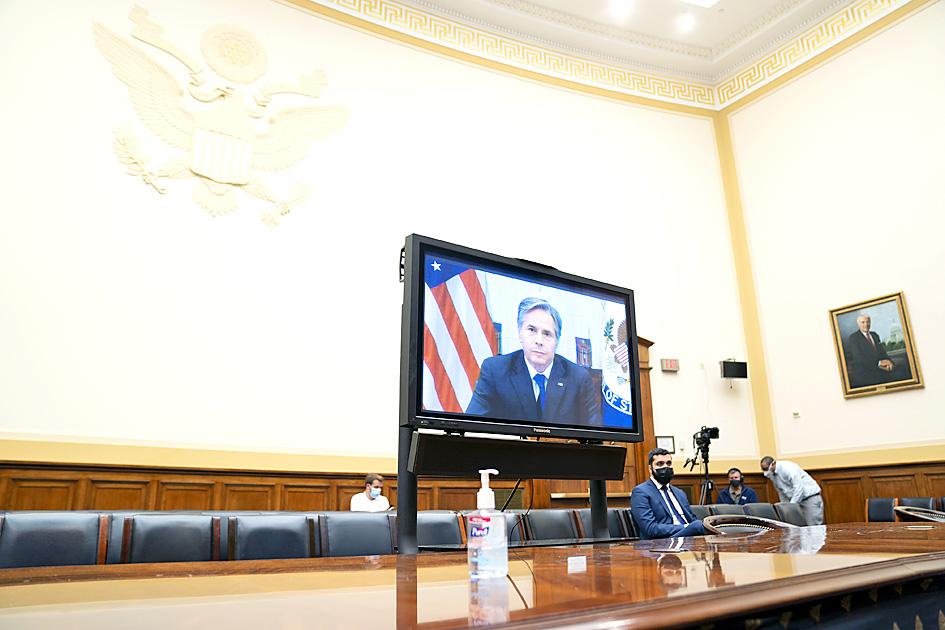
Photo: Bloomberg
Fitzpatrick asked Blinken if the US would “do whatever it takes” to support Ukraine and Taiwan from Russian and Chinese aggression respectively.
“Absolutely, we stand by our commitments to both countries,” Blinken said, citing discussions between US President Joe Biden and Ukrainian President Volodymyr Zelenskiy that he said reaffirmed those commitments.
Asked about Chinese state-run media’s ongoing attempts to draw parallels between the US’ relationship with Taiwan and Washington’s abandonment of Afghanistan, Blinken said that Beijing would love to see Washington stuck in Afghanistan for another decade.
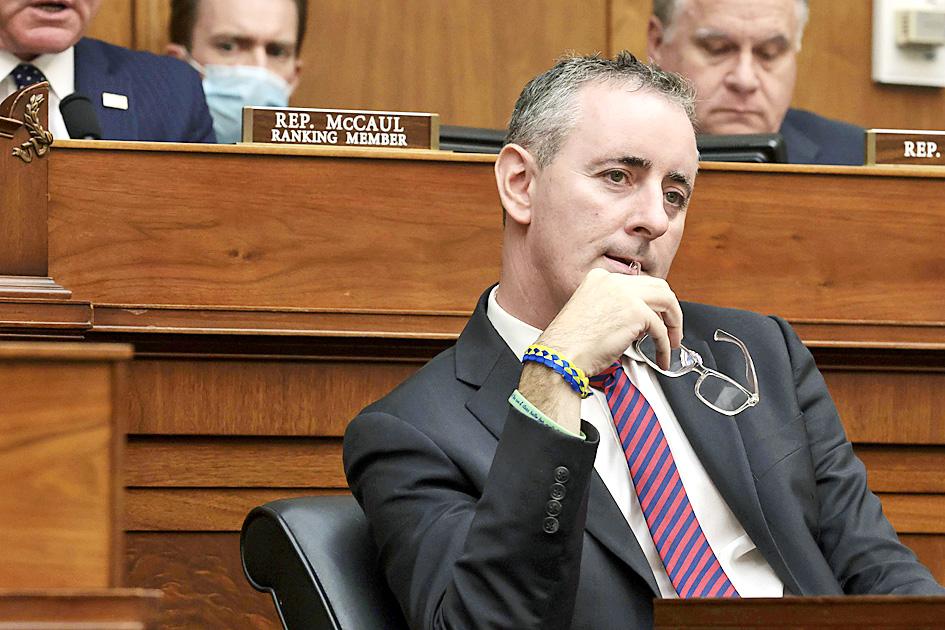
Photo: AFP
“As I said earlier, whatever protestations they may be making in newspapers or in their propaganda, there is nothing that China would have liked more than for us to re-up the war in Afghanistan and to remain bogged down for another five, 10 or 20 years,” Blinken told Fitzpatrick.
“That would have been profoundly against our strategic interests and profoundly in China’s strategic interests,” he added.
Blinken also defended Biden’s decision to pull out and pushed back on accusations that the US Department of State should have done more to evacuate Americans and at-risk Afghans, blaming the previous administration for lacking a plan.
He repeatedly said that it was the administration of former US president Donald Trump that had negotiated the withdrawal agreement with the Taliban.
Blinken added that the Biden administration could not renegotiate because of the group’s threats to resume killing Americans.

The Centers for Disease Control (CDC) yesterday reported the first case of a new COVID-19 subvariant — BA.3.2 — in a 10-year-old Singaporean girl who had a fever upon arrival in Taiwan and tested positive for the disease. The girl left Taiwan on March 20 and the case did not have a direct impact on the local community, it said. The WHO added the BA.3.2 strain to its list of Variants Under Monitoring in December last year, but this was the first imported case of the COVID-19 variant in Taiwan, CDC Deputy Director-General Lin Ming-cheng (林明誠) said. The girl arrived in Taiwan on

South Korea is planning to revise its controversial electronic arrival card, a step Taiwanese officials said prompted them to hold off on planned retaliatory measures, a South Korean media report said yesterday. A Yonhap News Agency report said that the South Korean Ministry of Foreign Affairs is planning to remove the “previous departure place” and “next destination” fields from its e-arrival card system. The plan, reached after interagency consultations, is under review and aims to simplify entry procedures and align the electronic form with the paper version, a South Korean ministry official said. The fields — which appeared only on the electronic form

The Ministry of Foreign Affairs (MOFA) is suspending retaliation measures against South Korea that were set to take effect tomorrow, after Seoul said it is updating its e-arrival system, MOFA said today. The measures were to be a new round of retaliation after Taiwan on March 1 changed South Korea's designation on government-issued alien resident certificates held by South Korean nationals to "South Korea” from the "Republic of Korea," the country’s official name. The move came after months of protests to Seoul over its listing of Taiwan as "China (Taiwan)" in dropdown menus on its new online immigration entry system. MOFA last week

A bipartisan group of US senators has introduced a bill to enhance cooperation with Taiwan on drone development and to reduce reliance on supply chains linked to China. The proposed Blue Skies for Taiwan Act of 2026 was introduced by Republican US senators Ted Cruz and John Curtis, and Democratic US senators Jeff Merkley and Andy Kim. The legislation seeks to ease constraints on Taiwan-US cooperation in uncrewed aerial systems (UAS), including dependence on China-sourced components, limited access to capital and regulatory barriers under US export controls, a news release issued by Cruz on Wednesday said. The bill would establish a "Blue UAS


 RSS
RSS