


A conservationist in Kinmen County is determined to save species of fish endemic to the islands, no matter the size.
Chen Kuang-yao (陳光耀), director of the Kinmen Wildlife Rehabilitation and Conservation Association, has dedicated himself to saving the many unique species that live in and around the outlying islands.
He has recently turned his sights to Metzia mesembrinum, a type of minnow, which Chen said is “nothing special,” but faces imminent extinction.
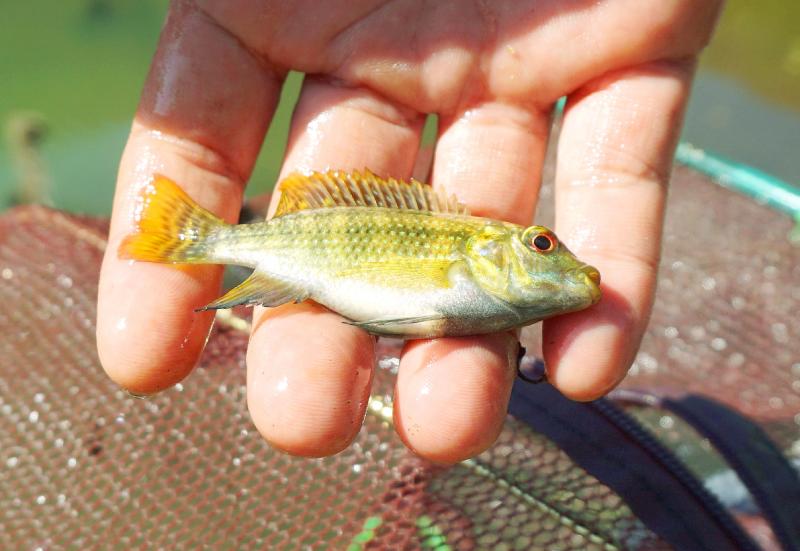
Photo: CNA
The freshwater fish cloaked in subdued browns and grays grows as long as 4.8cm, but only in Taiwan.
It disappeared from Taiwan proper more than a century ago, leaving Kinmen as the only place where it can be found in the wild.
Chen said that there are only about 10,000 left, primarily in the Guangcian (光前溪) and Doumen (斗門溪) creeks.
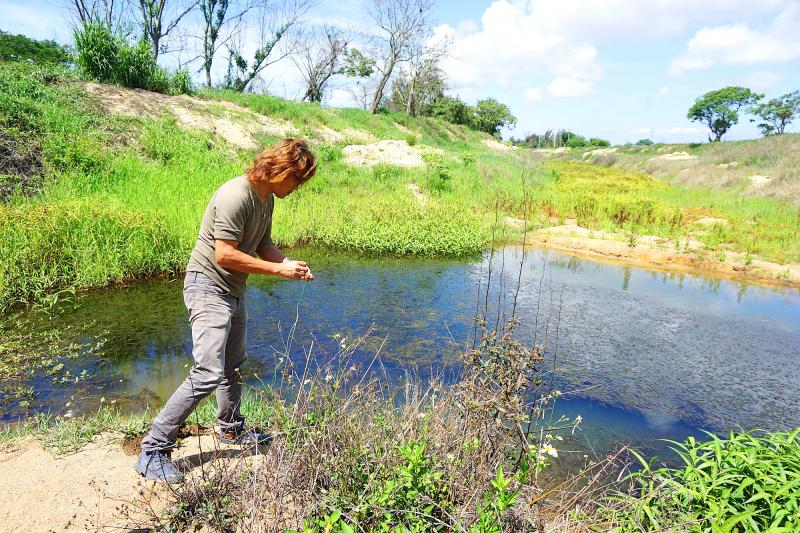
Photo: CNA
Yet in the short time between Chen’s last two surveys, it appears as though they have already disappeared from Doumen Creek, mainly due to drought conditions.
Kinmen has been experiencing its worst drought in 50 years, posing a threat to many aquatic species, Chen said on Tuesday last week.
Farmers have been rerouting what little water there is to irrigate their crops, leaving none for the fish, he said.
“Fish are not like other animals; they cannot move to another habitat,” he said. “If Metzia mesembrinum disappear from Kinmen, they will have disappeared from the Earth.”
Some rehabilitation efforts have preserved a small number of them, but the situation remains dire, he added.
This led Chen to reach deep into his own pockets to start what he calls a “fish reclamation workshop” committed to protecting the last of the world’s Metzia mesembrinum.
The workshop has three breeding tanks which hold about 300 of the fish as a “reserve fund.”
If they go extinct, these 300 fish could be released back into the wild to repopulate the island, Chen said.
He has also spared no expense on the NT$5 million (US$180,375) facility, all the way down to the high-protein eel food he purchases as feed.
All told, the workshop costs him about NT$50,000 per month, but Chen said that it is worthwhile.
“They might not look special, but each species has value,” he said. “If we preserve them, they will be there for the next generation.”
This is why he insists on conservation and rehabilitation, Chen said, because “an animal saved is an animal gained.”
Apart from Metzia mesembrinum, Chen also works tirelessly to preserve other rapidly disappearing fish species native to Kinmen.
Long after disappearing from the county’s main island, Chen rediscovered the climbing perch, or Anabas testudineus, in neighboring Lieyu Township (烈嶼).
He also managed to catch a rosy bitterling, which had been thought to be extinct from Kinmen for more than 20 years, both of which are also being rehabilitated at Chen’s workshop.
Chen said he is still chasing his own personal white whale.
The Snyder’s barb, or Barbodes snyderi, has not been seen in the wild for nearly two decades.
Chen said he has searched all over the county, including for three straight days in Cingtian Reservoir (擎天水庫), but the fish still eludes him.
Even after 10 years, he said he would keep looking.

NATIONAL SECURITY: Authorities are working to confirm the identities of the military personnel involved and investigating possible illegal conduct and regulatory violations Authorities are probing possible national security implications after Kinmen police and immigration officers on Sunday found a Chinese woman allegedly posing as a tourist while engaging in prostitution involving more than 10 military personnel. The woman, surnamed Chen (陳), has since been deported, authorities said, adding that investigators are still working to confirm the identities of those implicated, as the records only listed code names and aliases. The case stemmed from a report received by the Kinmen District Prosecutors’ Office on Friday last week from the Jinhu Precinct of the Kinmen County Police Bureau. On Sunday, police, along with the National Immigration

GLOBALGIVING: ‘ Caving to external pressure is not acceptable for an organization that has cultivated justice reform and human rights for 30 years,’ one NGO said A slew of non-government organizations (NGOs) have withdrawn from the GlobalGiving fundraising platform after it announced it would use “Chinese Taipei” instead of “Taiwan” from next month. The Taiwan Good Rice Association wrote on Facebook on Friday that it was informed on April 28 via a teleconference call of the change, which was made because the platform wanted to operate in China. Taiwan Good Rice is to terminate all cooperative relationships with GlobalGiving in response to the platform’s “unilateral and non-negotiable” decision to remove references to Taiwan, the NGO said. “Taiwan is in the official name of Taiwan Good Rice Association and the

HEAVY WEATHER: Typhoon Jangmi is due to crash straight into the Ryukyus as airlines look to shift flights to larger aircraft or cancel flights to Okinawa entirely Taiwan’s international air carriers announced flight adjustments over the weekend as Typhoon Jangmi is forecast to hit the Ryukyu Islands today and tomorrow. The Central Weather Administration (CWA) upgraded Jangmi from a tropical storm to a typhoon at 8am yesterday, with the eye located 580km south of Naha city. It was moving north at 19kph. Today, China Airlines’ CI-120, CI-121, CI-122 and CI-123 flights between Taoyuan and Naha, Okinawa, have been canceled as well as CI-132 and CI-133 between Kaohsiung and Naha. EVA Air’s BR-112, BR-113, BR-186 and BR-185 flights between Taoyuan and Naha are also canceled. Low-cost carrier Tigerair Taiwan canceled IT-230,

REASONS FOR TRAVEL: An assistant professor said that proposed amendments to penalize drivers if they used drugs overseas would not deter people from traveling People who operate a motor vehicle under the influence of marijuana would have their driver’s license revoked, even if they used the substance while overseas, the Ministry of Transportation and Communications said yesterday, citing proposed amendments to the Road Traffic Management and Penalty Act (道路交通管理處罰條例). The amendments would also authorize the government to revoke the licenses of people determined to have used Category 1 or Category 2 narcotics, even if they were not operating a vehicle while under the influence of drugs, as well as ban them from taking the license test for three years, the ministry said. People aged 18 or


 RSS
RSS