


Japanese Minister of Defense Nobuo Kishi in a speech in Vietnam on Sunday highlighted the importance of peace in the Taiwan Strait and the vital role Taiwan can play in the world.
Kishi made the remarks at the Vietnamese Ministry of National Defense in Hanoi, a day after he met with Vietnamese Minister of Defense Phan Van Giang, when he mentioned Taiwan and the importance of freedom of navigation and overflight in the Indo-Pacific region.
“Taiwan is located at the nexus of the East China Sea and the South China Sea, which is a key point for regional maritime security. Peace and stability in the Taiwan Strait are important to both the region and the international community,” Kishi said during his first overseas trip as defense minister.
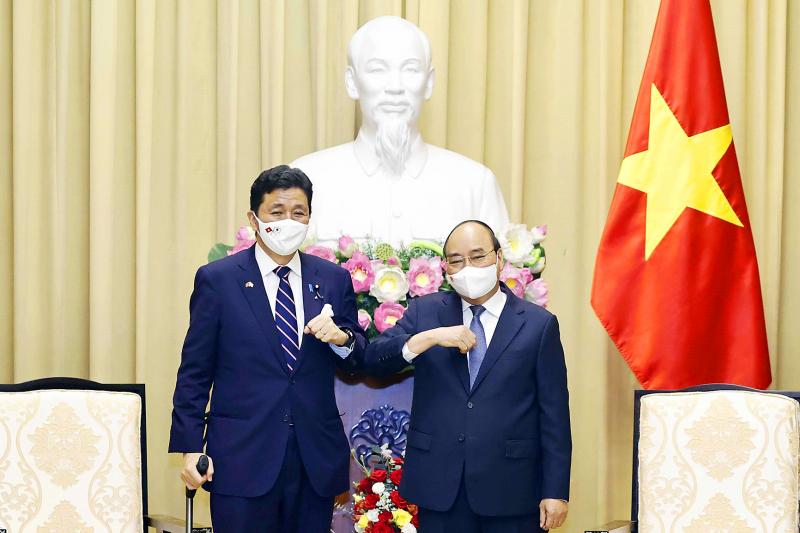
Photo: AP
He also commented on cross-strait tension over Taiwan’s status.
“It has been a consistent position of Japan to expect that it will be peacefully resolved through direct dialogues by relevant parties,” he said.
Calling Vietnam an important partner for Japan, with which it shares “the same destiny,” Kishi said that the countries should enhance defense cooperation for regional stability and address regional security issues amid a “harsh reality.”
He said that China’s Coast Guard Law, which was made more stringent in February, includes problematic stipulations that could conflict with international law, such as allowing the use force to enforce China’s claims to maritime areas.
The legitimate rights of all relevant countries, including Japan and Vietnam, should never be undermined due to the law, he said, adding that Japan would never tolerate anything that would heighten tensions in the East China Sea and South China Sea.
Countries in the region are facing “an unprecedentedly severe reality, including in the security arena,” he said.
In the waters and airspace of the East and South China seas, actions are being taken based on one-sided assertions that are incompatible with the international order, Kishi said.
Freedom of navigation and freedom of flight must not be unduly contravened, he said.
To that end, it is important to promote the importance of the “rule of law,” the basic principle of peaceful resolution of conflict, and above all, to put it into practice, he added.
He said that attempts to change the “status quo” through coercion continue in the East China Sea, including in waters around the Japanese-controlled Diaoyutai Islands (釣魚台) — known as the Senkaku Islands in Japan — which are claimed by Taiwan as well as China.
The situation is becoming more and more serious, with repeated cases of Chinese coast guard vessels intruding into territorial waters and approaching Japanese fishing vessels, he said.
In the South China Sea, China has continued to militarize disputed rocky outcrops, frequently conducted military exercises and is believed to have launched ballistic missiles, Kishi said.
“Japan strongly opposes unilateral attempts to change the status quo by coercion and any activities that raise tensions, and shares concerns with Vietnam,” he said.

The Centers for Disease Control (CDC) yesterday reported the first case of a new COVID-19 subvariant — BA.3.2 — in a 10-year-old Singaporean girl who had a fever upon arrival in Taiwan and tested positive for the disease. The girl left Taiwan on March 20 and the case did not have a direct impact on the local community, it said. The WHO added the BA.3.2 strain to its list of Variants Under Monitoring in December last year, but this was the first imported case of the COVID-19 variant in Taiwan, CDC Deputy Director-General Lin Ming-cheng (林明誠) said. The girl arrived in Taiwan on

South Korea is planning to revise its controversial electronic arrival card, a step Taiwanese officials said prompted them to hold off on planned retaliatory measures, a South Korean media report said yesterday. A Yonhap News Agency report said that the South Korean Ministry of Foreign Affairs is planning to remove the “previous departure place” and “next destination” fields from its e-arrival card system. The plan, reached after interagency consultations, is under review and aims to simplify entry procedures and align the electronic form with the paper version, a South Korean ministry official said. The fields — which appeared only on the electronic form

The Ministry of Foreign Affairs (MOFA) is suspending retaliation measures against South Korea that were set to take effect tomorrow, after Seoul said it is updating its e-arrival system, MOFA said today. The measures were to be a new round of retaliation after Taiwan on March 1 changed South Korea's designation on government-issued alien resident certificates held by South Korean nationals to "South Korea” from the "Republic of Korea," the country’s official name. The move came after months of protests to Seoul over its listing of Taiwan as "China (Taiwan)" in dropdown menus on its new online immigration entry system. MOFA last week

A bipartisan group of US senators has introduced a bill to enhance cooperation with Taiwan on drone development and to reduce reliance on supply chains linked to China. The proposed Blue Skies for Taiwan Act of 2026 was introduced by Republican US senators Ted Cruz and John Curtis, and Democratic US senators Jeff Merkley and Andy Kim. The legislation seeks to ease constraints on Taiwan-US cooperation in uncrewed aerial systems (UAS), including dependence on China-sourced components, limited access to capital and regulatory barriers under US export controls, a news release issued by Cruz on Wednesday said. The bill would establish a "Blue UAS


 RSS
RSS