


Hsinchu’s traditional architectural painting and guqin (古琴) have been named intangible cultural assets, bringing the city’s total to six and marking the first time the instrument has been recognized by any region.
The guqin is China’s oldest musical instrument with a history dating back 3,000 years, the Hsinchu Cultural Affairs Bureau said last week.
Growing up in Hsinchu, Shan Chih-yuan (單志淵) began learning how to make traditional Chinese instruments at a very young age from his father, particularly stringed instruments such as the guqin and ruan (阮), the bureau said.

Photo courtesy of the Hsinchu City Government
For more than 40 years he has dedicated himself to the craft, following the ancient methods from the Tang and Song dynasties that have largely been lost, it said, adding that his preference is to make every component from scratch, rather than using manufactured parts.
The detailed and colorful paintings of Fu Pai-tsun (傅?村) have also been registered as intangible cultural assets in recognition of his more than 60 years decorating shrines and temples.
Fu uses traditional techniques accumulated through decades of experience, including creating his own brushes and putty, the bureau said.
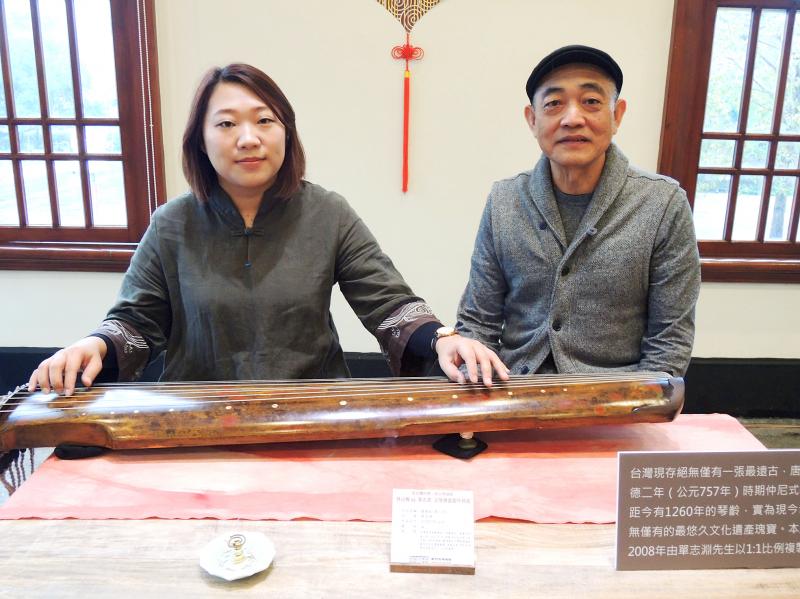
Photo: Hung Mei-hsiu, Taipei Times
He is now one of the few people versed in these methods, which he intends to pass on to his two sons, the bureau added.
Aside from the two new additions, Lin Yao-nung (林瑤農) has also been recognized as a preserver of the art of glassblowing, which had previously been named an intangible cultural asset.
Lin, who last year was recognized as a national craftsman, has been creating works of art from glass for more than four decades, the bureau said.
Like the other preservers of culture, he uses traditional methods, including freehand blowing and molding of glass, it said.
As one of the few glassblowers left in the city, Lin is also passing his knowledge on to his children, as well as his students in the Hsinchu area, it added.
The other three intangible cultural assets listed in Hsinchu are woodcarving, lacquer art and mother-of-pearl inlays.

The Centers for Disease Control (CDC) yesterday reported the first case of a new COVID-19 subvariant — BA.3.2 — in a 10-year-old Singaporean girl who had a fever upon arrival in Taiwan and tested positive for the disease. The girl left Taiwan on March 20 and the case did not have a direct impact on the local community, it said. The WHO added the BA.3.2 strain to its list of Variants Under Monitoring in December last year, but this was the first imported case of the COVID-19 variant in Taiwan, CDC Deputy Director-General Lin Ming-cheng (林明誠) said. The girl arrived in Taiwan on

South Korea is planning to revise its controversial electronic arrival card, a step Taiwanese officials said prompted them to hold off on planned retaliatory measures, a South Korean media report said yesterday. A Yonhap News Agency report said that the South Korean Ministry of Foreign Affairs is planning to remove the “previous departure place” and “next destination” fields from its e-arrival card system. The plan, reached after interagency consultations, is under review and aims to simplify entry procedures and align the electronic form with the paper version, a South Korean ministry official said. The fields — which appeared only on the electronic form

The Ministry of Foreign Affairs (MOFA) is suspending retaliation measures against South Korea that were set to take effect tomorrow, after Seoul said it is updating its e-arrival system, MOFA said today. The measures were to be a new round of retaliation after Taiwan on March 1 changed South Korea's designation on government-issued alien resident certificates held by South Korean nationals to "South Korea” from the "Republic of Korea," the country’s official name. The move came after months of protests to Seoul over its listing of Taiwan as "China (Taiwan)" in dropdown menus on its new online immigration entry system. MOFA last week

A bipartisan group of US senators has introduced a bill to enhance cooperation with Taiwan on drone development and to reduce reliance on supply chains linked to China. The proposed Blue Skies for Taiwan Act of 2026 was introduced by Republican US senators Ted Cruz and John Curtis, and Democratic US senators Jeff Merkley and Andy Kim. The legislation seeks to ease constraints on Taiwan-US cooperation in uncrewed aerial systems (UAS), including dependence on China-sourced components, limited access to capital and regulatory barriers under US export controls, a news release issued by Cruz on Wednesday said. The bill would establish a "Blue UAS


 RSS
RSS