


A symbolic “public burial” for the victims of COVID-19 is to be held at Taipei’s Liberty Square from tomorrow to Sept. 6 as a memorial to the dead and a protest against the government, the event’s organizers said yesterday.
A large tent installation would “give voice to the powerless, clear the names of the dead and seek the truth,” said Wuo Young-ie (吳永毅), an associate professor at Tainan National University of the Arts’ Graduate Institute of Documentary, who is leading the project.
The memorial is to consist of performances, artwork and nightly debates, Wuo told a news conference outside the Legislative Yuan’s Chun-hsien Building in Taipei.
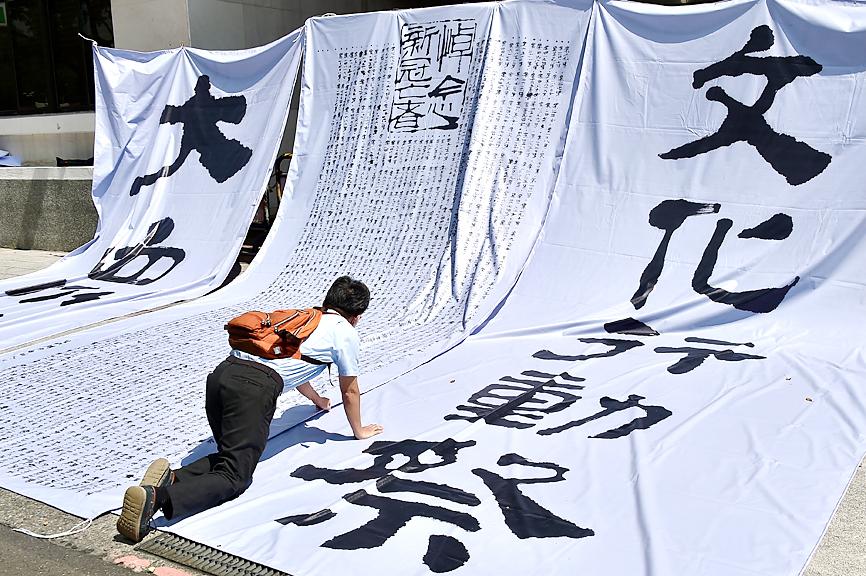
Photo: Tu Chien-jung, Taipei Times
Pieces from award-winning architect Hsieh Ying-chun (謝英俊), video artist Chen Chieh-jen (陳界仁) and theater director Wang Mo-lin (王墨林) would be featured throughout the week, Wuo said.
Groups representing the least powerful of society would also be welcomed to advocate their causes, including striking members of the Miramar Golf Country Club union, people seeking to prevent the demolition of Taichung’s Liming Kindergarten and properties along a railway project in Tainan, Chinese spouses living in Taiwan and foreign students, he said.
Due to the “inability to freely discuss certain topics” online, psychiatrist Su Wei-shuo (蘇偉碩) and other outspoken critics would be holding nightly debates at the tent, Wuo added.
Su, who last week launched a petition to put emergency approval of the Medigen COVID-19 vaccine to a referendum vote, said that the names of the dead are to be displayed on the outside of the tent.
“In life it was too much to bear, and in death they can only be referred to in code” due to the stigma associated with contracting COVID-19 and the government’s “suppression and cold-blooded denial,” Su said.
When democracy pioneer Chiang Wei-shui (蔣渭水) died of typhoid in 1931, his supporters organized a “public burial” to protest the Japanese colonial government, he said.
The prohibition on political gatherings and government criticism at the time bear a “striking similarity to today,” Su said, adding that he hopes the artists leading this “public burial” 90 years later could give voice to the “grief, anger and helplessness of the dead.”
The title of the structure designed by Hsieh, Mass Tent (大眾帳), is meant to symbolize that all beings under its eaves are sheltered and included, and all viewpoints welcomed, Wuo said.
The tent is to be erected tomorrow morning as a public installation by participants, “unlike the techniques used during the pandemic, which were controlled by the black-box operations of experts and others,” he added.
Young people are afraid to speak out, fearing they would be attacked online, Wuo said, inviting everyone to come to the event as equals and to speak their mind.

The Centers for Disease Control (CDC) yesterday reported the first case of a new COVID-19 subvariant — BA.3.2 — in a 10-year-old Singaporean girl who had a fever upon arrival in Taiwan and tested positive for the disease. The girl left Taiwan on March 20 and the case did not have a direct impact on the local community, it said. The WHO added the BA.3.2 strain to its list of Variants Under Monitoring in December last year, but this was the first imported case of the COVID-19 variant in Taiwan, CDC Deputy Director-General Lin Ming-cheng (林明誠) said. The girl arrived in Taiwan on

South Korea is planning to revise its controversial electronic arrival card, a step Taiwanese officials said prompted them to hold off on planned retaliatory measures, a South Korean media report said yesterday. A Yonhap News Agency report said that the South Korean Ministry of Foreign Affairs is planning to remove the “previous departure place” and “next destination” fields from its e-arrival card system. The plan, reached after interagency consultations, is under review and aims to simplify entry procedures and align the electronic form with the paper version, a South Korean ministry official said. The fields — which appeared only on the electronic form

The Ministry of Foreign Affairs (MOFA) is suspending retaliation measures against South Korea that were set to take effect tomorrow, after Seoul said it is updating its e-arrival system, MOFA said today. The measures were to be a new round of retaliation after Taiwan on March 1 changed South Korea's designation on government-issued alien resident certificates held by South Korean nationals to "South Korea” from the "Republic of Korea," the country’s official name. The move came after months of protests to Seoul over its listing of Taiwan as "China (Taiwan)" in dropdown menus on its new online immigration entry system. MOFA last week
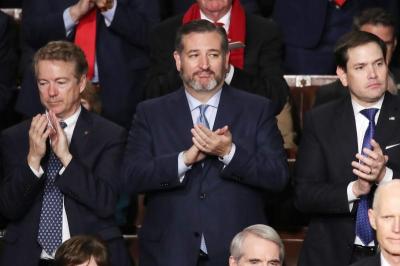
A bipartisan group of US senators has introduced a bill to enhance cooperation with Taiwan on drone development and to reduce reliance on supply chains linked to China. The proposed Blue Skies for Taiwan Act of 2026 was introduced by Republican US senators Ted Cruz and John Curtis, and Democratic US senators Jeff Merkley and Andy Kim. The legislation seeks to ease constraints on Taiwan-US cooperation in uncrewed aerial systems (UAS), including dependence on China-sourced components, limited access to capital and regulatory barriers under US export controls, a news release issued by Cruz on Wednesday said. The bill would establish a "Blue UAS


 RSS
RSS