


The Soil and Water Conservation Bureau on Tuesday obtained the right to use a patented traditional fishing method from residents of Fata’an Village (馬太鞍) in Hualien County’s Guangfu Township (光復), marking the first time a government office has been licensed to use an Aboriginal technology.
The bureau is to fund the renovation of a fishing area in a section of Fudeng Creek (芙登溪) in Fata’an Wetland (馬太鞍濕地) using palakaw, which was patented in 2017.
Palakaw means “using lakaw to fish,” village head Lalan Unak said.
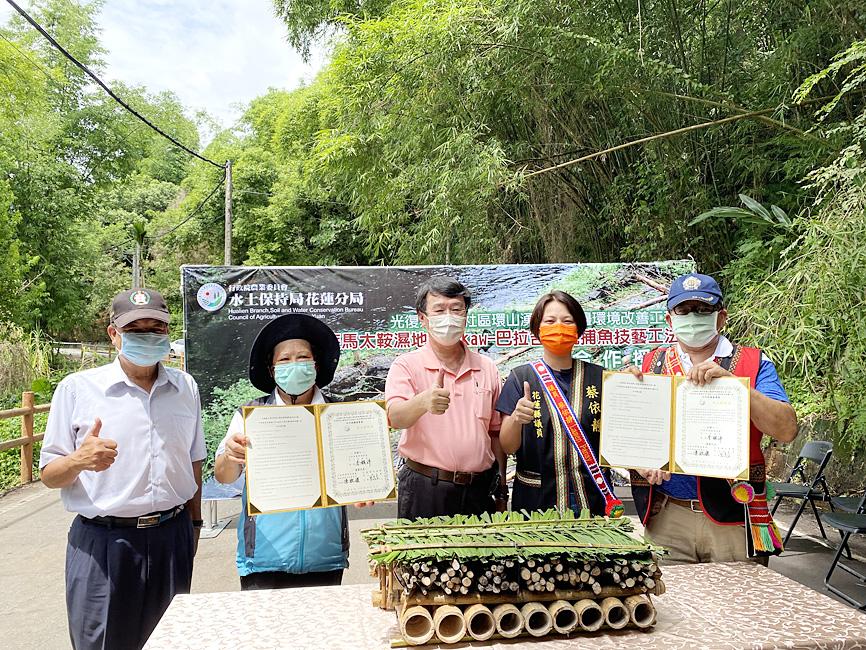
Photo: CNA
A lakaw is made of bamboo tubes, tree branches, betel nut tree leaves or other materials on hand, bound in layers to create a sort of “apartment” for fish and shrimp, he said.
The bamboo tubes comprise the lowest layer, giving bottom-feeders such as catfish and eels a place to live, he said.
The middle layer of branches is for small fish and shrimp to hide, while the top layer of leaves provides cover for larger fish, he added.
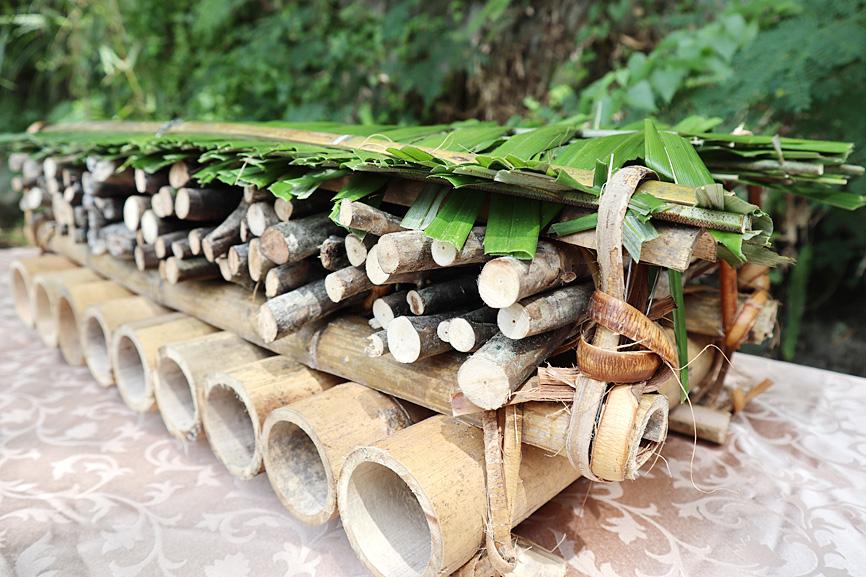
Photo: CNA
Before the harvest festival, weddings, funerals or other occasions, young villagers traditionally go to the wetlands to catch fish, he said.
All they need to do is block the ends of the lakaw and all kinds of creatures become easy to catch with nets and traps, he said.
Recognizing that Aboriginal innovations have long been stolen and used without permission for commercial profit, the government in 2015 passed the Protection Act for the Traditional Intellectual Creations of Indigenous Peoples (原住民族傳統智慧創作保護條例).
The following year, Fata’an Village residents applied to protect palakaw, which was granted a patent on Oct. 25, 2017.
The year after that, organizers of the Taichung World Flora Exposition licensed the technology for the event and invited villagers to demonstrate, Hualien County Councilor Lamen Panay said.
At a meeting of village elders three years ago, they expressed their sincere wish that young people would continue palakaw fishing in the wetland, she said.
The bureau has not only offered to fund restoration of the creek, but has also become the first public office to license the right to use an Aboriginal technology, she said, calling the event a “huge milestone.”
Hopefully, more tribes would pass on their culture in this way, ensuring that more Aboriginal voices are heard in public works projects, she added.

Considering that most countries issue more than five denominations of banknotes, the central bank has decided to redesign all five denominations, the bank said as it prepares for the first major overhaul of the banknotes in more than 24 years. Central bank Governor Yang Chin-lung (楊金龍) is expected to report to the Legislative Yuan today on the bank’s operations and the redesign’s progress. The bank in a report sent to the legislature ahead of today’s meeting said it had commissioned a survey on the public’s preferences. Survey results showed that NT$100 and NT$1,000 banknotes are the most commonly used, while NT$200 and NT$2,000

The Centers for Disease Control (CDC) yesterday reported the first case of a new COVID-19 subvariant — BA.3.2 — in a 10-year-old Singaporean girl who had a fever upon arrival in Taiwan and tested positive for the disease. The girl left Taiwan on March 20 and the case did not have a direct impact on the local community, it said. The WHO added the BA.3.2 strain to its list of Variants Under Monitoring in December last year, but this was the first imported case of the COVID-19 variant in Taiwan, CDC Deputy Director-General Lin Ming-cheng (林明誠) said. The girl arrived in Taiwan on

South Korea is planning to revise its controversial electronic arrival card, a step Taiwanese officials said prompted them to hold off on planned retaliatory measures, a South Korean media report said yesterday. A Yonhap News Agency report said that the South Korean Ministry of Foreign Affairs is planning to remove the “previous departure place” and “next destination” fields from its e-arrival card system. The plan, reached after interagency consultations, is under review and aims to simplify entry procedures and align the electronic form with the paper version, a South Korean ministry official said. The fields — which appeared only on the electronic form

The Ministry of Foreign Affairs (MOFA) is suspending retaliation measures against South Korea that were set to take effect tomorrow, after Seoul said it is updating its e-arrival system, MOFA said today. The measures were to be a new round of retaliation after Taiwan on March 1 changed South Korea's designation on government-issued alien resident certificates held by South Korean nationals to "South Korea” from the "Republic of Korea," the country’s official name. The move came after months of protests to Seoul over its listing of Taiwan as "China (Taiwan)" in dropdown menus on its new online immigration entry system. MOFA last week


 RSS
RSS