


Although the National Human Rights Commission has been in existence for one year, it has not used even half of its budget, and laws governing the enforcement of its authority are not completely in place, the New Power Party (NPP) said yesterday.
The party made the comments as the commission, a unit of the Control Yuan, celebrated the first anniversary of its establishment.
Article 2 of the Organic Act of the National Human Rights Commission (監察院國家人權委員會組織法) lists the functions and powers of the commission, including “investigating incidents involving torture, human rights violations or various forms of discrimination in accordance with its authority or in response to petition from the general public, and provide a remedy according to the law.”
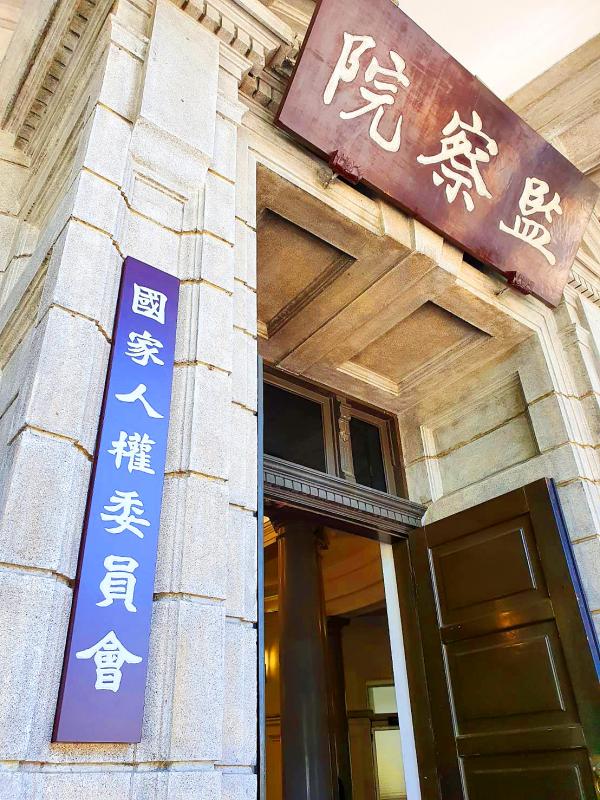
Photo: Hsieh Chun-lin, Taipei Times
However, a report submitted by the commission earlier this month showed that it had only used 46 percent of its budget, most of which was spent on hosting human rights seminars and funding studies, NPP Chairwoman Chen Jiau-hua (陳椒華) said.
The Control Yuan should quickly submit again a draft law governing the exercise of the commission’s power, which it retracted during last year’s legislative session, NPP Legislator Claire Wang (王婉諭) said.
Control Yuan President Chen Chu (陳菊) has said that the commission’s two core tasks are to safeguard human rights in Taiwan and promote human rights education, but so far it had mainly focused on education, she said.
“While we do not belittle the importance of reinforcing human rights education in the country, we want to remind the commission that it should perform all the tasks it is authorized to do,” Wang said.
A number of legislators have proposed amendments to the Constitution that are related to human rights protection, and the organic act has allowed the commission to make policy suggestions based on its understanding of international and domestic human rights issues, she added.
NPP caucus whip Chiu Hsien-chih (邱顯智) said that part of the commission’s responsibilities is to review laws and regulations in the nation and check if they meet human rights standards widely accepted by the international community.
The commission should open a probe into the Executive Yuan’s role in suppressing protests against a proposed service trade agreement with China on March 23, 2014, he said, adding that the government has yet to identify police officers who attacked student protesters.
The commission has not made any suggestion on the proposed amendments to the Assembly and Parade Act (集會遊行法), despite many legal experts saying the act does not adequately protect the rights of protesters, he added.
The NPP has proposed establishing a human rights committee at the Legislative Yuan to ensure that the National Human Rights Commission is consulted during the legislative process, he added.

The Centers for Disease Control (CDC) yesterday reported the first case of a new COVID-19 subvariant — BA.3.2 — in a 10-year-old Singaporean girl who had a fever upon arrival in Taiwan and tested positive for the disease. The girl left Taiwan on March 20 and the case did not have a direct impact on the local community, it said. The WHO added the BA.3.2 strain to its list of Variants Under Monitoring in December last year, but this was the first imported case of the COVID-19 variant in Taiwan, CDC Deputy Director-General Lin Ming-cheng (林明誠) said. The girl arrived in Taiwan on

South Korea is planning to revise its controversial electronic arrival card, a step Taiwanese officials said prompted them to hold off on planned retaliatory measures, a South Korean media report said yesterday. A Yonhap News Agency report said that the South Korean Ministry of Foreign Affairs is planning to remove the “previous departure place” and “next destination” fields from its e-arrival card system. The plan, reached after interagency consultations, is under review and aims to simplify entry procedures and align the electronic form with the paper version, a South Korean ministry official said. The fields — which appeared only on the electronic form

A bipartisan group of US senators has introduced a bill to enhance cooperation with Taiwan on drone development and to reduce reliance on supply chains linked to China. The proposed Blue Skies for Taiwan Act of 2026 was introduced by Republican US senators Ted Cruz and John Curtis, and Democratic US senators Jeff Merkley and Andy Kim. The legislation seeks to ease constraints on Taiwan-US cooperation in uncrewed aerial systems (UAS), including dependence on China-sourced components, limited access to capital and regulatory barriers under US export controls, a news release issued by Cruz on Wednesday said. The bill would establish a "Blue UAS

The Ministry of Foreign Affairs (MOFA) is suspending retaliation measures against South Korea that were set to take effect tomorrow, after Seoul said it is updating its e-arrival system, MOFA said today. The measures were to be a new round of retaliation after Taiwan on March 1 changed South Korea's designation on government-issued alien resident certificates held by South Korean nationals to "South Korea” from the "Republic of Korea," the country’s official name. The move came after months of protests to Seoul over its listing of Taiwan as "China (Taiwan)" in dropdown menus on its new online immigration entry system. MOFA last week


 RSS
RSS