


In the nearly four years since its creation, the National Police Agency’s (NPA) Counterterrorism Center has only been used for 38 days for counterterrorism training exercises, the National Audit Office said in a budget report on Thursday last week, calling on the agency to increase usage of the costly facility.
The NT$550 million (US$19.69 million) center in Taoyuan’s Sinwu District (新屋) — intended for use in simulating terror-related scenarios to train police and national security forces — opened in March 2017 after years of setbacks.
Its facilities include training grounds for urban combat, climbing and rappelling, hostage rescue and antiterrorism combat, as well as a multipurpose building, dormitory and cafeteria.
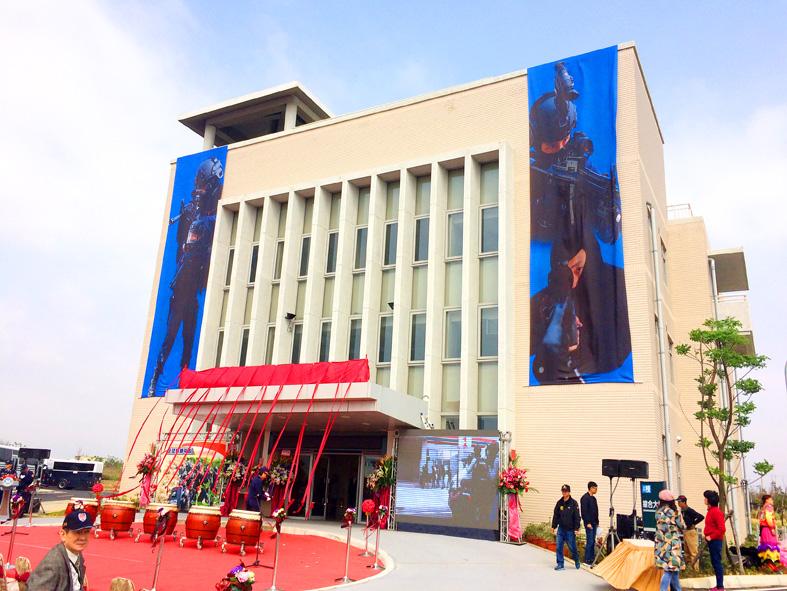
Photo: Lee Jung-ping, Taipei Times
Although the Ministry of the Interior approved the project in 2003, the groundbreaking ceremony was not held for another eight years.
Scheduled for completion in 2014, revisions and difficulty in finding contractors delayed the start of construction another four years until 2015.
However, the center has been underutilized in its first 960 days of operation from March 21, 2017, to Nov. 30 last year, the office said in its report for this past fiscal year.
During this period the center was only used 38 days for counterterrorism drills, or 3.96 percent of the time, the report said.
Only four joint antiterrorism exercises were held during the period: one each in 2017 and 2018, and two in 2019 for a total of four days, it added.
The Military Police Special Services, Coast Guard Investigation Branch and other special forces held seven drills between them, one each in 2017, 2019 and last year, and four in 2018, it said.
These seven exercises lasted a total of 34 days, training 844 officers, it showed.
By facility, the dormitory and antiterrorism combat training ground were used five times each, the hostage rescue facility was used four times, and the climbing and urban combat facilities were used three times each, it said.
The center has mostly been used for general police training rather than specialized counterterrorism response, it said.
Police training sessions were held 398 days over the period — 79 in 2017, 137 in 2018, 99 in 2019 and 83 last year — training 2,861 officers in total, it said.
The number of people trained at each facility ranged from 1,029 to 2,803, while the percentage of days used ranged from 29.17 to 36.98 percent, it added.
Although training police at the center increases its overall usage, it does not fulfill the original purpose of the facility, the office said, adding that it has already sent the NPA a formal request to hold more counterterrorism drills.
The NPA said it would continue conducting counterterrorism trainings at the center, including joint drills with security and police forces.
It also vowed to make better use of the center by inviting special forces and police departments from neighboring counties to conduct training drills, thereby providing additional opportunities for observation and exchange.

The Centers for Disease Control (CDC) yesterday reported the first case of a new COVID-19 subvariant — BA.3.2 — in a 10-year-old Singaporean girl who had a fever upon arrival in Taiwan and tested positive for the disease. The girl left Taiwan on March 20 and the case did not have a direct impact on the local community, it said. The WHO added the BA.3.2 strain to its list of Variants Under Monitoring in December last year, but this was the first imported case of the COVID-19 variant in Taiwan, CDC Deputy Director-General Lin Ming-cheng (林明誠) said. The girl arrived in Taiwan on

South Korea is planning to revise its controversial electronic arrival card, a step Taiwanese officials said prompted them to hold off on planned retaliatory measures, a South Korean media report said yesterday. A Yonhap News Agency report said that the South Korean Ministry of Foreign Affairs is planning to remove the “previous departure place” and “next destination” fields from its e-arrival card system. The plan, reached after interagency consultations, is under review and aims to simplify entry procedures and align the electronic form with the paper version, a South Korean ministry official said. The fields — which appeared only on the electronic form

A bipartisan group of US senators has introduced a bill to enhance cooperation with Taiwan on drone development and to reduce reliance on supply chains linked to China. The proposed Blue Skies for Taiwan Act of 2026 was introduced by Republican US senators Ted Cruz and John Curtis, and Democratic US senators Jeff Merkley and Andy Kim. The legislation seeks to ease constraints on Taiwan-US cooperation in uncrewed aerial systems (UAS), including dependence on China-sourced components, limited access to capital and regulatory barriers under US export controls, a news release issued by Cruz on Wednesday said. The bill would establish a "Blue UAS

The Ministry of Foreign Affairs (MOFA) is suspending retaliation measures against South Korea that were set to take effect tomorrow, after Seoul said it is updating its e-arrival system, MOFA said today. The measures were to be a new round of retaliation after Taiwan on March 1 changed South Korea's designation on government-issued alien resident certificates held by South Korean nationals to "South Korea” from the "Republic of Korea," the country’s official name. The move came after months of protests to Seoul over its listing of Taiwan as "China (Taiwan)" in dropdown menus on its new online immigration entry system. MOFA last week


 RSS
RSS