


The New Power Party (NPP) yesterday accused the Investment Commission of negligence for allegedly not investigating whether a firm that controls the logistics services of Taiwan’s two main science parks is funded by Chinese investors.
The party held a news conference after former NPP legislator Huang Kuo-chang (黃國昌) last week said that China Airlines’ sale of a stake in Science Park Logistics in 2017 had given Kerry TJ Logistics Co the opportunity to seize ownership of the company in 2018.
Huang said that Kerry TJ was funded by Chinese investors after it announced an equity transaction with China’s SF Holding Co in February.
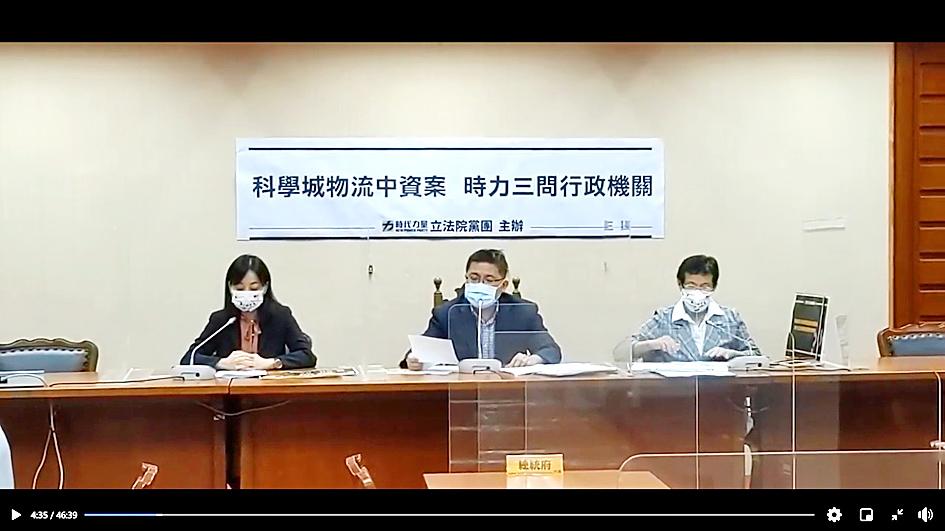
Photo copied by Wu Shu-wei, Taipei Times
At a news conference yesterday also attended by representatives from the state-owned Taiwan Sugar Corp and the Investment Commission, NPP caucus whip Chiu Hsien-chih (邱顯智) said that Science Park Logistics was established in 1998, and owned by China Airlines and Taiwan Sugar, with each holding a 50 percent stake.
By 2017, Taiwan Sugar and China Airlines each had a 26 percent stake, but the airline sold its stake to HCT Logistics, he said.
HCT Logistics in 2018 sold its 55 percent stake in Science Park Logistics to Kerry TJ, he added.
“Many people are concerned about Kerry TJ’s funding from China, as the firm in February announced an equity transaction with SF Holding Co, which is based in Shenzhen, China,” Chiu said.
NPP Chairwoman Chen Jiau-hua (陳椒華) said that the party received a tip-off that President Tsai Ing-wen’s (蔡英文) national policy adviser Chin Chia-hung (秦嘉鴻) had met with senior management from China Airlines and Taiwan Sugar at the headquarters of the Democratic Progressive Party ahead of the 2017 sale.
Taiwan Sugar did not exercise its right of first refusal when it learned that China Airlines was selling its stake, Chen said.
Chen questioned the lack of any minutes of the meeting and why Taiwan Sugar informed the State-Owned Enterprise Commission about it in an unofficial document.
Investment Commission Vice Executive Secretary Lu Cheng-hui (呂貞惠) said that Kerry TJ reported its equity transaction in February.
In April and May, the commission investigated the firm’s structure, Lu said, adding that it has yet to find any substantial evidence of funding from China.
“As the transaction is not complete yet, we have reminded the firm that it needs to disclose information of any Chinese shareholders voluntarily. We could also launch an investigation into the deal without having to wait for it to complete,” Lu said.
Taiwan Sugar vice president Ku Hsiao-jou (顧孝柔) said that the company decided not to buy China Airlines’ stake in Science Park Logistics in 2017 following a market analysis.
“We consulted the Southern Science Park Administration, which told us that Science Park Logistics does not have to be more than 50 percent owned by state-owned corporations,” she said.
Kerry TJ has denied being funded by Chinese investors.

The Centers for Disease Control (CDC) yesterday reported the first case of a new COVID-19 subvariant — BA.3.2 — in a 10-year-old Singaporean girl who had a fever upon arrival in Taiwan and tested positive for the disease. The girl left Taiwan on March 20 and the case did not have a direct impact on the local community, it said. The WHO added the BA.3.2 strain to its list of Variants Under Monitoring in December last year, but this was the first imported case of the COVID-19 variant in Taiwan, CDC Deputy Director-General Lin Ming-cheng (林明誠) said. The girl arrived in Taiwan on

South Korea is planning to revise its controversial electronic arrival card, a step Taiwanese officials said prompted them to hold off on planned retaliatory measures, a South Korean media report said yesterday. A Yonhap News Agency report said that the South Korean Ministry of Foreign Affairs is planning to remove the “previous departure place” and “next destination” fields from its e-arrival card system. The plan, reached after interagency consultations, is under review and aims to simplify entry procedures and align the electronic form with the paper version, a South Korean ministry official said. The fields — which appeared only on the electronic form

The Ministry of Foreign Affairs (MOFA) is suspending retaliation measures against South Korea that were set to take effect tomorrow, after Seoul said it is updating its e-arrival system, MOFA said today. The measures were to be a new round of retaliation after Taiwan on March 1 changed South Korea's designation on government-issued alien resident certificates held by South Korean nationals to "South Korea” from the "Republic of Korea," the country’s official name. The move came after months of protests to Seoul over its listing of Taiwan as "China (Taiwan)" in dropdown menus on its new online immigration entry system. MOFA last week
A bipartisan group of US senators has introduced a bill to enhance cooperation with Taiwan on drone development and to reduce reliance on supply chains linked to China. The proposed Blue Skies for Taiwan Act of 2026 was introduced by Republican US senators Ted Cruz and John Curtis, and Democratic US senators Jeff Merkley and Andy Kim. The legislation seeks to ease constraints on Taiwan-US cooperation in uncrewed aerial systems (UAS), including dependence on China-sourced components, limited access to capital and regulatory barriers under US export controls, a news release issued by Cruz on Wednesday said. The bill would establish a "Blue UAS


 RSS
RSS