


Before the COVID-19 pandemic swept the globe in spring last year, Priscilla Young (楊曉嵐), the author of a new 32-page photography zine titled Breakfast Shop (早餐店), noticed a lack of Taiwanese breakfast options in her native San Francisco Bay area.
Unlike bubble tea, which has risen to the status of possibly Taiwan’s most famous export, local breakfast staples like savory, egg pancakes (danbing, 蛋餅) have had less success making it into the US dining mainstream.
Young, a designer who spent about a decade living in Taiwan, told the Taipei Times in an e-mail interview last week that the more she spoke with others about breakfast in Taiwan, where members of her family still live, the more she realized that she knew little about it.
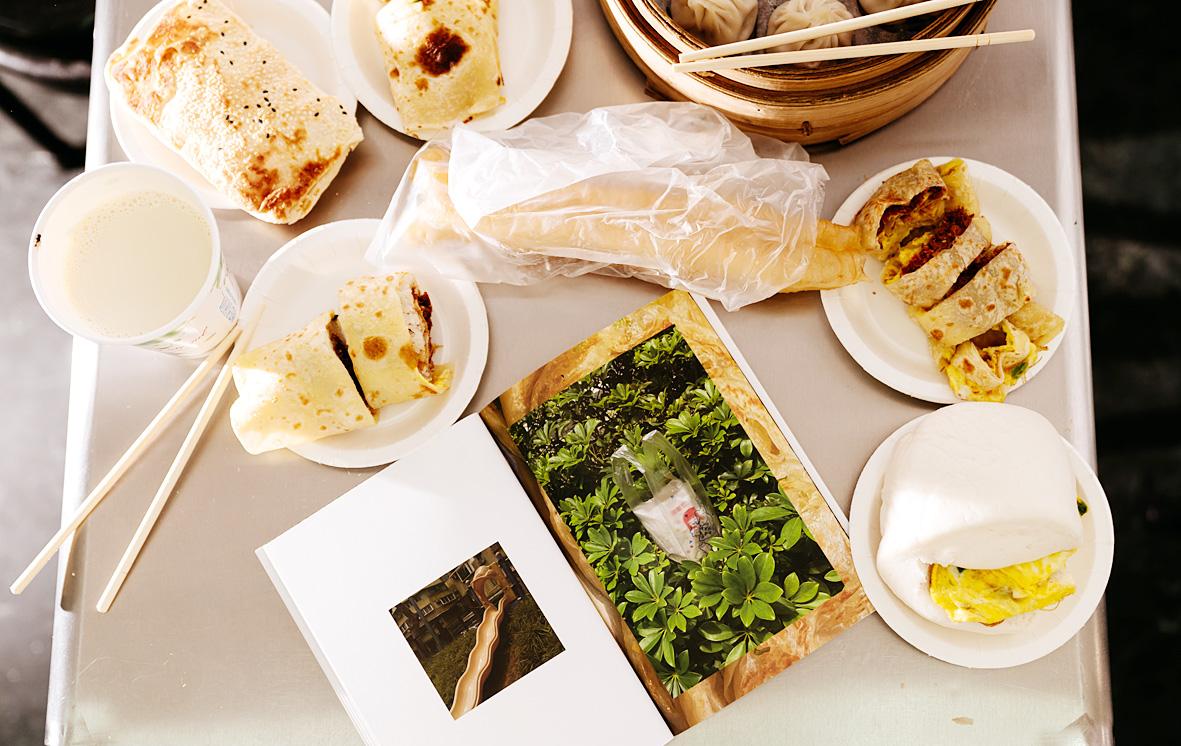
Photo courtesy of Yang Ya-chun
She traveled across the nation with her father for 17 days in January, fueled by a desire to research the local breakfast scene — at length and at first hand.
Breakfast Shop, which was published late last month, is the product of that delicious pilgrimage and a love letter to Taiwanese breakfast food and culture.
With uncaptioned photographs shot with her iPhone, Young presents a sentimental view of the quintessential Taiwanese breakfast experience in her self-published work.
On the matte pages, she artfully arranged images of freshly served dishes; for example, crispy, deep-fried dough sticks (youtiao, 油條) made from scratch or slow-cooked peanut soup (huashengtang, 花生湯), whose faint sweetness softens the flavor of heavier menu items.
While food takes center stage in the photo book, Young dedicates nearly as much space to capturing a relaxed early morning mood.
Turning her lens away from the plates, she documents sights like the sculpted roof of a temple, typical in Taiwanese residential areas, or a mosaic tiled floor reminiscent of Taiwanese architecture of the middle of last century.
Taiwanese breakfast — served to tired commuters and late-night crowds alike — is a lifestyle and comforting, Young said.
The fragrant scent of the griddle at a neighborhood shop draws customers into what she described as a community where “people start their days and end their nights.”
To an unfamiliar eye, the pictures collected in the red and white-covered zine seem like they could come from any local breakfast joint.
However, Young said that each region has a unique take on breakfast.
In northern Taiwan, where convenience is king, food options are designed for people to “pick up and go,” she said.
Southern residents might take more time to sit down and enjoy a bowl of soup or porridge, while Aborigines in the east incorporate fresh, locally sourced produce, she said.
Young’s search for what she called “beauty in the ordinary and the unnoticed” is also visible in her decision to zoom in on objects like an old-fashioned textured window and red rubber bands used by shops to close takeout boxes.
The faces pictured in Breakfast Shop, whose masks reveal the reality of the pandemic, are those of anonymous strangers, but the zine is not the visual diary of an impassive tourist.
Young, who fondly remembers buying breakfast before class as a child in Taiwan, included a photo of her grandmother’s home in Taipei.
On Instagram, she has created the “breakfast__shop” account, which is meant to be a digital extension to Breakfast Shop.
There, she also advertises branded T-shirts she made in collaboration with a friend, Taiwanese artist Chou Yi (周依).
The vision for Breakfast Shop, which Young understands as an ongoing project, was to recognize the everyday as art, she said.
“It was soul crushing to see what was happening from afar,” she said of the escalating anti-Asian violence in the US, which began during her stay in Taiwan.
“Now is the time to spread more love,” she said.

The Centers for Disease Control (CDC) yesterday reported the first case of a new COVID-19 subvariant — BA.3.2 — in a 10-year-old Singaporean girl who had a fever upon arrival in Taiwan and tested positive for the disease. The girl left Taiwan on March 20 and the case did not have a direct impact on the local community, it said. The WHO added the BA.3.2 strain to its list of Variants Under Monitoring in December last year, but this was the first imported case of the COVID-19 variant in Taiwan, CDC Deputy Director-General Lin Ming-cheng (林明誠) said. The girl arrived in Taiwan on

South Korea is planning to revise its controversial electronic arrival card, a step Taiwanese officials said prompted them to hold off on planned retaliatory measures, a South Korean media report said yesterday. A Yonhap News Agency report said that the South Korean Ministry of Foreign Affairs is planning to remove the “previous departure place” and “next destination” fields from its e-arrival card system. The plan, reached after interagency consultations, is under review and aims to simplify entry procedures and align the electronic form with the paper version, a South Korean ministry official said. The fields — which appeared only on the electronic form

A bipartisan group of US senators has introduced a bill to enhance cooperation with Taiwan on drone development and to reduce reliance on supply chains linked to China. The proposed Blue Skies for Taiwan Act of 2026 was introduced by Republican US senators Ted Cruz and John Curtis, and Democratic US senators Jeff Merkley and Andy Kim. The legislation seeks to ease constraints on Taiwan-US cooperation in uncrewed aerial systems (UAS), including dependence on China-sourced components, limited access to capital and regulatory barriers under US export controls, a news release issued by Cruz on Wednesday said. The bill would establish a "Blue UAS

The Ministry of Foreign Affairs (MOFA) is suspending retaliation measures against South Korea that were set to take effect tomorrow, after Seoul said it is updating its e-arrival system, MOFA said today. The measures were to be a new round of retaliation after Taiwan on March 1 changed South Korea's designation on government-issued alien resident certificates held by South Korean nationals to "South Korea” from the "Republic of Korea," the country’s official name. The move came after months of protests to Seoul over its listing of Taiwan as "China (Taiwan)" in dropdown menus on its new online immigration entry system. MOFA last week


 RSS
RSS