


The Forestry Bureau’s Pingtung office on Friday hosted a workshop on the conservation of the eastern grass owl and the extension of its habitats in Kaohsiung, and Pingtung and Chiayi counties.
Taiwan’s unique indigenous grass owl subspecies is one of six subspecies in East Asia, with populations in the lower reaches of the mountains of southern Taiwan, the office said.
The owl’s habitats largely overlap with extensively populated areas, and habit loss due to agriculture and urban development poses a major threat to its survival, the office said.
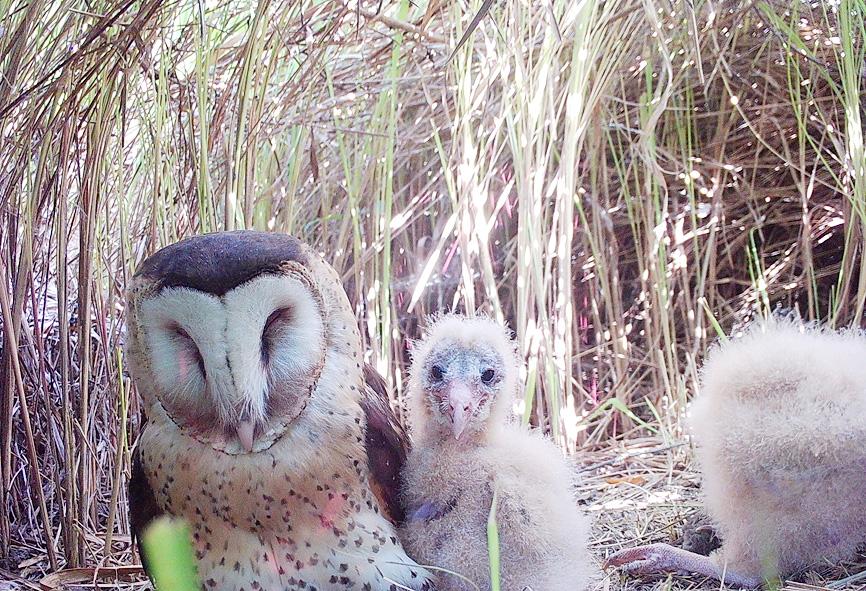
Photo: Chen Yan-ting, Taipei Times
Poisoning by agrochemical residues and accidental hunting also pose risks, it added.
Conservation efforts are complicated by a lack of data on the elusive nocturnal bird and little public awareness of the owl’s conservation status, it said.
The bureau in 2018 listed the owl as a subspecies of concern in the short and medium term, it said.
In May, the bureau included it on a list of 22 species and subspecies with nationwide priority conservation status, it said.
Programs to protect the owl include efforts to reverse habitat fragmentation and stop habitat loss, it said.
Additionally, the bureau is offering rewards to farmers who use sustainable methods and make efforts to protect target areas for conservation in their communities, it said.
The bureau’s branch offices in southern Taiwan should strengthen partnerships with researchers and conservation groups to protect the owl, it said.
Hung Hsiao-yu (洪孝宇), a researcher at National Pingtung University of Science and Technology, said that a government-funded program to build habitat platforms has achieved some success.
Video evidence shows that owls are occupying 10 of the 21 platforms that were built in southern Taiwan, providing bureau officials with important data on habitat distribution, he said.
Officials should inform farmers in the region that owls are natural predators of mice and that the farmers also benefit from the platforms, he said.

Considering that most countries issue more than five denominations of banknotes, the central bank has decided to redesign all five denominations, the bank said as it prepares for the first major overhaul of the banknotes in more than 24 years. Central bank Governor Yang Chin-lung (楊金龍) is expected to report to the Legislative Yuan today on the bank’s operations and the redesign’s progress. The bank in a report sent to the legislature ahead of today’s meeting said it had commissioned a survey on the public’s preferences. Survey results showed that NT$100 and NT$1,000 banknotes are the most commonly used, while NT$200 and NT$2,000

The Centers for Disease Control (CDC) yesterday reported the first case of a new COVID-19 subvariant — BA.3.2 — in a 10-year-old Singaporean girl who had a fever upon arrival in Taiwan and tested positive for the disease. The girl left Taiwan on March 20 and the case did not have a direct impact on the local community, it said. The WHO added the BA.3.2 strain to its list of Variants Under Monitoring in December last year, but this was the first imported case of the COVID-19 variant in Taiwan, CDC Deputy Director-General Lin Ming-cheng (林明誠) said. The girl arrived in Taiwan on

South Korea is planning to revise its controversial electronic arrival card, a step Taiwanese officials said prompted them to hold off on planned retaliatory measures, a South Korean media report said yesterday. A Yonhap News Agency report said that the South Korean Ministry of Foreign Affairs is planning to remove the “previous departure place” and “next destination” fields from its e-arrival card system. The plan, reached after interagency consultations, is under review and aims to simplify entry procedures and align the electronic form with the paper version, a South Korean ministry official said. The fields — which appeared only on the electronic form

The Ministry of Foreign Affairs (MOFA) is suspending retaliation measures against South Korea that were set to take effect tomorrow, after Seoul said it is updating its e-arrival system, MOFA said today. The measures were to be a new round of retaliation after Taiwan on March 1 changed South Korea's designation on government-issued alien resident certificates held by South Korean nationals to "South Korea” from the "Republic of Korea," the country’s official name. The move came after months of protests to Seoul over its listing of Taiwan as "China (Taiwan)" in dropdown menus on its new online immigration entry system. MOFA last week


 RSS
RSS