


The Taipei City Government on Tuesday announced a NT$42 million (US$1.5 million) fund to help market vendors provide delivery services, as the city expects a permanent transition to a delivery economy.
Since Taiwan in May entered a partial lockdown to stymie a COVID-19 outbreak, food and grocery delivery has gone from being a niche market to a daily necessity for many residents.
At the city’s daily COVID-19 news conference, Taipei Mayor Ko Wen-je (柯文哲) said that his administration is responsible for three things amid the pandemic: disease prevention, stimulus and transition.
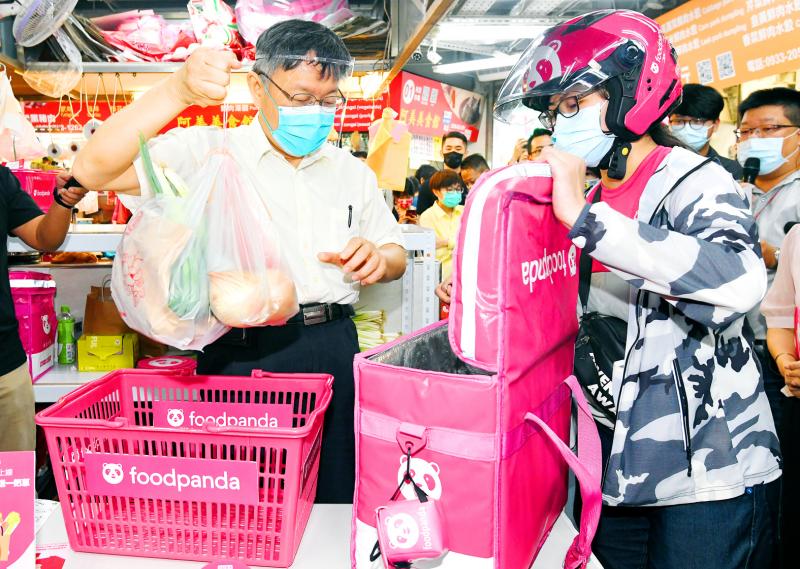
Photo: Liao Chen-huei, Taipei Times
With each of these responsibilities in mind, Ko said that offering direct subsidies to uncompetitive industries is not as attractive as helping businesses transition to a post-pandemic operating model as soon as possible.
Businesses cannot expect to return to their old operating model after the pandemic, Ko said.
For instance, traditional markets, cafeterias and night markets cannot expect that customers would return as though nothing happened, willing to eat in a crowded public space, he said.
To help these businesses adapt to new consumer habits, the city government has begun a delivery service fee subsidy program, Ko said.
A total of NT$42 million has been set aside for market vendors to cover delivery platforms’ service fees, Taipei Department of Economic Development Commissioner Lin Chung-chieh (林崇傑) said.
Businesses with tax registration can apply to cover half of their monthly delivery service fees up to NT$10,000, capped at a total of NT$60,000, Lin said.
Those without tax registration can apply to cover one-quarter of their fees up to NT$5,000 for up to six months, Lin added.
Stalls at 21 traditional markets and eight night markets have so far applied, with some delivery platforms offering promotions, he said, encouraging people to take advantage of the program.
Asked whether the city could further ease certain pandemic restrictions, Ko said that libraries, parks, recreational equipment and other facilities would gradually reopen if case numbers continue to fall and the outbreak is brought under control.
Gradual reopening is necessary to identify and control problems as soon as they arise, he added.

The Centers for Disease Control (CDC) yesterday reported the first case of a new COVID-19 subvariant — BA.3.2 — in a 10-year-old Singaporean girl who had a fever upon arrival in Taiwan and tested positive for the disease. The girl left Taiwan on March 20 and the case did not have a direct impact on the local community, it said. The WHO added the BA.3.2 strain to its list of Variants Under Monitoring in December last year, but this was the first imported case of the COVID-19 variant in Taiwan, CDC Deputy Director-General Lin Ming-cheng (林明誠) said. The girl arrived in Taiwan on

South Korea is planning to revise its controversial electronic arrival card, a step Taiwanese officials said prompted them to hold off on planned retaliatory measures, a South Korean media report said yesterday. A Yonhap News Agency report said that the South Korean Ministry of Foreign Affairs is planning to remove the “previous departure place” and “next destination” fields from its e-arrival card system. The plan, reached after interagency consultations, is under review and aims to simplify entry procedures and align the electronic form with the paper version, a South Korean ministry official said. The fields — which appeared only on the electronic form

A bipartisan group of US senators has introduced a bill to enhance cooperation with Taiwan on drone development and to reduce reliance on supply chains linked to China. The proposed Blue Skies for Taiwan Act of 2026 was introduced by Republican US senators Ted Cruz and John Curtis, and Democratic US senators Jeff Merkley and Andy Kim. The legislation seeks to ease constraints on Taiwan-US cooperation in uncrewed aerial systems (UAS), including dependence on China-sourced components, limited access to capital and regulatory barriers under US export controls, a news release issued by Cruz on Wednesday said. The bill would establish a "Blue UAS

The Ministry of Foreign Affairs (MOFA) is suspending retaliation measures against South Korea that were set to take effect tomorrow, after Seoul said it is updating its e-arrival system, MOFA said today. The measures were to be a new round of retaliation after Taiwan on March 1 changed South Korea's designation on government-issued alien resident certificates held by South Korean nationals to "South Korea” from the "Republic of Korea," the country’s official name. The move came after months of protests to Seoul over its listing of Taiwan as "China (Taiwan)" in dropdown menus on its new online immigration entry system. MOFA last week


 RSS
RSS