


The Chinese Nationalist Party (KMT) is colluding with outside forces to harm the nation’s health authorities, as it is filing a lawsuit against the adoption of a domestically developed COVID-19 vaccine, Democratic Progressive Party (DPP) lawmakers said yesterday.
“We urge KMT Chairman Johnny Chiang (江啟臣) to drop the lawsuit, which is based on ridiculous reasons and groundless claims. We ask the KMT to stop abusing the resources of the judicial system,” DPP legislative caucus whip Liu Shyh-fang (劉世芳) said.
KMT officials led by Chiang and lawmakers on Tuesday filed the lawsuit at the Taipei District Prosecutors’ Office, accusing Minister of Health and Welfare Chen Shih-chung (陳時中) and Food and Drug Administration (FDA) Director Wu Shou-mei (吳秀梅) of granting emergency use authorization for the Medigen COVID-19 vaccine without adhering to standard procedure and to obtain personal financial gain.
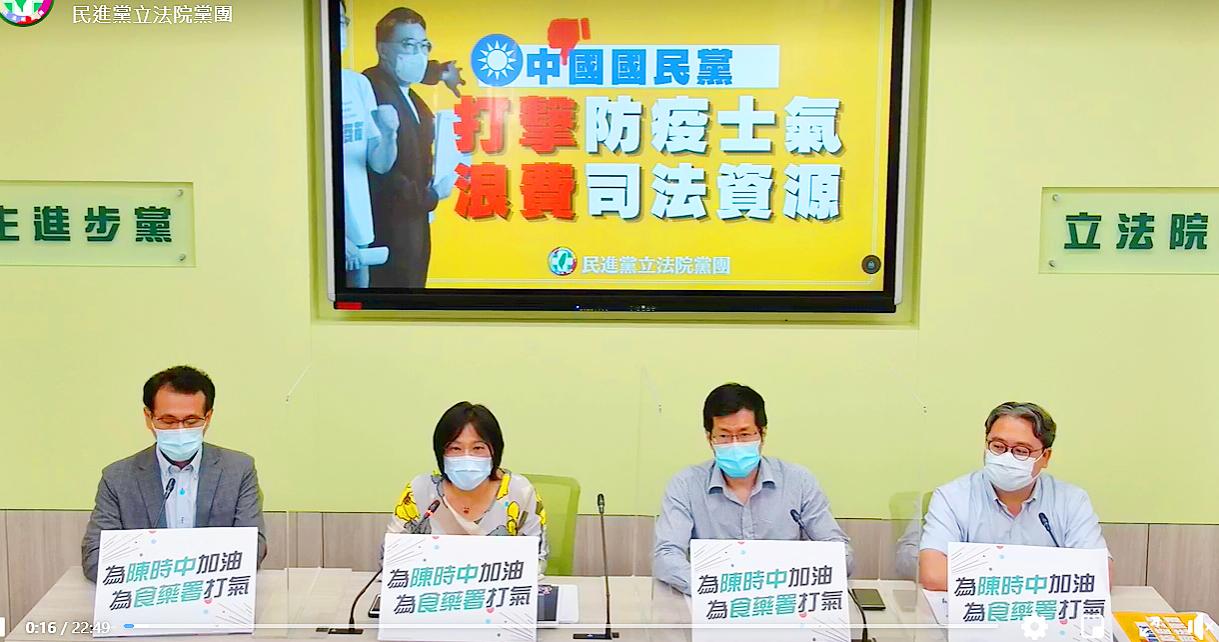
Photo copied by Chien Hui-ju, Taipei Times
DPP Legislator Cheng Yun-peng (鄭運鵬) said that the KMT has vilified Taiwan’s vaccine development efforts.
“The KMT is doing this to open the door to the Chinese-controlled distribution of BioNTech’s COVID-19 vaccine,” he said, refering to Shanghai Fosun Pharmaceutical Group, the German drugmaker’s distributor for Taiwan and China, including Hong Kong and Macau.
“KMT officials are conspiring with the Chinese government to create political dispute ... during this uncertain time” when the nation should focus on preventing the spread of COVID-19, Cheng added.
DPP Legislator Huang Shih-chieh (黃世杰) said that the FDA in May set conditions for vaccine emergency use authorization.
“The FDA has carried out the procedure based on international standards supported by the scientific community. The Medigen vaccine was granted conditional approval based on reviews by medical experts. There is no evidence of manipulation,” he said, adding that the process was transparent.
“The KMT’s claim that there was illegal profiteering is ridiculous,” he said.
The KMT is colluding with outside forces, with the apparent aim of bringing down the leaders of the FDA and the Central Epidemic Command Center, the two most crucial agencies in the nation’s disease prevention efforts, DPP legislative caucus secretary-general Lo Chih-cheng (羅致政) said.
“The KMT aims to create dispute, demoralize frontline medical workers and hamper Taiwan’s diligent efforts to bring the local infection situation under control,” Lo said.

The Centers for Disease Control (CDC) yesterday reported the first case of a new COVID-19 subvariant — BA.3.2 — in a 10-year-old Singaporean girl who had a fever upon arrival in Taiwan and tested positive for the disease. The girl left Taiwan on March 20 and the case did not have a direct impact on the local community, it said. The WHO added the BA.3.2 strain to its list of Variants Under Monitoring in December last year, but this was the first imported case of the COVID-19 variant in Taiwan, CDC Deputy Director-General Lin Ming-cheng (林明誠) said. The girl arrived in Taiwan on

South Korea is planning to revise its controversial electronic arrival card, a step Taiwanese officials said prompted them to hold off on planned retaliatory measures, a South Korean media report said yesterday. A Yonhap News Agency report said that the South Korean Ministry of Foreign Affairs is planning to remove the “previous departure place” and “next destination” fields from its e-arrival card system. The plan, reached after interagency consultations, is under review and aims to simplify entry procedures and align the electronic form with the paper version, a South Korean ministry official said. The fields — which appeared only on the electronic form
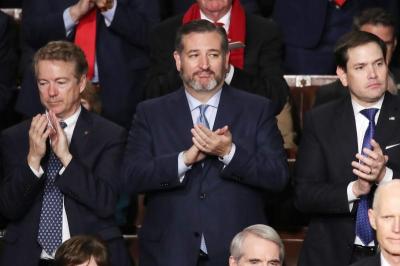
A bipartisan group of US senators has introduced a bill to enhance cooperation with Taiwan on drone development and to reduce reliance on supply chains linked to China. The proposed Blue Skies for Taiwan Act of 2026 was introduced by Republican US senators Ted Cruz and John Curtis, and Democratic US senators Jeff Merkley and Andy Kim. The legislation seeks to ease constraints on Taiwan-US cooperation in uncrewed aerial systems (UAS), including dependence on China-sourced components, limited access to capital and regulatory barriers under US export controls, a news release issued by Cruz on Wednesday said. The bill would establish a "Blue UAS

The Ministry of Foreign Affairs (MOFA) is suspending retaliation measures against South Korea that were set to take effect tomorrow, after Seoul said it is updating its e-arrival system, MOFA said today. The measures were to be a new round of retaliation after Taiwan on March 1 changed South Korea's designation on government-issued alien resident certificates held by South Korean nationals to "South Korea” from the "Republic of Korea," the country’s official name. The move came after months of protests to Seoul over its listing of Taiwan as "China (Taiwan)" in dropdown menus on its new online immigration entry system. MOFA last week


 RSS
RSS