


The Supreme Court yesterday upheld a ruling acquitting a Taiwanese ship owner and two other businessmen, along with three crew members, of charges related to selling oil to North Korea in open waters in 2018 in violation of UN sanctions. The ruling was final.
Taichung prosecutors in September 2019 charged the owner of the oil tanker Polaris and chairman of Rise Loyal Corp Tsai Tsung-lin (蔡宗霖), Wintak Petrochemical Group’s chairman, surnamed Chiu (邱), Pasis Trading Co’s chairman, surnamed Hsu (徐), and three foreign crew members of the Polaris with forging documents, presenting fraudulent invoices, falsifying customs declarations and contravening the Business Entity Accounting Act (商業會計法).
The prosecutors accused Tsai of dealing with Taiwanese petrochemical companies to transport fuel oil from the Port of Taichung to a location in the East China Sea on the Polaris.
The fuel was then transferred to another vessel, they said, adding that the alleged illicit transfers occurred from January to November 2018.
The transfers involved Chinese and North Korean-registered ships, and the deals were made mainly through a Chinese businessman named Xie Jiaqing (謝加慶), prosecutors said, calling the activities “illegal oil smuggling.”
The activities were being monitored by international agencies, as the UN had imposed an economic embargo against North Korea.
It was alleged that fuel oil was transferred from the Polaris to the North Korean-flagged Myong Ryu 1 in the East China Sea on May 24, 2018.
After Taiwan’s judiciary launched an investigation, prosecutors at the time said Tsai allegedly colluded with Xie to make 21 ship-to-ship transfers in 2018 for total of 92,000 tonnes of fuel oil worth an estimated NT$1.7 billion (US$60.6 million at the current exchange rate).
During court hearings, Tsai said he formed a commercial partnership with Chiu’s and Hsu’s firms to operate a “marine fuel depot” for ship-to-ship oil transfers, which he said was a “legal business transaction” on the open seas that was not prohibited by Taiwanese law.
The accused denied any wrongdoing, saying the vessel pictured in satellite imagery presented in court as evidence did not look like the Polaris, adding that it was a case of mistaken identity.
The Taichung District Court found the defendants not guilty and a second ruling by the High Court last year also acquitted them.
Prosecutors appealed the ruling, which led to the Supreme Court’s final verdict yesterday.
The ship’s Burmese captain Aung Nyein, Chinese chief steward Huang Jianwei (黃建威) and two Indonesian crew members were last year allowed to return home after having been stranded on the ship for nearly two years, due to travel restrictions placed on them while litigation was under way.
Their plight caused an outcry from humanitarian groups after power to the ship was cut and the crew’s provisions ran out. Civic groups provided aid to the crew until their release.
After learning of yesterday’s verdict, Tsai said the lawsuit and having to fire-sale the ship caused his company to incur losses of about NT$200 million.
“However, I am glad that it is finally over, and that the court has restored justice for us. I can be proud to walk in public, to say that I have been proven an innocent man,” he said.
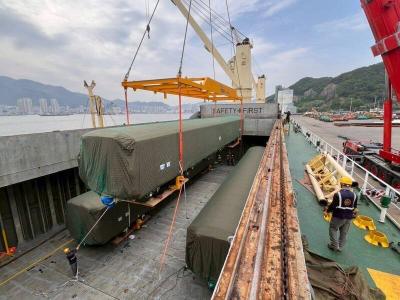
The first of 10 new high-capacity trains purchased from South Korea’s Hyundai Rotem arrived at the Port of Taipei yesterday to meet the demands of an expanding metro network, Taipei Rapid Transit Corp (TRTC) said yesterday. The train completed a three-day, 1,200km voyage from the Port of Masan in South Korea, the company said. Costing NT$590 million (US$18.79 million) each, the new six-carriage trains feature a redesigned interior based on "human-centric" transportation concepts, TRTC said. The design utilizes continuous longitudinal seating to widen the aisles and optimize passenger flow, while also upgrading passenger information displays and driving control systems for a more comfortable
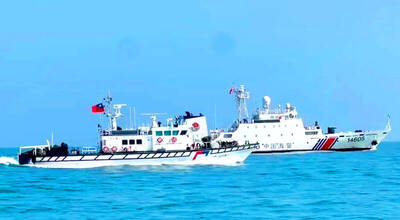
Instead of focusing solely on the threat of a full-scale military invasion, the US and its allies must prepare for a potential Chinese “quarantine” of Taiwan enforced through customs inspections, Stanford University Hoover fellow Eyck Freymann said in a Foreign Affairs article published on Wednesday. China could use various “gray zone” tactics in “reconfiguring the regional and ultimately the global economic order without a war,” said Freymann, who is also a nonresident research fellow at the US Naval War College. China might seize control of Taiwan’s links to the outside world by requiring all flights and ships entering or leaving Taiwan
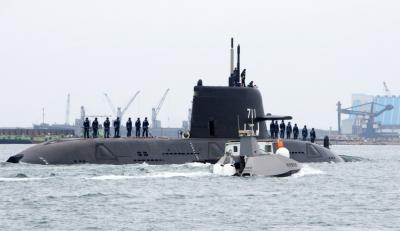
Taiwan's first indigenous defense submarine, the SS-711 Hai Kun (海鯤, or Narwhal), departed for its 13th sea trial at 7am today, marking its seventh submerged test, with delivery to the navy scheduled for July. The outing also marked its first sea deployment since President William Lai (賴清德) boarded the submarine for an inspection on March 19, drawing a crowd of military enthusiasts who gathered to show support. The submarine this morning departed port accompanied by CSBC Corp’s Endeavor Manta (奮進魔鬼魚號) uncrewed surface vessel and a navy M109 assault boat. Amid public interest in key milestones such as torpedo-launching operations and overnight submerged trials,
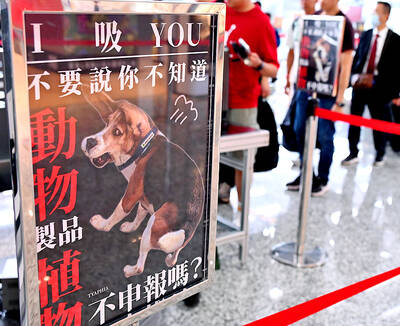
Quarantine awareness posters at Taiwan Taoyuan International Airport have gone viral for their use of wordplay. Issued by the airport branch of the Animal and Plant Health Inspection Agency, the posters feature sniffer dogs making a range of facial expressions, paired with advisory messages built around homophones. “We update the messages for holidays and campaign needs, periodically refreshing materials to attract people’s attention,” quarantine officials said. “The aim is to use the dogs’ appeal to draw focus to quarantine regulations.” A Japanese traveler visiting Taiwan has posted a photo on X of a poster showing a quarantine dog with a


 RSS
RSS