


The Civil Aeronautics Administration (CAA) is to activate two new long-range radar systems by the end of the year to monitor the nation’s airspace, it said on Wednesday.
The systems — which are installed in Cape Santiago (三貂角) and Oluanpi (鵝鑾鼻), in the easternmost and southernmost points of Taiwan proper respectively — were installed to meet an increase in civil aviation flights over the past few years through the Taipei Flight Information Region, which is an important aviation hub for East Asia, the agency said.
The nation’s current long-range radar systems have been in service for more than 20 years, and while they are regularly maintained, it has become increasingly difficult to find replacement parts and to keep up with maintenance costs, it said.
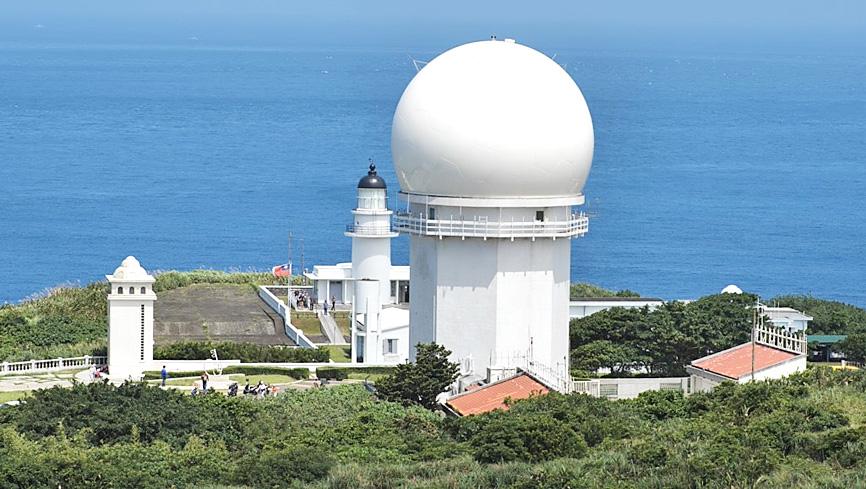
Photo courtesy of the Civil Aeronautics Administration
In 2019, the CAA was allocated NT$676 million (US$24.1 million) to upgrade aviation radar systems. For the long-range radar upgrades, the agency installed a new primary surveillance radar system, while ensuring that the secondary surveillance radar system is equipped with Mode S functionality, which allows selective interrogation of aircraft according to a unique 24-bit address assigned by the International Civil Aviation Organization.
The CAA encountered many challenges dismantling the long-range radar system at Cape Santiago, which is on a mountaintop, it said.
The circuitous mountain route made it difficult for large construction vehicles to access the radar station, and construction crews could only transport three large radome panels from the station at a time, it added.
The COVID-19 pandemic presented additional issues, such as uncertainty over the timing in receiving components and technical specialists from overseas, the agency said.
As the new radar system is 32.3m tall, construction would need to stop during the northeast monsoon or a strong wind, it said.
The CAA is testing the long-range radar systems, which involves parameter adjustments, an on-site acceptance test and a 30-day confidence test.
The long-range radar systems are built using 101 panels, with each system weighing 5.2 tonnes, the CAA said, adding that the radomes’ bases are coated with special paint to prevent corrosion.
The agency’s Air Navigation and Weather Services have 11 radar systems across the nation, including nine terminal area radar systems and two long-range radar systems.
The primary radar system is capable of detecting flights within 200 nautical miles (370.4km), with a surveillance capacity of 1,000 flights.
The secondary radar system can detect flights within 250 nautical miles, with a surveillance capacity of 500 flights.
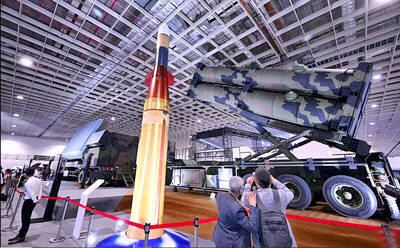
Taiwan is to commence mass production of the Tien Kung (天弓, “Sky Bow”) III, IV and V missiles by the second quarter of this year if the legislature approves the government’s NT$1.25 trillion (US$39.78 billion) special defense budget, an official said yesterday. Commenting on condition of anonymity, a defense official with knowledge of the matter said that the advanced systems are expected to provide crucial capabilities against ballistic and cruise missiles for the proposed “T-Dome,” an advanced, multi-layered air defense network. The Tien Kung III is an air defense missile with a maximum interception altitude of 35km. The Tien Kung IV and V
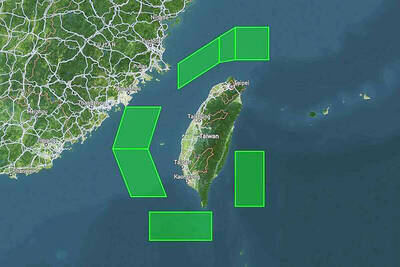
The disruption of 941 flights in and out of Taiwan due to China’s large-scale military exercises was no accident, but rather the result of a “quasi-blockade” used to simulate creating the air and sea routes needed for an amphibious landing, a military expert said. The disruptions occurred on Tuesday and lasted about 10 hours as China conducted live-fire drills in the Taiwan Strait. The Civil Aviation Administration (CAA) said the exercises affected 857 international flights and 84 domestic flights, affecting more than 100,000 travelers. Su Tzu-yun (蘇紫雲), a research fellow at the government-sponsored Institute for National Defense and Security Research, said the air
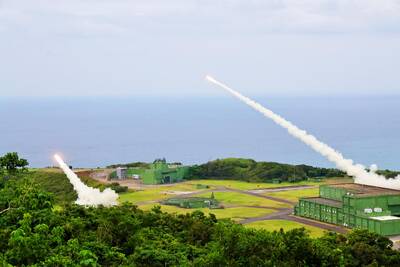
Taiwan lacks effective and cost-efficient armaments to intercept rockets, making the planned “T-Dome” interception system necessary, two experts said on Tuesday. The concerns were raised after China’s military fired two waves of rockets during live-fire drills around Taiwan on Tuesday, part of two-day exercises code-named “Justice Mission 2025.” The first wave involved 17 rockets launched at 9am from Pingtan in China’s Fujian Province, according to Lieutenant General Hsieh Jih-sheng (謝日升) of the Office of the Deputy Chief of the General Staff for Intelligence at the Ministry of National Defense. Those rockets landed 70 nautical miles (129.6km) northeast of Keelung without flying over Taiwan,
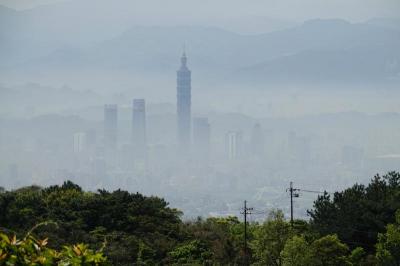
A strong continental cold air mass is to bring pollutants to Taiwan from tomorrow, the Ministry of Environment said today, as it issued an “orange” air quality alert for most of the country. All of Taiwan except for Hualien and Taitung counties is to be under an “orange” air quality alert tomorrow, indicating air quality that is unhealthy for sensitive groups. In China, areas from Shandong to Shanghai have been enveloped in haze since Saturday, the ministry said in a news release. Yesterday, hourly concentrations of PM2.5 in these areas ranged from 65 to 160 micrograms per cubic meter (mg/m³), and pollutants were


 RSS
RSS