


The government must include young people in its COVID-19 vaccination plan if its goal of herd immunity is to be achieved, Chinese Nationalist Party (KMT) Chairman Johnny Chiang (江啟臣) said yesterday, as he criticized the ruling party for failing to purchase enough vaccines to cover adolescents.
Addressing a virtual news conference held by the KMT’s Youth Department, Chiang reiterated his call for the Democratic Progressive Party (DPP) administration to purchase safe, internationally recognized vaccines for the nation’s millions of young people.
Failing to purchase vaccines today would be tomorrow’s regret, he added.
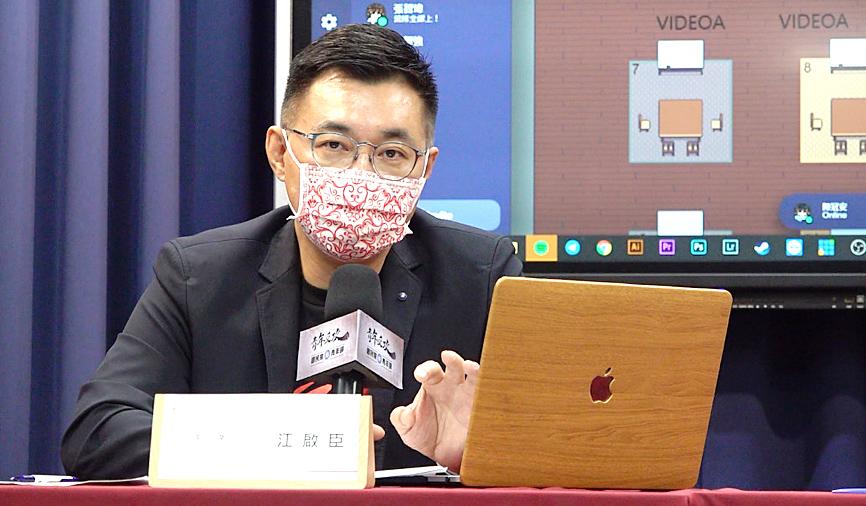
Photo: Shih Hsiao-kuang, Taipei Times
In addition, Chiang raised concerns about rising joblessness and limited stimulus for younger age groups.
The unemployment rate is likely to climb as students graduate, he said, citing data indicating that 80 percent of graduates are willing to accept a lower salary if it means finding a job.
However, only about 20 percent are expected to find employment, he said.
Adding to what Chiang calls a messy stimulus rollout, young people have been “pushed to the sidelines,” he said, calling on the DPP to convene a provisional Legislative Yuan meeting to address these issues.
Meanwhile, the Economic Democracy Union yesterday released a statement urging the private sector not to cross the “red line” dividing generosity and collusion when procuring vaccines on behalf of the government.
Hon Hai Precision Industry Co and Taiwan Semiconductor Manufacturing Co are in the process of procuring vaccines from Germany’s BioNTech, which has contracted China’s Shanghai Fosun Pharmaceutical Group to distribute the vaccines in Taiwan, China, Hong Kong and Macau.
The government is allowing the companies to make the purchases on its behalf as long as they are manufactured and packaged by the original manufacturer and delivered straight to Taiwan.
To ensure vaccine quality and prevent China from taking the opportunity to belittle Taiwan, the union recommended four additional requirements.
First, the firms should insist on using the original German packaging, and reject labeling advertising Chinese consent or its authorization of Shanghai Fosun to “care for the health and welfare of Taiwanese compatriots,” the union said.
Second, vaccines should be delivered directly from Germany on Taiwanese airlines, it said.
Third, ownership of the vaccines should be transferred to the government before they depart from Germany to ensure that they meet contract requirements and prevent China from delaying delivery, it added.
Fourth, the firms should not cooperate with Shanghai Fosun on any ceremonies or promotions regarding the procurement, it said.
Regarding reports that the companies have not named any government representatives in their negotiations, the union said that commercial procurement contracts cannot legally involve government authority or coerce the government into accepting certain arrangements.
The union also urged the companies to ensure that the contracts do not consent to the collection or transfer of personal data to China.
There is much that the government should do to procure vaccines, but “falling into China’s political trap” is not one of them, the union said, calling on Taiwanese to remain wary of Beijing’s political machinations.

The Centers for Disease Control (CDC) yesterday reported the first case of a new COVID-19 subvariant — BA.3.2 — in a 10-year-old Singaporean girl who had a fever upon arrival in Taiwan and tested positive for the disease. The girl left Taiwan on March 20 and the case did not have a direct impact on the local community, it said. The WHO added the BA.3.2 strain to its list of Variants Under Monitoring in December last year, but this was the first imported case of the COVID-19 variant in Taiwan, CDC Deputy Director-General Lin Ming-cheng (林明誠) said. The girl arrived in Taiwan on

South Korea is planning to revise its controversial electronic arrival card, a step Taiwanese officials said prompted them to hold off on planned retaliatory measures, a South Korean media report said yesterday. A Yonhap News Agency report said that the South Korean Ministry of Foreign Affairs is planning to remove the “previous departure place” and “next destination” fields from its e-arrival card system. The plan, reached after interagency consultations, is under review and aims to simplify entry procedures and align the electronic form with the paper version, a South Korean ministry official said. The fields — which appeared only on the electronic form
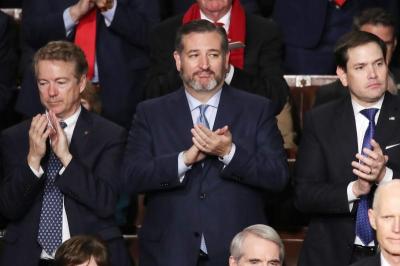
A bipartisan group of US senators has introduced a bill to enhance cooperation with Taiwan on drone development and to reduce reliance on supply chains linked to China. The proposed Blue Skies for Taiwan Act of 2026 was introduced by Republican US senators Ted Cruz and John Curtis, and Democratic US senators Jeff Merkley and Andy Kim. The legislation seeks to ease constraints on Taiwan-US cooperation in uncrewed aerial systems (UAS), including dependence on China-sourced components, limited access to capital and regulatory barriers under US export controls, a news release issued by Cruz on Wednesday said. The bill would establish a "Blue UAS

The Ministry of Foreign Affairs (MOFA) is suspending retaliation measures against South Korea that were set to take effect tomorrow, after Seoul said it is updating its e-arrival system, MOFA said today. The measures were to be a new round of retaliation after Taiwan on March 1 changed South Korea's designation on government-issued alien resident certificates held by South Korean nationals to "South Korea” from the "Republic of Korea," the country’s official name. The move came after months of protests to Seoul over its listing of Taiwan as "China (Taiwan)" in dropdown menus on its new online immigration entry system. MOFA last week


 RSS
RSS