


The Central Epidemic Command Center (CECC) yesterday detailed the timeline of events leading up to its joint news conference with the Taipei City Government on Friday last week in response to accusations from Taipei Mayor Ko Wen-je (柯文哲) that the center tried to “set him up.”
Ko in an interview on Wednesday with Broadcasting Corp of China chairman Jaw Shaw-kong (趙少康) said that the CECC only notified him of the news conference at Huannan Market (環南市場) 30 minutes in advance.
Only after he arrived and found so many officials present and prepared did he realize that he had been “lured into a trap,” Ko said.
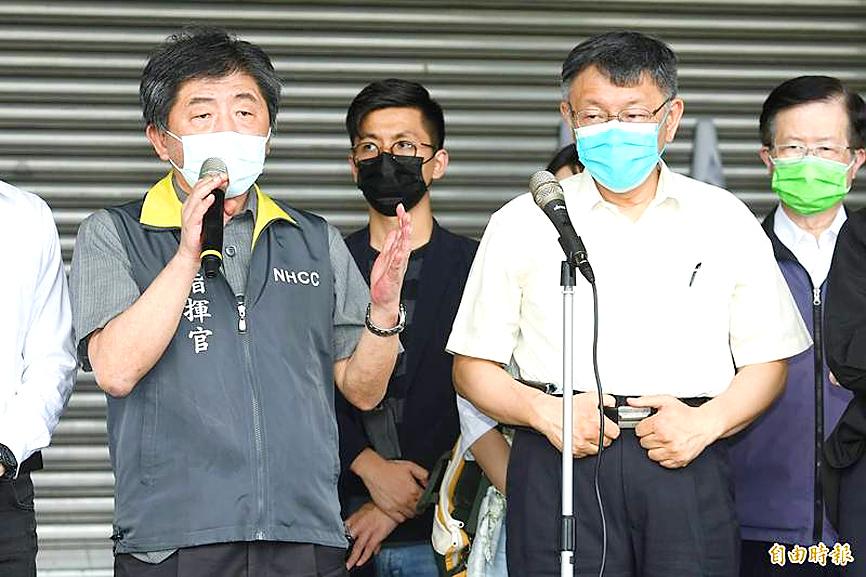
Photo: Yang Hsin-hui, Taipei Times
In response to the confirmation of 41 COVID-19 cases linked to the market in Taipei’s Wanhua District (萬華) on Friday last week, the CECC said it decided to convene a news conference on that day at 11:30am to unveil a joint command mission with the Taipei City Government.
At 9:45am, Minister of Health and Welfare Chen Shih-chung (陳時中), who heads the center, called Taipei Deputy Mayor Vivian Huang (黃珊珊) about the event, it said.
Huang transferred the call to Ko, who agreed with Chen on creating the joint command, it added.
At about 10am, Council of Agriculture Minister Chen Chi-chung (陳吉仲) called Huang twice, in the second call specifying that he, Chen Shih-chung and Minister of Economic Affairs Wang Mei-hua (王美花) would be attending the news conference, it added.
After Chen Chi-chung invited Huang to attend, she said Ko would also be attending, the CECC said.
At 11:01am, Taipei City Government spokeswoman Chen Chih-han (陳智菡) notified the media of the event, saying that Ko and Huang would be present, it said.
At 11:20am, Ko and Huang arrived at the market, it added.
The news conference was held to explain response measures to market vendors, workers and residents, not to “set a trap,” it said.
Ko in the interview with Jaw also claimed to have a list of Presidential Office staff who had been vaccinated, which he vowed to publicize “in due time.”
Chinese Nationalist Party (KMT) Legislator Lee De-wei (李德維) lent his support to the threat, saying that Taipei’s records could expose the preferential vaccination of many top officials and their loved ones.
Presidential Office spokesman Xavier Chang (張惇涵) said that all qualified staff had gotten vaccinated based on expert recommendations and proper procedures.
Vaccines are crucial to the pandemic response and national security, and to protect the president and vice president, he added.
Asked by Jaw whether he would run for president in 2024, Ko said he only needs to make an announcement if he does not run, but he would not force the issue.
Upon leaving office next year, he would still have 13 months until the election, Ko said, adding that he would first focus on finishing his current tasks.
Ko said that he would be open to cooperating with the pan-blue or the pan-green camp, depending on the terms, but that discussion would need to wait, since Taiwanese politics changes by the day.
Ko suggested that the Democratic Progressive Party is intentionally stirring up anti-China sentiment as the issue is politically popular.
Ninety percent of people consider themselves to be Taiwanese, so “Taiwanese independence” is not worth discussing, he said.
However, independence is a real issue, and maintaining the “status quo” is the only option, he said.
Additional reporting by Lin Liang-sheng and CNA

The Centers for Disease Control (CDC) yesterday reported the first case of a new COVID-19 subvariant — BA.3.2 — in a 10-year-old Singaporean girl who had a fever upon arrival in Taiwan and tested positive for the disease. The girl left Taiwan on March 20 and the case did not have a direct impact on the local community, it said. The WHO added the BA.3.2 strain to its list of Variants Under Monitoring in December last year, but this was the first imported case of the COVID-19 variant in Taiwan, CDC Deputy Director-General Lin Ming-cheng (林明誠) said. The girl arrived in Taiwan on

South Korea is planning to revise its controversial electronic arrival card, a step Taiwanese officials said prompted them to hold off on planned retaliatory measures, a South Korean media report said yesterday. A Yonhap News Agency report said that the South Korean Ministry of Foreign Affairs is planning to remove the “previous departure place” and “next destination” fields from its e-arrival card system. The plan, reached after interagency consultations, is under review and aims to simplify entry procedures and align the electronic form with the paper version, a South Korean ministry official said. The fields — which appeared only on the electronic form

A bipartisan group of US senators has introduced a bill to enhance cooperation with Taiwan on drone development and to reduce reliance on supply chains linked to China. The proposed Blue Skies for Taiwan Act of 2026 was introduced by Republican US senators Ted Cruz and John Curtis, and Democratic US senators Jeff Merkley and Andy Kim. The legislation seeks to ease constraints on Taiwan-US cooperation in uncrewed aerial systems (UAS), including dependence on China-sourced components, limited access to capital and regulatory barriers under US export controls, a news release issued by Cruz on Wednesday said. The bill would establish a "Blue UAS

The Ministry of Foreign Affairs (MOFA) is suspending retaliation measures against South Korea that were set to take effect tomorrow, after Seoul said it is updating its e-arrival system, MOFA said today. The measures were to be a new round of retaliation after Taiwan on March 1 changed South Korea's designation on government-issued alien resident certificates held by South Korean nationals to "South Korea” from the "Republic of Korea," the country’s official name. The move came after months of protests to Seoul over its listing of Taiwan as "China (Taiwan)" in dropdown menus on its new online immigration entry system. MOFA last week


 RSS
RSS