


Like many humans, Emma has had her travel plans derailed by the COVID-19 pandemic, but after months of delay, the white rhino has arrived in Japan and is looking for love.
The five-year-old comes by way of Hsinchu County’s Leofoo Safari Park, where she beat a herd of competitors for the chance to find a companion and breed.
She had been scheduled for transfer to the Tobu Zoo in Tokyo’s Saitama Prefecture in March.
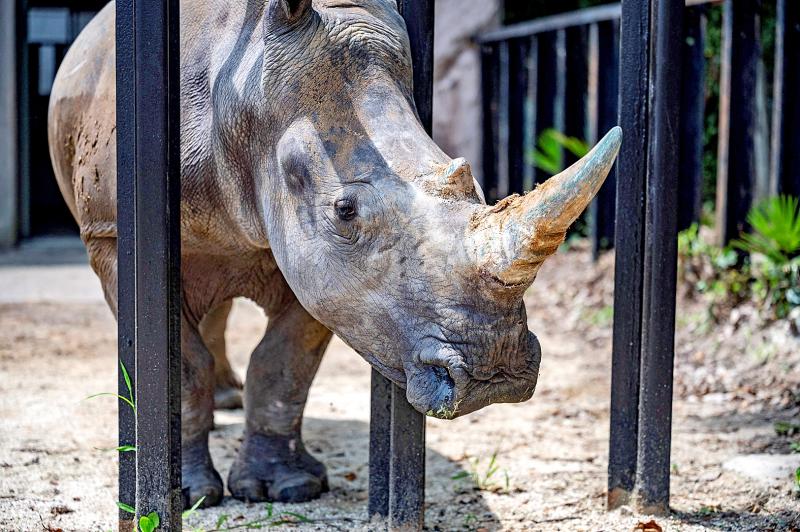
Photo: Philip Fong, AFP
“After some delays due to the coronavirus, Emma, a southern white rhino, arrived at our zoo on the evening of June 8,” the Tobu Zoo said. “We slowly opened the shipping container that had been placed in front of her sleeping room. Emma, without showing any signs of shyness, went straight into the sleeping room.”
The rhino used the extra time in Taiwan to prepare for the move, with keepers using Japanese for words like “come” and “no” to get her ready for her new home.
Safari staff said that she was picked from a herd of 23 rhinos because of her even temper and slender physique.
“Emma was chosen because of her mild personality ... and her smaller size also makes it easier to ship overseas,” park chief veterinarian and animal manager Sean Wu said earlier this year. “She seldom gets into fights with other rhinos or snatches others’ food.”
She is expected to be on show to the public in Japan for several weeks, but she also has the more serious business of getting acquainted with her first suitor: 10-year-old Moran.
Zoo breeding programs have played a key role in repopulating southern white rhino herds.
The species numbers about 19,000 rhinos found in the wild across southern Africa, the conservation group Save the Rhino said.
Their northern cousins were not so lucky. Only two remain, both female, rendering the species functionally extinct.
Leofoo Safari Park imported eight rhinos from Africa in 1979 and has the most successful breeding program in Asia, with 23 animals in its herd.

The Centers for Disease Control (CDC) yesterday reported the first case of a new COVID-19 subvariant — BA.3.2 — in a 10-year-old Singaporean girl who had a fever upon arrival in Taiwan and tested positive for the disease. The girl left Taiwan on March 20 and the case did not have a direct impact on the local community, it said. The WHO added the BA.3.2 strain to its list of Variants Under Monitoring in December last year, but this was the first imported case of the COVID-19 variant in Taiwan, CDC Deputy Director-General Lin Ming-cheng (林明誠) said. The girl arrived in Taiwan on

South Korea is planning to revise its controversial electronic arrival card, a step Taiwanese officials said prompted them to hold off on planned retaliatory measures, a South Korean media report said yesterday. A Yonhap News Agency report said that the South Korean Ministry of Foreign Affairs is planning to remove the “previous departure place” and “next destination” fields from its e-arrival card system. The plan, reached after interagency consultations, is under review and aims to simplify entry procedures and align the electronic form with the paper version, a South Korean ministry official said. The fields — which appeared only on the electronic form

A bipartisan group of US senators has introduced a bill to enhance cooperation with Taiwan on drone development and to reduce reliance on supply chains linked to China. The proposed Blue Skies for Taiwan Act of 2026 was introduced by Republican US senators Ted Cruz and John Curtis, and Democratic US senators Jeff Merkley and Andy Kim. The legislation seeks to ease constraints on Taiwan-US cooperation in uncrewed aerial systems (UAS), including dependence on China-sourced components, limited access to capital and regulatory barriers under US export controls, a news release issued by Cruz on Wednesday said. The bill would establish a "Blue UAS

The Ministry of Foreign Affairs (MOFA) is suspending retaliation measures against South Korea that were set to take effect tomorrow, after Seoul said it is updating its e-arrival system, MOFA said today. The measures were to be a new round of retaliation after Taiwan on March 1 changed South Korea's designation on government-issued alien resident certificates held by South Korean nationals to "South Korea” from the "Republic of Korea," the country’s official name. The move came after months of protests to Seoul over its listing of Taiwan as "China (Taiwan)" in dropdown menus on its new online immigration entry system. MOFA last week


 RSS
RSS