


Remote learning can place increased strain on children’s eyes and parents should supervise the amount of time they spend in front of a screen during the COVID-19 pandemic, a Hsinchu-based ophthalmologist said.
Taiwan’s level 3 COVID-19 alert means that schools nationwide remain closed and have shifted to online classes.
Chen Ying-shan (陳瑩山), a doctor at China Medical University Hospital’s Hsinchu Branch, said that he recently treated a high-school student whose sight declined from minus-1.5 to minus-3.5 diopters since the COVID-19 outbreak began.
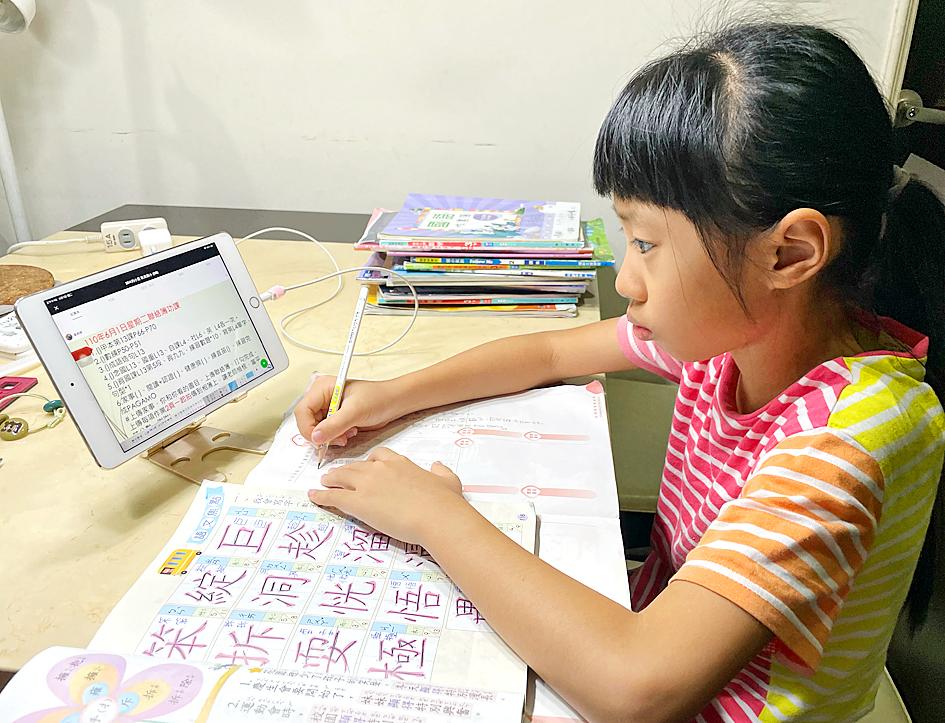
Photo: Liu Hsin-de, Taipei Times
The child had been learning from home and spent too much looking at screens, which created tension in the ciliary muscles and an overabundance of blood in the eye tissue, he said.
This can result in worsening myopia, fatigue and soreness of the eyes, he said, adding that eye drops taken nightly relieved the soreness the student was experiencing, while rest might reverse some of the vision loss.
A child learning from home should take a 10-minute break for every 30 minutes of online classes and should be made to leave their desks, do eye exercises, stretches and walk around the home, he said.
Resting the eyes means not using devices with screens, especially cellphones, which have a smaller screen than computers and are more tiring on the eyes, he said.
Lutein, which is found in leafy greens and egg yolks, is good for the eyes, he said, adding that about 6 to 10mg should be ingested per day, or about the amount contained in a bowl of spinach.
Moderate amounts of protein and five types of fruits and vegetables should be eaten daily, and deep-fried foods should be avoided, he said, adding that trans fats can harm eye health by hardening the blood vessels.

The Centers for Disease Control (CDC) yesterday reported the first case of a new COVID-19 subvariant — BA.3.2 — in a 10-year-old Singaporean girl who had a fever upon arrival in Taiwan and tested positive for the disease. The girl left Taiwan on March 20 and the case did not have a direct impact on the local community, it said. The WHO added the BA.3.2 strain to its list of Variants Under Monitoring in December last year, but this was the first imported case of the COVID-19 variant in Taiwan, CDC Deputy Director-General Lin Ming-cheng (林明誠) said. The girl arrived in Taiwan on

South Korea is planning to revise its controversial electronic arrival card, a step Taiwanese officials said prompted them to hold off on planned retaliatory measures, a South Korean media report said yesterday. A Yonhap News Agency report said that the South Korean Ministry of Foreign Affairs is planning to remove the “previous departure place” and “next destination” fields from its e-arrival card system. The plan, reached after interagency consultations, is under review and aims to simplify entry procedures and align the electronic form with the paper version, a South Korean ministry official said. The fields — which appeared only on the electronic form

A bipartisan group of US senators has introduced a bill to enhance cooperation with Taiwan on drone development and to reduce reliance on supply chains linked to China. The proposed Blue Skies for Taiwan Act of 2026 was introduced by Republican US senators Ted Cruz and John Curtis, and Democratic US senators Jeff Merkley and Andy Kim. The legislation seeks to ease constraints on Taiwan-US cooperation in uncrewed aerial systems (UAS), including dependence on China-sourced components, limited access to capital and regulatory barriers under US export controls, a news release issued by Cruz on Wednesday said. The bill would establish a "Blue UAS

The Ministry of Foreign Affairs (MOFA) is suspending retaliation measures against South Korea that were set to take effect tomorrow, after Seoul said it is updating its e-arrival system, MOFA said today. The measures were to be a new round of retaliation after Taiwan on March 1 changed South Korea's designation on government-issued alien resident certificates held by South Korean nationals to "South Korea” from the "Republic of Korea," the country’s official name. The move came after months of protests to Seoul over its listing of Taiwan as "China (Taiwan)" in dropdown menus on its new online immigration entry system. MOFA last week


 RSS
RSS