


People who are allergic to certain foods or medications should still get vaccinated against COVID-19, as most reactions can be treated, a Linkou Chang Gung Memorial Hospital medical expert said on Thursday.
Dermatologist Chung Wen-hung (鐘文宏), who is also director of the Taoyuan hospital’s Drug Hypersensitivity Clinical and Research Center, urged people to get vaccinated as soon as they are allowed to, because the virus is more deadly than vaccine-induced allergic reactions.
Most allergic reactions triggered by vaccines can be treated, Chung said, adding that the hospital has received many inquiries about this issue after the Central Epidemic Command Center (CECC) announced an expanded vaccination program.
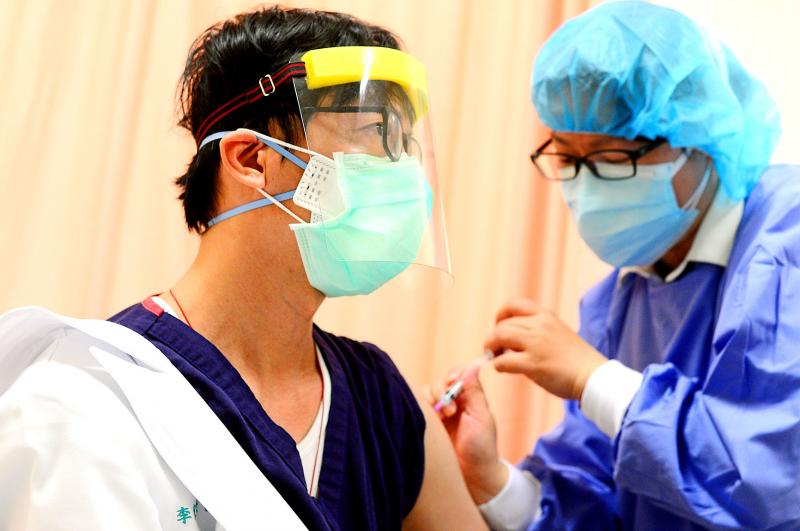
Photo: Wang Yi-sung, Taipei Times
From Tuesday next week, people aged 75 or older, residents and staff at long-term care facilities, and people on dialysis are to be eligible for vaccination, the CECC has said.
Currently, only medical personnel, epidemic prevention workers and people in other high-risk jobs are on priority lists.
At least 759,000 COVID-19 vaccine doses had been administered in Taiwan as of Thursday, most of them from AstraZeneca.
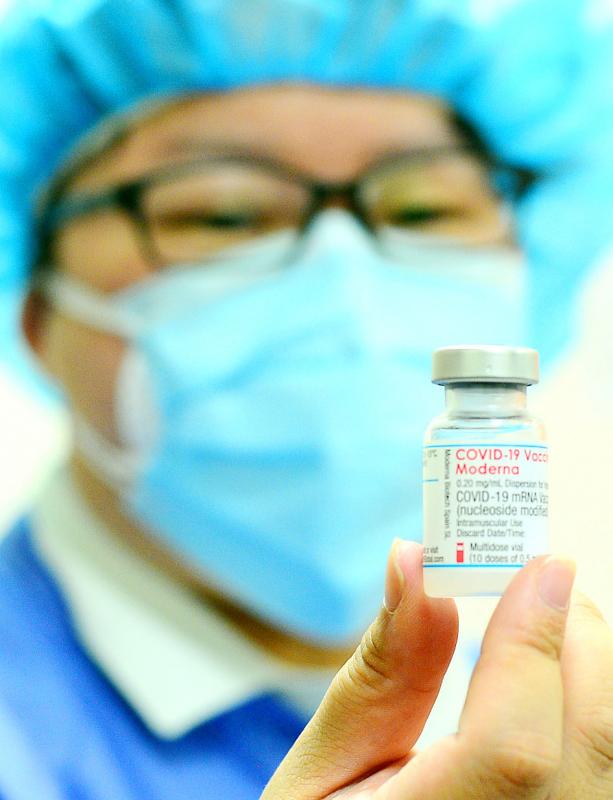
Photo: Wang Yi-sung, Taipei Times
So far, Taiwan has reported one case of blood clotting and more than 100 incidents of severe allergic reactions, all of which were related to the AstraZeneca vaccine.
Some people might have an acute allergic reaction, such as hives or shortness of breath, shortly after a jab, while others might get a rash or a more serious response a few days after the injection, Chung said.
However, such symptoms typically subside after treatment, he said.
Taiwanese are more prone to medicine-induced allergic reactions than people from other countries, he said.
Chung did not explain why, but said that allergies to food and medication usually indicate a high sensitivity to external substances.
Chen Wei-ti (陳偉迪), another dermatologist at Linkou Chang Gung Memorial Hospital, said that vaccine-induced allergic reactions are linked to excipients, a substance added to a vaccine as a stabilizer or for other purposes.
Vaccines manufactured by AstraZeneca and Johnson & Johnson contain an excipient called polysorbate, while vaccines developed by Pfizer-BioNTech and Moderna use polyethylene glycol (PEG), Chen said.
The US Centers for Disease Control and Prevention advise people who are allergic to polysorbate to not get AstraZeneca or Johnson & Johnson vaccines, but use brands that use PEG, Chung said.
Similarly, those who are allergic to PEG should not get the Pfizer-BioNTech or Moderna jabs, he cited the US agency as saying.
People should always inform medical personnel of allergies before receiving any vaccine, he said.
Anyone who has an allergic reaction after a first dose should consider a different brand for their second dose, he said.

The Centers for Disease Control (CDC) yesterday reported the first case of a new COVID-19 subvariant — BA.3.2 — in a 10-year-old Singaporean girl who had a fever upon arrival in Taiwan and tested positive for the disease. The girl left Taiwan on March 20 and the case did not have a direct impact on the local community, it said. The WHO added the BA.3.2 strain to its list of Variants Under Monitoring in December last year, but this was the first imported case of the COVID-19 variant in Taiwan, CDC Deputy Director-General Lin Ming-cheng (林明誠) said. The girl arrived in Taiwan on

South Korea is planning to revise its controversial electronic arrival card, a step Taiwanese officials said prompted them to hold off on planned retaliatory measures, a South Korean media report said yesterday. A Yonhap News Agency report said that the South Korean Ministry of Foreign Affairs is planning to remove the “previous departure place” and “next destination” fields from its e-arrival card system. The plan, reached after interagency consultations, is under review and aims to simplify entry procedures and align the electronic form with the paper version, a South Korean ministry official said. The fields — which appeared only on the electronic form

A bipartisan group of US senators has introduced a bill to enhance cooperation with Taiwan on drone development and to reduce reliance on supply chains linked to China. The proposed Blue Skies for Taiwan Act of 2026 was introduced by Republican US senators Ted Cruz and John Curtis, and Democratic US senators Jeff Merkley and Andy Kim. The legislation seeks to ease constraints on Taiwan-US cooperation in uncrewed aerial systems (UAS), including dependence on China-sourced components, limited access to capital and regulatory barriers under US export controls, a news release issued by Cruz on Wednesday said. The bill would establish a "Blue UAS

The Ministry of Foreign Affairs (MOFA) is suspending retaliation measures against South Korea that were set to take effect tomorrow, after Seoul said it is updating its e-arrival system, MOFA said today. The measures were to be a new round of retaliation after Taiwan on March 1 changed South Korea's designation on government-issued alien resident certificates held by South Korean nationals to "South Korea” from the "Republic of Korea," the country’s official name. The move came after months of protests to Seoul over its listing of Taiwan as "China (Taiwan)" in dropdown menus on its new online immigration entry system. MOFA last week


 RSS
RSS