


Professional go player Hsu Chia-yuan (許家元) was on Monday conferred the title of ninth dan — the highest professional ranking — at a ceremony in Tokyo.
Hsu, 23, received the title for winning the 59th Judan competition held in April. The competition, which is sponsored by Sankei Shimbun, has been held annually since 1962.
Representative to Japan Frank Hsieh (謝長廷) attended the ceremony, and used the opportunity to thank Japan for donating 1.24 million doses of the AstraZeneca COVID-19 vaccine to Taiwan.
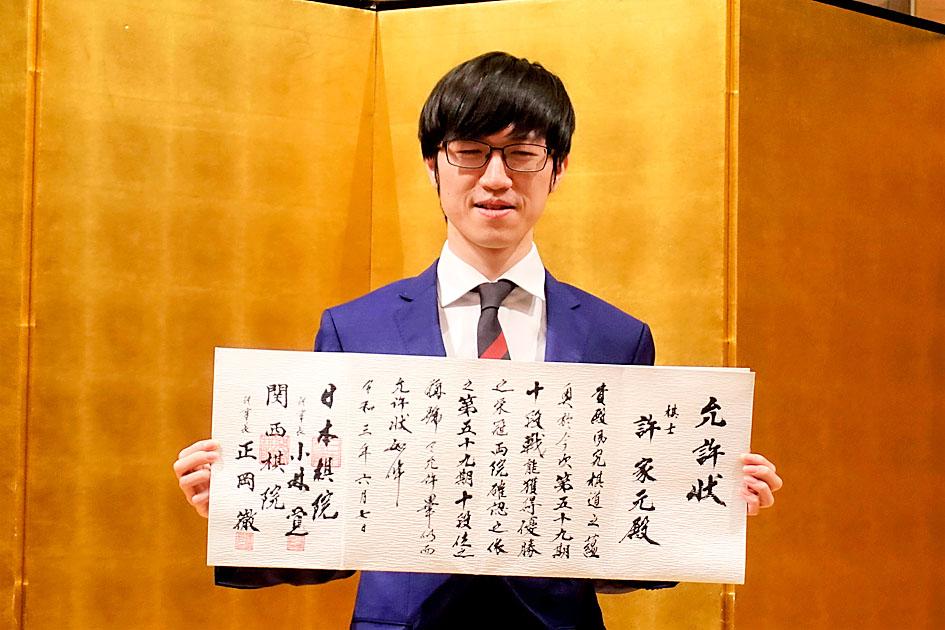
Photo: Lin Tsuei-yi, Taipei Times
Hsieh said Hsu’s win also demonstrated how the game of go could bring Taiwanese and Japanese even closer together.
At the Gosei competition held in 2018, Hsu beat Japanese Yuta Iyama to claim the title of Gosei.
Hsu had been given the rank of eighth dan after his Gosei win, but was upgraded to ninth dan on Monday for holding two of the seven professional go titles in Japan.
Hsu, who began his professional go career in 2013, became the third-fastest player in Japan to reach the rank of ninth dan, behind Shibano Toramaru and Yuta Iyama.
Hsu challenged Toramaru in the Judan competition, winning three out of five matches to claim the title.
Japan Go Association chairman Satoru Kobayashi praised Hsu for his “interesting go play style,” and said that Hsu and Toramaru are the “two most interesting people in the world of Japanese go.”
“Hsu’s style is modest. If he feels the game isn’t going well, he cedes defeat — he doesn’t sloppily drag it on,” Kobayashi said.
Hsu, Toramaru, 21, and Ryo Ichiriki, 23, have received attention among Japanese go players and fans due to their talent and young age, he said.
Hsu said go players’ skills have largely converged since the emergence of go-playing artificial-
intelligence software.
Mental drive is now as important as skill, he said, adding that winning was a great honor and a big confidence boost.
Hsu echoed Hsieh’s thanks to Japan for its vaccine donation, saying he was “deeply moved.”
To celebrate Hsu’s win, Sankei Shimbun began selling Taiwanese pineapples on its Web site on Sunday, the company said, adding that it sold 100 in just three hours.

The Centers for Disease Control (CDC) yesterday reported the first case of a new COVID-19 subvariant — BA.3.2 — in a 10-year-old Singaporean girl who had a fever upon arrival in Taiwan and tested positive for the disease. The girl left Taiwan on March 20 and the case did not have a direct impact on the local community, it said. The WHO added the BA.3.2 strain to its list of Variants Under Monitoring in December last year, but this was the first imported case of the COVID-19 variant in Taiwan, CDC Deputy Director-General Lin Ming-cheng (林明誠) said. The girl arrived in Taiwan on

South Korea is planning to revise its controversial electronic arrival card, a step Taiwanese officials said prompted them to hold off on planned retaliatory measures, a South Korean media report said yesterday. A Yonhap News Agency report said that the South Korean Ministry of Foreign Affairs is planning to remove the “previous departure place” and “next destination” fields from its e-arrival card system. The plan, reached after interagency consultations, is under review and aims to simplify entry procedures and align the electronic form with the paper version, a South Korean ministry official said. The fields — which appeared only on the electronic form

A bipartisan group of US senators has introduced a bill to enhance cooperation with Taiwan on drone development and to reduce reliance on supply chains linked to China. The proposed Blue Skies for Taiwan Act of 2026 was introduced by Republican US senators Ted Cruz and John Curtis, and Democratic US senators Jeff Merkley and Andy Kim. The legislation seeks to ease constraints on Taiwan-US cooperation in uncrewed aerial systems (UAS), including dependence on China-sourced components, limited access to capital and regulatory barriers under US export controls, a news release issued by Cruz on Wednesday said. The bill would establish a "Blue UAS

The Ministry of Foreign Affairs (MOFA) is suspending retaliation measures against South Korea that were set to take effect tomorrow, after Seoul said it is updating its e-arrival system, MOFA said today. The measures were to be a new round of retaliation after Taiwan on March 1 changed South Korea's designation on government-issued alien resident certificates held by South Korean nationals to "South Korea” from the "Republic of Korea," the country’s official name. The move came after months of protests to Seoul over its listing of Taiwan as "China (Taiwan)" in dropdown menus on its new online immigration entry system. MOFA last week


 RSS
RSS