


Labor union representatives yesterday called on the government to distribute COVID-19 relief funds directly to workers.
They asked the Ministry of Labor to take charge of the process, and not to go through industry associations or trade unions, as done in the past.
The government has raised the nationwide COVID-19 alert to level 3, which has led to commercial districts seeing few customers even on weekends.
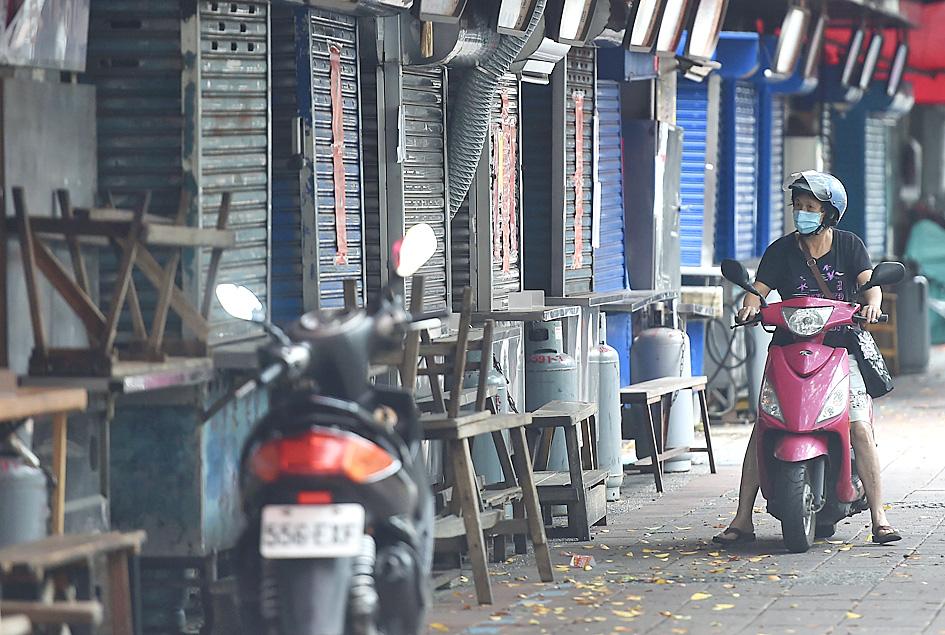
Photo: Chien Jung-fong, Taipei Times
Shops and vendors have witnessed a steep drop in business, while many workers have seen their salaries reduced, which has affected their livelihoods, New Taipei Confederation of Trade Unions chairman Hung Ching-fu (洪清福) told an online briefing.
Hung said that while it is good to know that the government is working on economic relief packages and allocating more funds for such budgets, the ministry should take full charge of the process and disburse the relief funds directly to workers.
Since last year, the restrictions caused by the pandemic have affected large swathes of the nation’s labor force, including people working in airlines and the tourism sector, as well as those furloughed due to government orders to shut down certain businesses, Taoyuan Confederation of Trade Unions chairwoman Chu Mei-hsueh (朱梅雪) said.
“Most of the affected people are part-time employees working at restaurants and retailers, many of whom are now out of work. Overall, the biggest impact has been on the service, restaurant and hospitality sectors, as well as those catering to domestic consumption,” she added.
“However, we see that the government’s proposed economic relief packages are mostly the same as last year’s — they have to go through companies and bosses. Workers will again end up not receiving relief funds, because many employers would not report furloughed workers to the government when ordered to close for business,” she said.
Due to the outbreak this year, the nation’s small-capital businesses, including family-operated eateries, restaurants and service-providing shops, are more prone to shutting down or even entirely terminating their operations, Chu said.
They do not have big incentives to apply for employee wage subsidies, and in other cases, they are excluded from such programs, because the conditions and requirements are too high.
“We are seeing infections within communities, so the greatest impact has been on small businesses. When the pandemic is over, the employers will restart their businesses. They will not necessarily retain their original employees, but instead hire new workers,” Chu added.

The Centers for Disease Control (CDC) yesterday reported the first case of a new COVID-19 subvariant — BA.3.2 — in a 10-year-old Singaporean girl who had a fever upon arrival in Taiwan and tested positive for the disease. The girl left Taiwan on March 20 and the case did not have a direct impact on the local community, it said. The WHO added the BA.3.2 strain to its list of Variants Under Monitoring in December last year, but this was the first imported case of the COVID-19 variant in Taiwan, CDC Deputy Director-General Lin Ming-cheng (林明誠) said. The girl arrived in Taiwan on

South Korea is planning to revise its controversial electronic arrival card, a step Taiwanese officials said prompted them to hold off on planned retaliatory measures, a South Korean media report said yesterday. A Yonhap News Agency report said that the South Korean Ministry of Foreign Affairs is planning to remove the “previous departure place” and “next destination” fields from its e-arrival card system. The plan, reached after interagency consultations, is under review and aims to simplify entry procedures and align the electronic form with the paper version, a South Korean ministry official said. The fields — which appeared only on the electronic form

A bipartisan group of US senators has introduced a bill to enhance cooperation with Taiwan on drone development and to reduce reliance on supply chains linked to China. The proposed Blue Skies for Taiwan Act of 2026 was introduced by Republican US senators Ted Cruz and John Curtis, and Democratic US senators Jeff Merkley and Andy Kim. The legislation seeks to ease constraints on Taiwan-US cooperation in uncrewed aerial systems (UAS), including dependence on China-sourced components, limited access to capital and regulatory barriers under US export controls, a news release issued by Cruz on Wednesday said. The bill would establish a "Blue UAS

The Ministry of Foreign Affairs (MOFA) is suspending retaliation measures against South Korea that were set to take effect tomorrow, after Seoul said it is updating its e-arrival system, MOFA said today. The measures were to be a new round of retaliation after Taiwan on March 1 changed South Korea's designation on government-issued alien resident certificates held by South Korean nationals to "South Korea” from the "Republic of Korea," the country’s official name. The move came after months of protests to Seoul over its listing of Taiwan as "China (Taiwan)" in dropdown menus on its new online immigration entry system. MOFA last week


 RSS
RSS