


More than 42,000 people on Friday received a COVID-19 vaccine shot, the Central Epidemic Command Center (CECC) said yesterday, adding that 500 local clinics would become vaccination centers by next month, while 1,000 would offer jabs by August.
The CECC on Thursday distributed 150,000 doses of the AstraZeneca vaccine to local governments, which provided them to frontline essential workers in Taipei and New Taipei City, as well as frontline healthcare professionals in other areas.
Minister of Health and Welfare Chen Shih-chung (陳時中), who heads the center, said that people were much more enthusiastic to be vaccinated on Friday than before, as 42,920 people received a shot in one day.
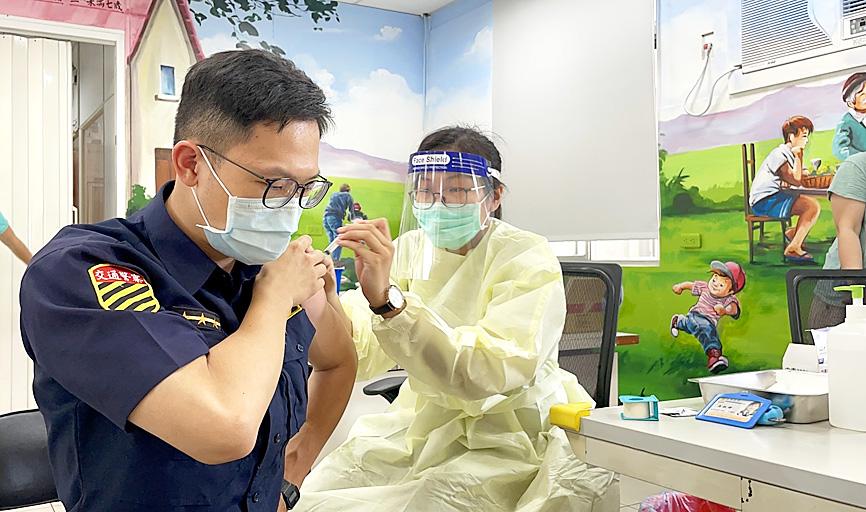
Photo: Wan Yu-chen, Taipei Times
The most doses of the vaccine were administered in Kaohsiung, with 7,768 doses given, followed by Taipei with 5,164 doses, New Taipei City with 5,502 doses, Tainan with 4,762 doses and Taoyuan with 4,276 doses, the center’s data showed.
The CECC would distribute more doses on Tuesday, Chen said.
As the supply of vaccines gradually increases, the center is preparing to administer the doses more efficiently, he said, adding that about 500 local clinics would be added to the list of designated vaccination locations by next month and there would be about 1,000 such clinics by August.
The center has received several offers from corporations or religious groups interested in procuring vaccines for Taiwan, Chen said, adding that the CECC was grateful.
“However, at the same time, we want to remind them that even if an authorized agent submitted an official proposal [to obtain vaccines], the procurement contract must ultimately be signed by the central government with the original vaccine manufacturer,” he said, adding that if an agent seeking to acquire vaccines provides authorization documents from the vaccine maker, negotiations could begin.
“The central government would also be responsible for the overall planning and distribution of the vaccines,” Chen said. “After all, the vaccine would be injected into human bodies, so the government must supervise and control its safety and efficacy.”
The Buddha’s Light International Association, associated with Fo Guang Shan Monastery in Kaohsiung, on Thursday submitted documents to the Ministry of Health and Welfare, expressing its intent to acquire and donate up to 500,000 doses of the Johnson & Johnson COVID-19 vaccine.
Hon Hai Precision Industry founder Terry Gou (郭台銘) intends to work with his Yonglin Foundation to purchase up to 10 million doses of the Pfizer-BioNTech vaccine from Shanghai Fosun Pharmaceutical Group (上海復星醫藥集團) to donate for domestic use, foundation chief executive director Amanda Liu (劉宥彤) said on Thursday.
Fosun has partnered with BioNTech to market and distribute the vaccine in China, Macau and Hong Kong.


South Korea is planning to revise its controversial electronic arrival card, a step Taiwanese officials said prompted them to hold off on planned retaliatory measures, a South Korean media report said yesterday. A Yonhap News Agency report said that the South Korean Ministry of Foreign Affairs is planning to remove the “previous departure place” and “next destination” fields from its e-arrival card system. The plan, reached after interagency consultations, is under review and aims to simplify entry procedures and align the electronic form with the paper version, a South Korean ministry official said. The fields — which appeared only on the electronic form
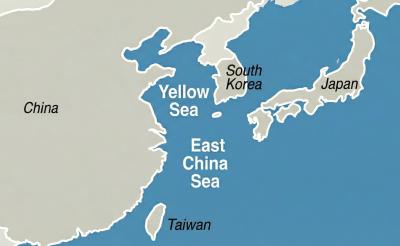
China has reserved offshore airspace in the Yellow Sea and East China Sea from March 27 to May 6, issuing alerts usually used to warn of military exercises, although no such exercises have been announced, the Wall Street Journal (WSJ) reported yesterday. Reserving such a large area for 40 days without explanation is an “unusual step,” as military exercises normally only last a few days, the paper said. These alerts, known as Notice to Air Missions (Notams), “are intended to inform pilots and aviation authorities of temporary airspace hazards or restrictions,” the article said. The airspace reserved in the alert is

A bipartisan group of US senators has introduced a bill to enhance cooperation with Taiwan on drone development and to reduce reliance on supply chains linked to China. The proposed Blue Skies for Taiwan Act of 2026 was introduced by Republican US senators Ted Cruz and John Curtis, and Democratic US senators Jeff Merkley and Andy Kim. The legislation seeks to ease constraints on Taiwan-US cooperation in uncrewed aerial systems (UAS), including dependence on China-sourced components, limited access to capital and regulatory barriers under US export controls, a news release issued by Cruz on Wednesday said. The bill would establish a "Blue UAS
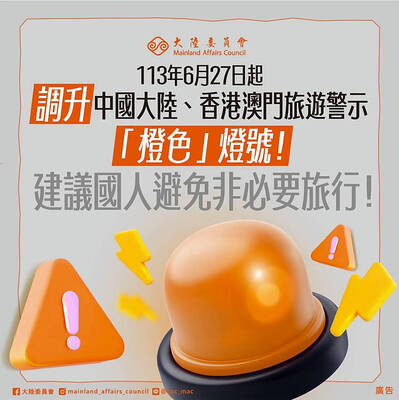
More than 6,000 Taiwanese students have participated in exchange programs in China over the past two years, despite the Mainland Affairs Council’s (MAC) “orange light” travel advisory, government records showed. The MAC’s publicly available registry showed that Taiwanese college and university students who went on exchange programs across the Strait numbered 3,592 and 2,966 people respectively. The National Immigration Agency data revealed that 2,296 and 2,551 Chinese students visited Taiwan for study in the same two years. A review of the Web sites of publicly-run universities and colleges showed that Taiwanese higher education institutions continued to recruit students for Chinese educational programs without


 RSS
RSS